

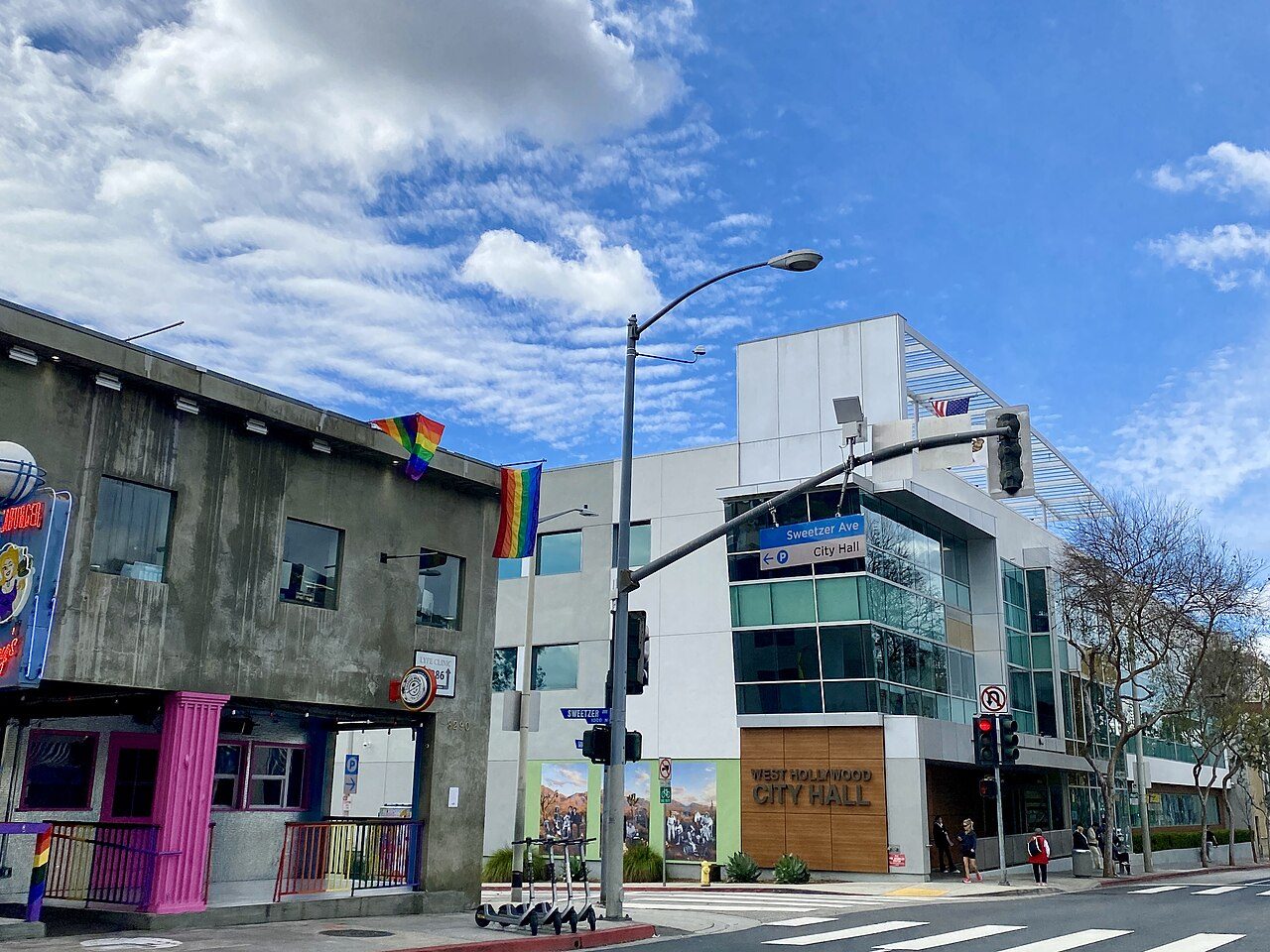
West Hollywood was built to keep a secret.
It’s in the neon over the bars and clubs on Santa Monica Blvd in the Rainbow District: Trunks, Micky’s, Mattie’s, the patio at Beaches Tropicana. It’s in the valet lines outside the boutique hotels and outside the Troubadour and Dan Tana’s next door, where the same valets have been parking cars for decades. It’s in the way a stranger can walk into a club, a coffee shop, a gym, a small business here and, for a few hours, be no one’s business but their own.
This town started as Sherman, a railroad yard built by workers who came from somewhere else to lay track for somebody else’s fortune. You can still smell the sweat of brown hands that laid those tracks, and hear the Spanish and Chinese carried on the wind alongside the orange groves and olive trees, and beneath all of it, the marrow and ash and song of the Tongva people, who were here in this Cahuenga Valley long before any of it had a name. It was the operating headquarters for Moses Sherman’s Los Angeles Pacific Railway, until Henry Huntington folded it into the Pacific Electric in 1911. The same Red Cars rattled down the center of Santa Monica Boulevard until 1941. The rattle of myth began.
Long before it had a city government at all, this stretch of land ran on the same bargain: gambling clubs lined Sunset, and bars, Gold Coast, Motherlode, The Palms, kept their windows blackened, storefronts that turned their backs to the street on purpose so the people inside could stay hidden from Sheriff’s raids. Streetwalkers and hustlers worked the corners for a coin, and undercover deputies waited in the alleys, playing discreet right up until they weren’t, getting off with a man before arresting him for it.
Decades later, when the city incorporated in 1984, people started calling it something grander, a gay Camelot, a Camelot for renters, take your pick. It was never that. The myth outlived the reality, the way it always does with kingdoms, and the myth is the one we kept telling.
The City Council voted 3 to 2 to install a network of cameras that photographs and logs the license plate of every vehicle entering and leaving the city.
On the east side, it was Russian Jews who fled the Soviet Union and, more recently, families who fled Putin’s invasion and unjust war on Ukraine, building a whole stretch of Plummer Park in a language that wasn’t English. It was the delis with the borscht and the black bread, the bakeries with trays of pirozhki and medovik in the window, the smell of nail polish remover and hair product drifting out of the salons that opened before anyone else was awake. It was the Pussycat Theatre, dark inside in the middle of the day, where closeted men came looking for intimacy and a taste of pleasure and desire they weren’t permitted anywhere else in their lives. This stretch of land opened a freedom, an escape, a new way of life, and it has been a haven for immigrants and dreamers ever since.
That trust is not a mood. It is a business model. Roughly 40 percent of the city’s revenue comes from taxes tied to who shows up and how much they spend, and every hotel stay in this city is taxed at 15.5 percent of the room rate. Tourism is not a nice-to-have here. It is the budget, written in neon and bar tabs and bed sheets changed twice a day.
The City Council voted 3 to 2 to install a network of cameras that photographs and logs the license plate of every vehicle entering and leaving the city. Heilman, Meister, and Hang voted yes. Byers and Erickson voted no, and they deserve credit for it. They upheld the liberties this city claims to protect, while the other three voted them away.
The stated justification was public safety. It doesn't hold up. In June alone, the system logged 88 stolen-vehicle alerts and led to three recoveries, for a no-bid contract worth $1.47 million.
And the LAPD, which polices a city many times this size, chose this year not to renew its own Flock contract after finding a false positive rate near 32 percent. West Hollywood signed on anyway, for a tool the region’s largest police force just walked away from.
Do the people who work for the city itself, the ones who drive in every morning to run its departments, even know their own employer signed a contract with a state surveillance system that takes away their civil liberties?
Almost no one noticed any of this happening. I know because I asked. I stood in the Trader Joe’s on Westmount and Santa Monica, under a brand new Flock camera mounted on the signal pole across the intersection, and asked the employees working the registers if they knew it was there. They didn’t. I asked people walking to and from John Reed Fitness down the block, the ones who park in that same lot four mornings a week, if they knew their plate was being logged every time they came to work out. They didn’t either. I have asked bartenders, door staff, hotel workers on break, servers between sections. The answer is always some version of the same sentence: I had no idea. Do the people who work for the city itself, the ones who drive in every morning to run its departments, even know their own employer signed a contract with a state surveillance system that takes away their civil liberties?
That surprise should worry the council more than it seems to. In the two years before this contract was approved, outside agencies, including at least one federal agency, accessed Flock’s national network from West Hollywood’s data 14 times without authorization, undetected the whole time. That data-sharing is not a glitch. It is a pattern serious enough that California lawmakers voted this year to audit the region’s fusion centers, the intelligence hubs where local surveillance data gets pooled and shared upward, over allegations that they have been routing information to ICE in violation of state law. Los Angeles County’s own fusion center, the Joint Regional Intelligence Center, is among those now under review.
For the workers who keep this city’s restaurants, hotels, and clubs running, many of them immigrants, many of them undocumented, that review is not an abstraction. Nor is it abstract for the people who build the houses here, who maintain the yards, who clean the homes, who serve this city so the people who live in it never have to think about how it stays standing. It is already too late for some of them.
In January, a gardener in his seventies, with a heart condition, was reportedly taken by masked agents believed to be ICE while working a WeHo property he had serviced for a decade. His truck sat in the driveway. His phone sat on the seat. In July, agents swept through the Santa Palm Car Wash at Santa Monica and Palm and detained three or four longtime employees in about ten minutes, while customers stood at the edge of the lot and watched. Neither incident required Flock to happen. But a citywide camera network built to log and to share the movement of every vehicle in this city does not make the next one harder. It makes it easier, at the exact moment the region’s own data-sharing practices are under state investigation.
The patrons matter too, and for the same reason the workers do: this city sells discretion. People drive into WeHo from all over the county because it is a place they don’t have to explain themselves. Some aren’t out at work. Some are visiting from families where they can’t be.
Young Black and Brown kids drive in from other parts of the county, some of them not out yet, some of them still working out what coming out even looks like, because West Hollywood is supposed to offer them safety and community, not tracking, not targeting, not surveillance.
A license plate reader does not know or care about any of that. It logs the car outside Bottega Louie on a first date, the shift worker clocking in at Pavilions, the person parking three blocks away to walk into an AA meeting at the Log Cabin because anonymity was the entire point of coming. It logs the car of a woman driving in for care at Planned Parenthood and a trans person driving in for care at the LGBT Center, both choosing this city over their own precisely because no one here was supposed to be keeping track.
It logs the car of the person singing karaoke at Gym Bar, the one watching the street from the balcony at Fiesta Cantina, the one performing at Musical Mondays at the Chapel inside the Abbey. It logs the car of a young trans person who got kicked out of the house in Texas and drove west, performing in drag for the first time in their life on that same stage. None of those people are anonymous anymore. If even a fraction of that clientele decides a night out now comes with a paper trail, that is a direct hit to the tax base the city says it can’t live without.
None of this is hidden. It’s sitting in a staff report anyone can read. What’s missing is the conversation, the one where the Trader Joe’s cashier and the gym member and the gardener’s family and the car wash manager all get asked, before the cameras go up, whether they want this. This city has been living off an image of itself for 40 years, and Flock is what cracked it open and broke it.
The City Council has a chance to pull the plug on this contract at the next budget review. It’s time to remind them what West Hollywood actually stands for.
This piece by Nik Roybal, WeHo community advocate and organizer for #FlockOffWeHo, was originally posted by Los Angeles Blade, Southern California's LGBTQ news source.


