This article has been updated on August 14 to include a letter signed by detainees inside Adelanto who attest to the validity of fly larvae in the facility's drinking water, new video footage of water contamination, and medical expert testimony.
50 detainees at the Adelanto ICE Processing Center signed a letter demanding that authorities conduct an investigation into the facility’s water quality issues. In late July, L.A. TACO published a video of what appeared to be worms inside the drinking water in the facility. L.A. Daily News confirmed the contaminants were fly larvae. Detainees allege that after they spoke with authorities in the detention center, they were indifferent about their drinking water concerns until they pressured staff.
As of August 4, they write, no information was provided regarding the water quality. Some names have been redacted to protect detainees who fear retaliation from detention center authorities for speaking out. Parias alleged retaliation from facility staff for speaking out about the worms detainees found in late July. He believes that two searches of his cell that have occurred since the publishing of the allegations of worms in the water were retaliatory. He said that his cell had never been searched prior to him speaking out and that facility staff confiscated a newspaper he was featured in that was about the worms in the water.
“Se hizo para que, eh, que vieran todas las personas de lo que se encontró aquí, de los gusanos,...Que es cierto, que nada es mentira,” Carlitos Ricardo Parias told L.A. TACO in an interview from inside the Adelanto ICE Processing Center.
(“[The letter] was made so that people could see what was found like the worms… so that [people] know its real, not a lie)
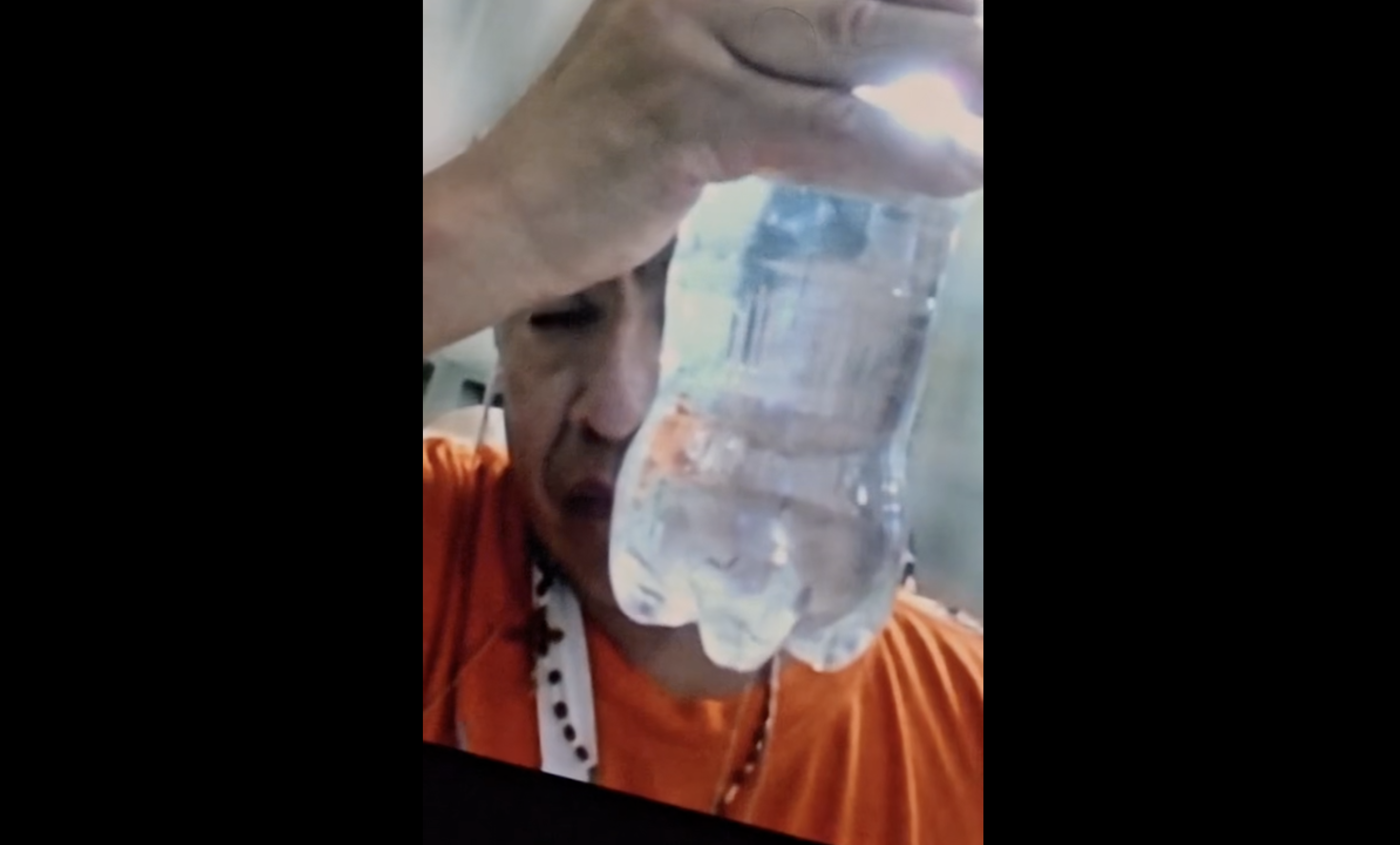
Video footage obtained and reviewed by L.A. TACO shows what appears to be debris in drinking water inside the Adelanto ICE Processing Center drinking water. During a video call with Jose Luis Muñoz-Zabala, he showed L.A. TACO a clear bottle filled with drinking water that contained debris. He said he collected the water on Wednesday from the yellow containers where detainees are provided water. He described the contamination as looking similar to what is found on the inside of piping. While on a video call with L.A. TACO around 3 p.m. on Thursday, he said detainees found debris-like contamination and what appeared to be worms in the drinking water once again. He said facility staff removed the water shortly after.
“The continued presence of contaminants in the water is a significant concern. It is not clear where the matter is coming from, but ICE should allow external investigators to examine the water and determine whether it's truly safe to drink.”
Dr. Joseph Nwadiuko, a physician and assistant professor of medicine at the University of Pennsylvania, told L.A. TACO in a statement:
“The multiple reports of debris in the drinking water are troubling. Clean water is a basic human need and failure to provide it would jeopardize the health of those detained and violate national detention standards,” said Dr. William Weber with the Medical Justice Alliance told L.A. TACO in a statement.
In a statement to L.A. TACO, a Department of Homeland Security spokesperson repeated earlier statements made, including saying that the detention facility receives its water from the City of Adelanto, and that both staff and detainees consume the same drinking water. The spokesperson said that claims of subprime conditions at Adelanto ICE processing facility are false.
A separate statement from a GEO Group spokesperson was similar to the statement from DHS, claiming that the facility’s drinking water "is supplied by the City of Adelanto municipal water system, which tests that water and reports the results publicly."
The spokesperson also said in the statement that the housing units in Adelanto are equipped with drinking fountains or sinks and insulated ice water containers, and that a separate “nationally recognized, FDA-certified company” also tests the facility’s water.
L.A. TACO has not heard back from the U.S. Immigration and Customs Enforcement regarding these allegations.
Pixelated video footage shared with L.A. TACO by Carlos Jurado, Parias’ lawyer, showed Parias holding a water bottle with what appears to be pieces of moving, floating contamination in it.
“Son animalitos como tipo gusano, pero color negro y chiquitos que se andan moviendo en el agua . . . ahí andan y están vivos,” Carlitos Ricardo Parias, also known as Richard L.A., a well-known TikToker, told L.A. TACO yesterday evening via phone from inside the Adelanto ICE Processing Center.
(“They are little animals, like worms, black in color, and small that are moving around in the water . . . swimming and alive.”)
Parias told L.A. TACO that around 7 p.m. Wednesday night, one of his companions got water from one of the two 10-gallon containers where 75 to 80 detainees receive their drinking water. He described the gallons as being yellow in color with a red cap. He said he’s seen these containers in routine use inside the facility for around eight months and that he is unaware of where the facility sources the water that is inside of these containers.
"’Richard, mira lo que encontre,’” Parias told L.A. TACO that his companion said this as he showed him what he described as little worms in the drinking water.
(“‘Richard, look what I found.’”)
When the detainees looked into the container, they saw more worms. Parias said that after finding the worms, detainees collected around seven to ten worms inside a soda bottle so they could preserve them as evidence of the conditions they were experiencing inside the facility. He says he still has the worms inside the soda bottle at the time of this publication.
A family member of another detainee inside of the facility spoke with L.A. TACO on the condition of anonymity and shared that when they talked to their loved one yesterday, they shared that the water they were given also had contamination in it.
“Casi nos están envenenando a todos con ese tipo de animalitos que hay . . . varias personas que se sienten mal del estómago,” Parias told L.A. TACO.
(English translation: “They are almost poisoning us with this type of little animals . . . many people are experiencing stomach issues.”)
Parias said detainees drank the water they found the worms in because they were thirsty.
Jurado told L.A. TACO that last week that another client of his inside of the immigration detention center was diagnosed with having a bacteria called H. Pylori, after complaining of stomach issues. He told L.A. TACO that doctors said that the likely source of the bacteria was from a water source.
On July 16, a federal judge granted, in part, a preliminary injunction to detainees who sued the Department of Homeland Security and Immigration and Customs Enforcement due to alleged inhumane conditions inside the Adelanto ICE Processing Center, according to reporting by L.A. TACO.
The judge ordered independent monitors assigned to the facility and that detainees be immediately provided with 24-hour access to clean potable drinking water, among other requirements.
Parias also alleged to L.A. TACO that when the containers are emptied, it takes the facility staff up to three hours before they are filled with water again.
L.A. TACO reported earlier this week that Parias has been held inside of the Adelanto facility for nine months without receiving proper medical care after he was shot in the elbow by a federal agent during a targeted immigration enforcement operation.
At least four deaths have been linked to the Adelanto ICE Processing Center under the second Trump administration, according to reporting by L.A. TACO.
Parias told L.A. TACO that many detainees inside are scared to speak up about the conditions they are experiencing inside and, for that reason, the detainees chose not to notify facility staff about the worms when they found them. He said that detainees believed the staff would not do anything about the matter, and that the staff would instead take the worms away, which they saw as crucial evidence of the poor water quality.
Instead, Parias said detainees decided to alert their loved ones of what had occurred, so that people on the outside would know what was going on.
Yesterday morning, he said facility staff became informed about the situation, but staff said the source of the contamination was sinks. He said he and detainees allege that the worms come out of both the sink and drinking water containers.
It has been a few months since detainees have noticed this type of contamination in their water, but detainees feared speaking out about it because they fear retaliation from facility staff, according to Parias.
Parias explained that facility staff were alerted to the water situation yesterday and were looking into where the contamination came from. He said staff changed the water inside after being alerted, but that it appeared that more contamination was found inside the new water brought by staff. Detainees notified the staff of the new discovery.
“Ahorita de los animalitos nadie se había, atrevido a hablar y pues desafortunadamente, me tocó a mí . . . eso es lo que está pasando aquí en Adelanto, California, y espero que nada por esto que estoy diciendo, no se la vayan a agarrar contra mí. Porque ellos quieren ahora sí que callarme para no decir nada. Pero, pues, es injusto lo que están haciendo estas personas con todos nosotros,” Parias told L.A. TACO.
(“Right now, in regards to the little animals, no one had dared speak up about them, unfortunately, and it fell on me . . . this is what is happening here in Adelanto, California, and I hope that nothing is held against me for what I am saying. Because they want to silence me so I don’t say anything. But, it is an injustice what they are doing, these people, with all of us.”)
“ I've never seen anything as wild as that in immigration detention,” Dr. Joseph Nwadiuko, a physician and assistant professor of medicine at the University of Pennsylvania, who has researched immigration detention for the past seven years, told L.A. TACO.
“[The] issue is not so much about the larva . . . it's about the fact that the water has gotten to be so dirty that something like that could grow . . . and all the other bugs and parasites that we don't see that could be growing along that larva could be more dangerous to people who are detained.”
Dr. Nwadiuko said that the visible contamination could be an indicator that there is something invisible in the water that is capable of harming someone’s health. He added that while the worms may not be infectious themselves, they could carry bacteria that could result in infections.
He warned that this type of contaminant could be particularly harmful for people who are immunocompromised, potentially leading to life-threatening infections as well. He said this is an indicator that the water quality of the facility is beyond poor and that the only time he has ever seen something similar was when he was overseas.
Dr. Greg Pierce is the senior director of the Luskin Center for Innovation at UCLA and the director of the Human Right to Water Solutions Lab. He studies policy and planning related to water, but is not a water quality expert. He told L.A. TACO that it is not surprising for there to be a drinking water quality issue in a U.S. carceral facility, because they have occurred under past administrations, as well.
“ . . . the video appears to suggest an acute and gross violation of basic drinking water quality standards, which poses an immediate health risk. I have not seen too many settings (including around the world) with such visible contamination with such obvious health ramifications,” Dr. Pierce said.
In a statement to L.A. TACO, an ICE spokesperson said the Adelanto ICE Processing Center receives their water from the City of Adelanto, and that businesses, residents, staff, and detainees drink from the same water source. The agency spokesperson directed L.A. TACO to the Adelanto Water Service Website.
“... before water reaches our facility, samples from wells and 36 individual locations throughout the City of Adelanto have been collected and tested in state-certified, third-party laboratories,” said an ICE Spokesperson.
L.A. TACO reached out to the City of Adelanto for further comment. We will update this story if we hear back.
Dr. Pierce said that an immigration detention center, like any other facility, tends to get its water from a much larger system if it's near populated areas, and that system would be regulated by the Environmental Protection Agency. He said that contamination can exist in plumbing, or introduced by tanks and faucets, especially if the system is large and poorly maintained.
“AFTER the water goes from the external system (city here) to the facility. Any contamination introduced by premise plumbing is the responsibility of the facility (ICE here), not the system,” said Dr. Pierce.
"Detainees at the Adelanto ICE Processing Center have 24-hour access to clean, potable drinking water. The facility does not operate its own water system . . . Its drinking water is supplied by the City of Adelanto municipal water system, which tests that water and reports the results publicly,” said a GEO Group Spokesperson in a statement to L.A. TACO on August 4.
The spokesperson pointed to a 2025 Adelanto Consumer Confidence report that explains how city water is tested at various locations. The spokesperson said results for the water quality of the supply are in the 2025 Adelanto Consumer Confidence Report.
“Every housing unit at the facility has drinking fountains or sinks, and each is also equipped with insulated ice water containers that are cleaned, sanitized, and refilled three times daily…Separately from the City’s testing the facility has its tap water tested each year by a nationally recognized, FDA-certified company. The most recent test, completed in January 2026, found all results within required ranges."
This story has been updated to include expert testimony from water and medical experts who reviewed video footage and our reporting. Additionally, we updated with a comment from an ICE spokesperson and a spokesperson for GEO Group.