

Skip to Content
Featured

Flock License Plate Readers Spark Privacy Concerns at L.A. State Historic Park in Chinatown

“For many the state park, Yaanga, has been a place of convening and arrival since before this country. The irony of these cameras disrupting that legacy is upsetting," said Joel Garcia of Meztli Projects.

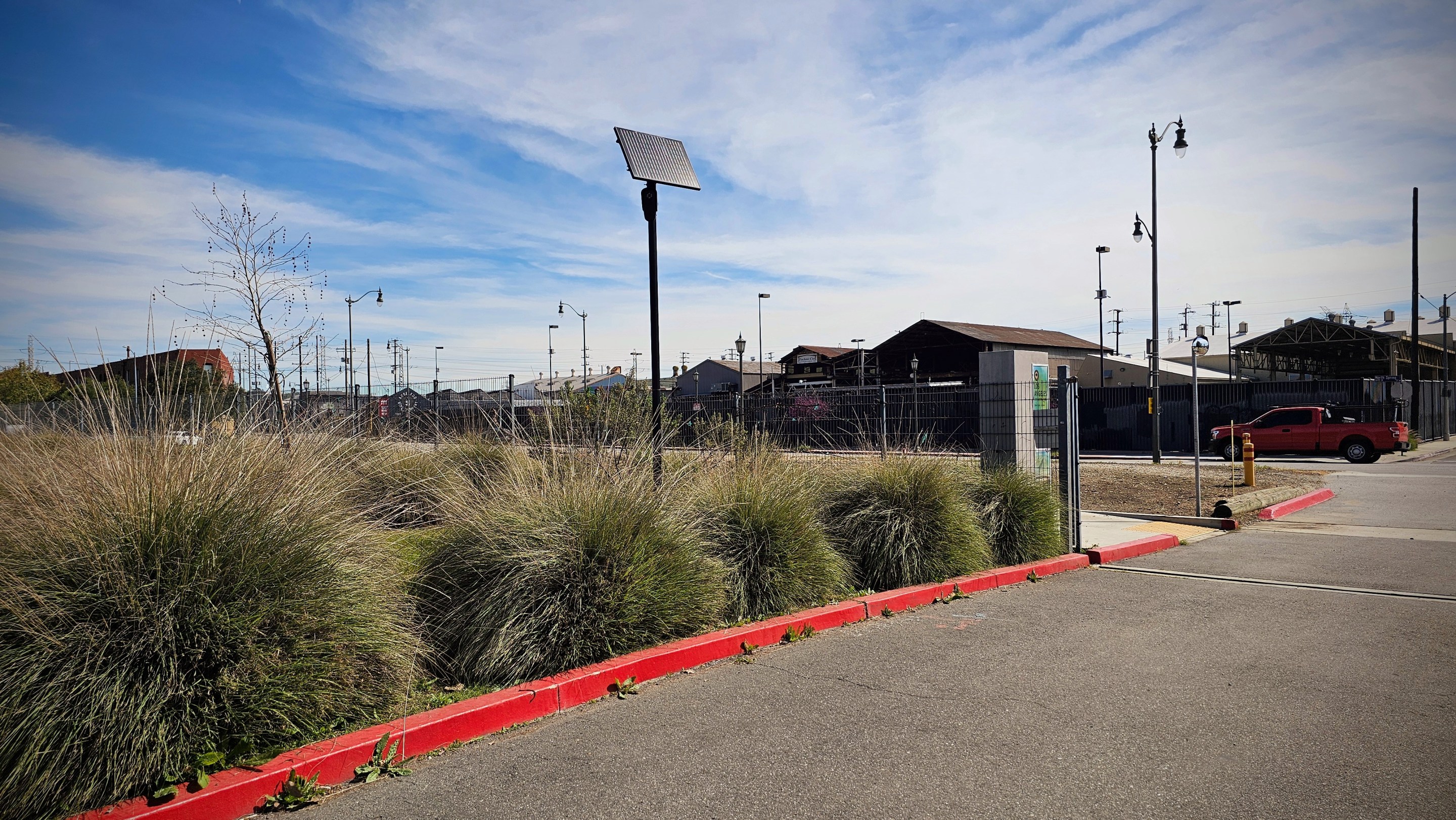
A Flock license plate reader behind a row of shrubs near the entrance of L.A. State Historic Park. A car drives past the park in the background.

A Flock license plate reader near one of the entrances to L.A. State Historic Park. Photo by Lexis-Olivier Ray for L.A. TACO.

As cars pull in and out of the parking lot at L.A. State Historic Park in Chinatown, two nondescript-looking black cameras powered by solar panels quietly keep an eye on every vehicle entering or leaving the property.

The cameras are license plate readers made by Flock Safety, a controversial private surveillance company that works with thousands of police departments and cities in the United States. 

Flock’s products—which range from automatic license plate readers (ALRPs) to more traditional cameras that can track people in real time—are marketed as AI solutions to help communities reduce crime.

Research, however, shows that Flock Safety’s technology isn’t as effective at reducing crime as the technology company claims. And critics argue that Flock’s license plate readers constitute unwarranted mass surveillance.

“The problem with mass surveillance is that it always expands beyond the uses for which it is initially justified—and sure enough, Flock’s system is undergoing insidious expansion across multiple dimensions,” wrote Jay Stanley, Senior Policy Analyst for the American Civil Liberties Union (ACLU).

The cameras in L.A. State Historic Park were installed in late 2024, a spokesperson for California State Parks confirmed.

In recent months, amidst ongoing federal immigration raids, police across the country have faced increased pushback from members of the public who fear that federal authorities will get their hands on Flock data collected by local law enforcement agencies. 

Last year, 404 Media reported that, although ICE does not have a contract with Flock Safety, researchers found that federal immigration authorities can access Flock’s license plate data by making requests to local law enforcement. 

When reached for comment, a park official initially declined to answer basic questions about the Flock cameras.

“This is a public records request that needs to be requested through our legal office in Sacramento,” Public Safety Superintendent Captain Jeff Langley claimed when asked for the date the cameras were installed and for what purpose.

Langley also declined to confirm which law enforcement agencies have access to the license plate readers.

After multiple follow-up emails, Marty Greenstein, Director of Communications for California State Parks, told L.A. TACO in a written statement that the cameras were installed in late 2024, “to deter theft and vandalism, provide useful information for investigating incidents at the park, and provide important notices such as Amber Alert identification.”

Greenstein confirmed that park officials share data from the Flock cameras with “local and state law enforcement agencies in California.” They do not share data with “out-of-state law enforcement agencies or federal agencies,” according to Greenstein.

“State Parks has found these cameras to be a helpful tool at parks throughout the state,” Greenstein noted. “For example, the cameras have assisted in identifying stolen vehicles and locating missing, at-risk individuals.”

A sign attached to a gate reads: "park is under 24 hour video surveillance."
The south entrance to L.A. State Historic Park. Photo by Lexis-Olivier Ray for L.A. TACO.

California law prohibits local police from sharing data obtained through license plate readers with out-of-state and federal law enforcement agencies without a warrant.

However, previous reporting and audits have shown that California police regularly violate those laws.

Law enforcement agencies in Southern California—including the Los Angeles Police Department (LAPD) and sheriff’s departments in San Diego and Orange County—searched license plate readers for ICE and Customs and Border Protection (Border Patrol) over 100 times, CalMatters reported.

And a 2023 American Civil Liberties Unions (ACLU) study found that 71 California law enforcement agencies violated state law by sharing license plate reader data with out-of-state agencies.

While Flock license plate readers have become regular fixtures in Home Depot parking lots and on private property, it is not common to see Flock cameras in public settings like parks in Los Angeles.

A spokesperson for the Los Angeles Department of Recreation and Parks confirmed with L.A. TACO that there are no Flock cameras across the city’s more than 500 parks and facilities.

In recent years, communities in Los Angeles have increasingly resorted to crowdfunding to pay for and install Flock license plate readers.

Flock Safety credits a camera that was installed by the Baldwin Vista Hillside Neighborhood Association at the only entrance into the neighborhood with helping law enforcement arrest a suspect who was accused of breaking into L.A. Mayor Karen Bass’ Baldwin Hills home and stealing two firearms. 

Last year, a public debate ensued after wealthy residents in Cheviot Hills raised over $200,000 to buy Flock cameras. The residents donated the cameras to the Los Angeles Police Foundation with one stipulation: the police could use them only in Cheviot Hills.

Efforts to install Flock cameras in neighboring cities have been met with intense pushback.

Last month, the city of Santa Cruz became the first California city to cancel its contract with Flock Safety.

A sign that says "Zanja Madre" (Mother Ditch) hangs on a fence separating L.A. State Historic Park from the Metro train tracks.
Zanja Madre (Mother Ditch) was the original aqueduct that brought water to the Pueblo de Los Angeles from the Rio Porciuncula (L.A. River). Photo by Lexis-Olivier Ray for L.A. TACO.

L.A. State Historic Park is unique in that it is a state-run park within the city of Los Angeles that is not only one of the few green spaces in the area but is also a park that regularly hosts community events, concerts, and film shoots, as well as multi-day festivals that bring tens of thousands of people to the park.

Joel Garcia, the director and co-founder of Meztli Projects, an Indigenous-based arts and culture collaborative, was surprised to learn about the Flock cameras in L.A. State Historic Park.

In January, Meztli Projects hosted an event there that brought together various drum-based communities to share in song and dance. At the event, screen printing stations were set up to create posters and other “pro-immigration” materials and resource guides, Garcia explained.

‘It was a response directly to what’s happening with ICE and the Trump administration," Garcia told L.A. TACO during an interview. 

Garcia said he noticed the solar panel that powers one of the Flock cameras upon entering the parking lot. But he thought it powered a light.

“I always thought that was solar paneling for lighting,” he said.

When he checked with his colleagues, nobody said they were aware that there were license plate readers in the parking lot.

“I didn’t notice them either,” Garcia said.

“Unfortunately we are getting normalized to a level of surveillance [similar to] post 9-11, but this weaponizing of ‘public safety tools’ especially at a state park is unacceptable,” Garcia said in a written statement to L.A. TACO. “For many the state park, Yaanga, has been a place of convening and arrival since before this country. The irony of these cameras disrupting that legacy is upsetting."

Across from the present-day park once stood River Station, Garcia noted, a major passenger railroad stop during the late 1800s and early 1900s that brought huge numbers of immigrants to Los Angeles.

“[The park] has been a place of arrival for many different societies,” Garcia noted.

Having worked with the park before, Garcia said he’s noticed that there is sometimes a “disconnect” between what local park staff believes in and the decisions that regional park staff make for the park.

“There’s a huge disconnect between what happens up top and what happens at the park,” Garcia said.

Ultimately, however, Garcia sees this conflict as an “opportunity to empower.”

“[At times] there’s folks on the inside who want to help, and sometimes we as organizers have to provide them the tools to help,” Garcia said. “That may include connecting park staff with tribal leadership, or delivering the messaging that community members want to convey.”

Stay in touch

Sign up for our free newsletter

More from L.A. TACO

He Built a Camera From Firearms To Photograph U.S. Gun Owners For ‘Thoughts & Prayers’ At La Luz de Jesus Gallery

"I hope the exhibit leaves people unsettled in a productive way, says artist Wayne Martin Belger. "I don’t tell viewers what side to stand on. I create a space where they have to sit with what they’re seeing."

February 24, 2026

How Photographer Alanna Airitam Got In With Black Outlaw Motorcycle Clubs For Her Show ‘Black Diamonds’ at La Luz De Jesus Gallery

"When an OG told me, ‘We just wanted to ride,’ I kept thinking about that. The open road. Wind in your face. Pulling over wherever you want. It’s the American freedom myth we’ve seen in films like Easy Rider. But what did that actually look like for Black men in the late 1950s, navigating sundown towns, police harassment, and the necessity of the Green Book?"

February 24, 2026

Daily Memo: Several ICE Agents Seen Meeting With Bell PD This Evening

The Bell Police Department, who has previously interfered with and arrested community watchers on behalf of ICE, was once again seen cooperating and meeting with about a little over half a dozen Federal Immigration Agents in the late evening raising concerns again about SB54 violations.

February 23, 2026

Waking Up In Puerto Vallarta The Morning After Cartel Attacks

L.A. TACO's editor-in-chief reports from the ground the day after El Mencho's death.

February 23, 2026

Update: At Least 20 States Burn In Mexico as Cartel Retaliates Against U.S.-Assisted Federal Killing of ‘El Mencho’

El Mencho was the last of the old guard—the final mass-trafficking titan standing alongside El Chapo and El Mayo—now fallen, marking the end of an era in Mexican organized crime. The era, typified by fame and big names splashed across books, TV shows, and international arrest warrants, began around 1990, the time in which El Chapo rose to prominence.  

February 22, 2026

Sunday Taquitos #16: Child’s Play

Sunday Taquitos! Art by Ivan Ehlers.

February 22, 2026
See all posts