


Skip to Content
Food

Unmatched Hustle: Immigrant from Michoacán’s Tierra Caliente Creates Innovative Tortillería on Wheels…In Bakersfield

Many come and buy pounds and pounds to share with their family members as soon as they taste a warm “taco de sal,” a tortilla sprinkled simply with salt and rolled up like a thin flauta. It’s common to eat tacos de sal while waiting in line at a tortillería in Mexico, but not so much in the U.S. 

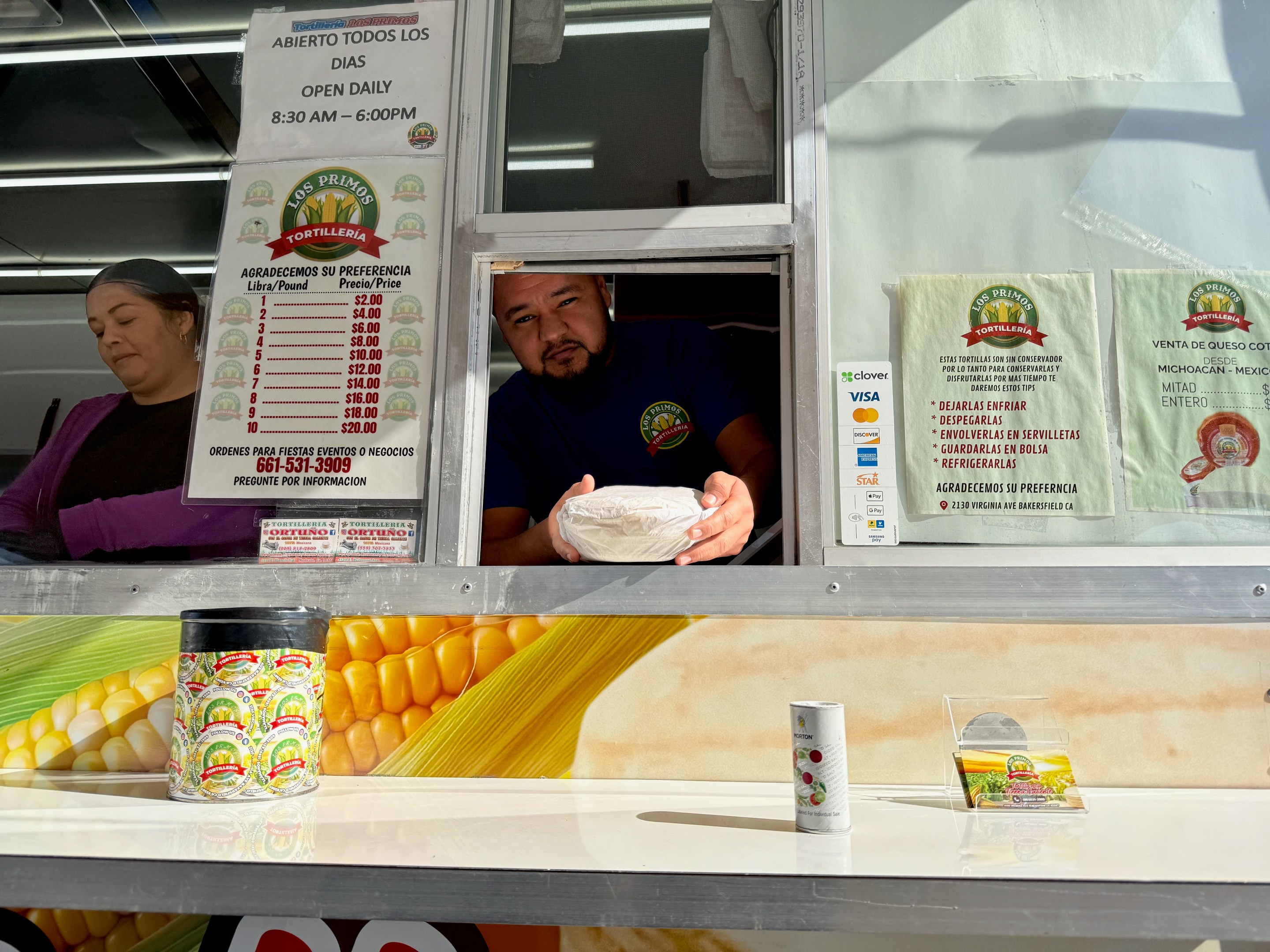
Tortillería Los Primos truck

Tortillería Los Primos truck. Photo by Javier Cabral for L.A. TACO.

Throughout most of Mexico, people consume tortillas like French people consume baguettes: They buy them fresh every day or at least every other day. 

However, that ritual was among the first to go as Mexican immigrants crossed into the U.S. and bought into the North American way of choosing convenience over freshness. Grabbing a pack of tortillas with your milk, eggs, and other weekly staples, all in the same supermarket, became more common here. Instead of stopping at a tortillería just for the tortillas, like they used to. 

But Marco Antonio Calles, co-owner of the revolutionary Tortillería Los Primos in Bakersfield, is single-handedly trying to bring some of that daily tortilla-eating foodways back to the U.S.

“Eating fresh tortillas [from a machine] is very common in Mexico, but not here in the U.S., so I opened this different kind of tortillería for everyone here in Bakersfield to remember how much better fresh tortilla still warm from the machine taste like,” he tells L.A. TACO on a sunny Tuesday afternoon, perched inside a trailer in a church parking lot. 

Tortillería Los Primos. Photo by Javier Cabral for L.A. TACO.
Each corn tortlilla at Tortillería Los Primos' tortilla machine is puffed up before being packed. Photo by Javier Cabral for L.A. TACO.
Each corn tortilla at Tortillería Los Primos' tortilla machine is puffed up before being packed. Photo by Javier Cabral for L.A. TACO.

His trailer is about 30 feet long and 12 feet wide. The majority of the square footage is taken up by a tortilla machine that Calles brought from Mexico, along with a professional mixer certified for use in the U.S.A. to mix the masa. The trailer is filled with the intoxicating smell of corn tortilla steam and the nostalgic whining and grinding sound of a tortilla machine running at full power.  

Calles moved to Central California from Michoacán’s Tierra Caliente region a couple of months before opening up his mobile tortilla trailer as a business venture because he saw daily tortilla culture missing from the U.S. He learned to make tortillas from a mentor, Ramiro Ortuño, who also opened up  “Tortilleria Ortuño,” a tortilla trailer in Modesto, a few months before he did. 

Tortillería Los Primos charges $2 for a pound of corn tortillas, translating to about 16 tortillas de mesa (the larger corn tortillas meant to be eaten with guisados at home). However, he also makes taco-sized, two-bite corn tortillas for local taqueros upon request. That price is comparable to stale, weeks-or-month-old corn tortillas found on non-Mexican supermarket shelves because Calles also uses instant corn tortilla flour. Though he says the exact recipe is a secret, he does confess that Maseca is part of the recipe. The flavor and texture are similar to any other Maseca-based tortilla, but being warm from the machine works wonders, similar to freshly baked bread that gets dense and dry as soon as it cools.

“That’s how I was taught to make tortillas, using tortilla flours,” he says.

In Mexico, 25% of the 120,000 tortillerías that pump out thousands of tortillas daily rely on Maseca, instead of the more time-and-labor-intensive nixtamal that is made by soaking field corn overnight and grinding it the next day. There are a lot of systemic factors that contribute to the trend of tortillerías and people making (and eating) Maseca-based tortillas both in Mexico and the U.S., instead of those made from nixtamal, but price and incentives are the two major factors. 

Many come and buy pounds and pounds to share with their family members as soon as they taste a warm “taco de sal,” a tortilla sprinkled simply with salt and rolled up like a thin flauta. It’s common to eat tacos de sal while waiting in line at a tortillería in Mexico, but not so much in the U.S. 

Maseca will often bankroll the capital for someone to open a new tortillería in Mexico as long as they use the product. Maseca-based tortillas also last much longer than natural, nixtamal-based tortillas, thanks to preservatives in the flour. Not to mention that Maseca flour relies on GMO corn to keep its prices dirt cheap, which has been tested to find concerning amounts of pesticides like glyphosate. 

Nonetheless, Calles has no plans of switching to nixtamal anytime soon as he’s dialed in his successful business formula in Bakersfield, where he lives. On a good day, he sells up to 2,000 pounds of tortillas. That’s about 32,000 tortillas. On an average day, half of that. 

Tortilleria Los Primos also sells cotija cheese imported from Michoacán.
Tortilleria Los Primos also sells cotija cheese imported from Michoacán. Photo via @tortillerialosprimos1/Instagram.

Thanks to a segment on Univision, hungry customers make a pit stop when driving through Bakersfield up and down the 5. Many come and buy pounds and pounds to share with their family members as soon as they taste a warm “taco de sal,” a tortilla sprinkled simply with salt and rolled up like a thin flauta. It’s common to eat tacos de sal while waiting in line at a tortillería in Mexico, but not so much in the U.S. 

So far, Calles has no plans to expand to more significant taco markets like L.A. But it does beg the question: Could a similar concept be successful in a city full of brick-and-mortar tortillerías owned by families for many generations? People stay loyal to tortillas, often for intangible and emotional reasons, and through generations. 

“My biggest inspiration for opening up my mobile tortillería are the customers that come in to experience a warm tortilla after decades of being unable to go back into Mexico,” Calles says. “It’s a beautiful and priceless tortilla moment.”

2130 Virginia Ave, Bakersfield, California 93307

Stay in touch

Sign up for our free newsletter

More from L.A. TACO

Daily Memo: ICE Is Ramping Up Operations With New Vehicles and Coachella Valley Is Being Targeted This Week

From Tuesday through today, L.A. TACO has confirmed at least 23 people have been taken by ICE.

The Highs and Lows of BIG SLEEPS, Legendary Pico-Union Graffiti Artist Turned Kidney Disease Activist

Los Angeles artist David Cavazos, aka “BIG SLEEPS,” faces a battle of kidney disease after overcoming the trials and tribulations of street violence, including a gunshot to the femoral artery.

March 26, 2026

California’s Shadowy ICE Holding Rooms Detained at Least 17,351 People Last Year

During the first year of the Trump administration's second term, at least 140,000 people nationwide were detained in these rooms—a steep jump from the 80,000 people held from September 2023 to the end of Biden's term.

Superbloom Eats: Where to Eat in Antelope Valley Before Visiting the Poppies

Here is where to find the best pizza, tacos, and more in the A.V. Remember to not step on any poppies!

March 24, 2026

Daily Memo: ICE Targets a Street Vendor in Santee Alley and More

Over the weekend, ICE was mostly up the coast and down towards San Diego. Today, we saw two more people get taken from their ISAP check-in in Downtown L.A., and in Santee Alley, we saw at least four agents target a food vendor and take him away. ICE also took a young woman in Indio today and was again scouting in Chula Vista and National City. 

Who Is and Who Is Not ICE at U.S. Airports

Travelers in the U.S. have been flooding us with messages concerned about ICE at airports, questioning or mistaking other agencies for ICE. Here is a quick visual guide.

March 23, 2026
See all posts