“[I]n that moment, I didn’t think I was going to survive. My son and family went through my head,” says Julian Cardenas, a U.S. Citizen speaking out for the first time in a U.S. Senate report about the brutality with which federal immigration agents detained him in July.
Cardenas, along with Alberto Nila and Ceasar Saltos, are three U.S. citizens who experienced violent detainments by federal immigration agents in Los Angeles county. They have never publicly spoken about their experiences before, according to the report which was authored by U.S. Senator Richard Blumenthal of Connecticut.
L.A. TACO has reported on the detention of U.S. Citizens by federal immigration agents, reporting at least 15 U.S. Citizens have been detained in over 96 "Kavanaugh Stops.”
L.A. TACO published an additional article on the Congressional probe yesterday.
Julian Cardenas (July 6, 2025)
Cardenas was pulled from his car in San Pedro, California, through a broken window by Department of Homeland Security agents. Cardenas encountered a group of federal immigration agents and he began recording them, using his first amendment rights to record agents as a citizen journalist. Agents got in their vehicles and Cardenas followed them on the interstate. Agents attempted to brake-check Cardenas and eventually pulled into a Los Alamitos parking lot. Cardenas parked a distance away so he could continue to observe them.
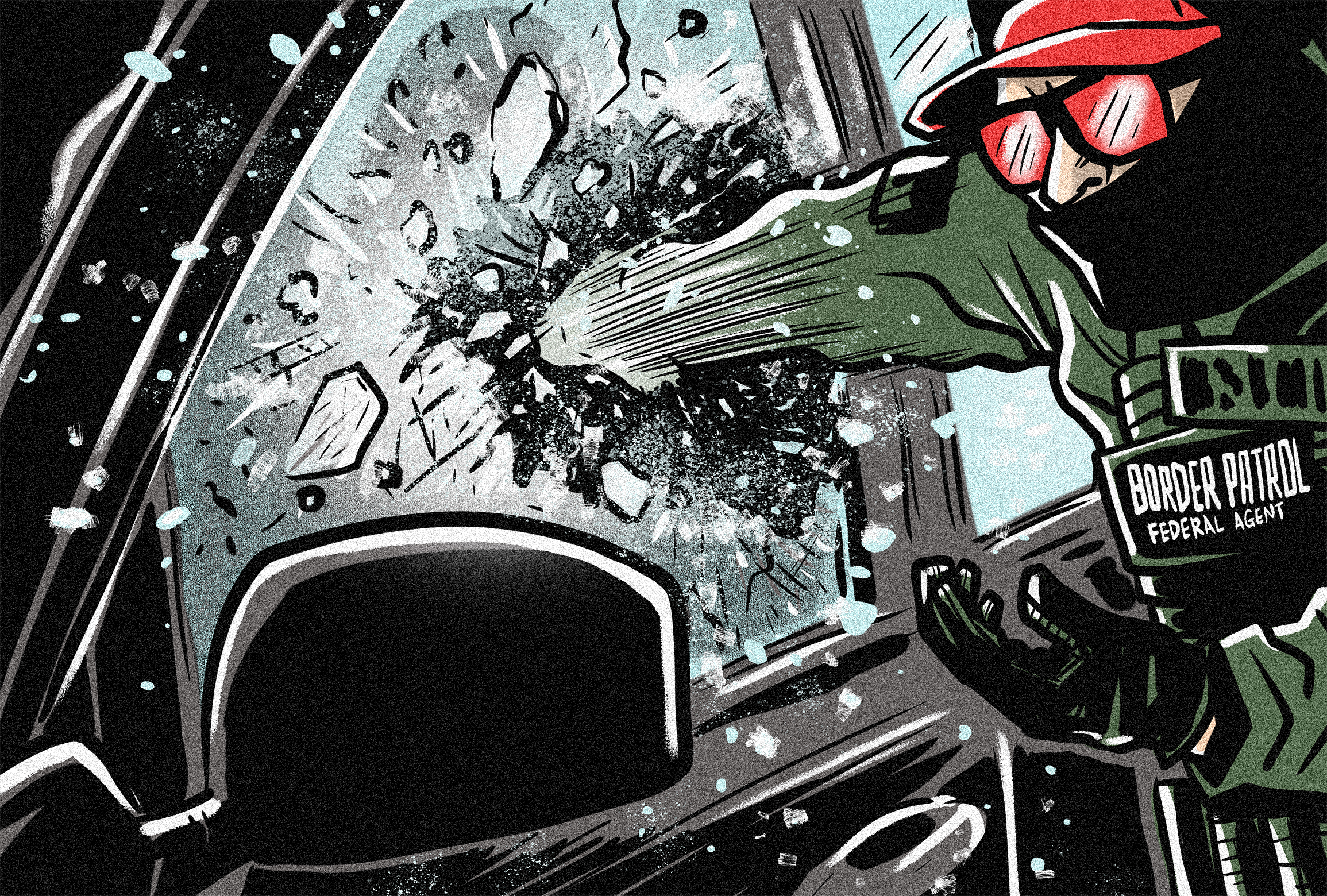
A U.S. Customs and Border Patrol agent saw him recording, then approached his vehicle, punched his window and ordered him to get out. Cardenas told the agent he was asserting his first amendment rights as a U.S. Citizen. The agents got into their vehicles, and drove off for a second time and pulled into the Joint Forces Training Base.
Cardenas did not follow them inside the base and instead stopped at a residential street. Cardenas began to turn his car around to leave the area, when he was boxed in by five agents, including the one that had gone up to his window. The agent him told him to get out of his car, and Cardenas told him he was exercising his first amendment right to film. The agent began to use a breaking window device on his vehicles window, eventually breaking it.
His head was slammed into the ground so hard he "saw stars." Three agents knelt on his neck and back.
“I couldn’t breathe. They pulled me up, and when I turned around, they told me that if I looked at their faces, they would slam me again,” Cardenas said.
He was bleeding, agents did offer him medical care, and it was three hours before agents took him to the hospital where he received minimal care. Agents drove recklessly to the UCI Health in Los Alamitos.
Cardenas was held in a detention facility for three days where he was denied access to counsel and his family. It was not until he was released from detention that he was diagnosed with a concussion. Agents pressured hospital staff to “speedily [clear]” so he could be taken into detention. They took him to the Metropolitan Detention Center in Los Angeles.
“[You’re] going in with the worst of the worst,” agents joked, and placed him with convicted murderers to scare him, he told senate investigators.
Over the next 48 hours agents questions him several times, and each time he asserted his right to remain silent and requested access to counsel, which was dismissed. His rights were never read to him.
He was transferred to the Santa Ana County Jail on July 7, where he was fingerprinted for the first time, and his cheek was swabbed without his consent. The federal government initially accused him of “using his car as a weapon” against agents, but charges were eventually dismissed due to lack of probable cause. He was released on the third day of his detainement on $25,000 bond.
“I was not in a federal database, so nobody could find out where I was, and they didn’t have contact with me until I was released,” Cardenas said.
His cellphone, which was confiscated during detention, has not been returned by the Department of Homeland Security as of November 7.
“Officers/Agents must be alert to medical symptoms such as coughing, fever, diarrhea, rashes or emaciation, in addition to obvious wounds, injuries, cuts, bruising or bleeding, heat related injury or illness, and dehydration. Any observed or reported injury or illness must be reported, and appropriate medical care must be provided or sought in a timely manner, ” according to the 2015 U.S. Customs and Border Protection National Standards on Transport, Escort, Detention, and Search.
Alberto Nila (August 1, 2025)
Nila was driving his work van in Sylmar, California when it was blocked by unmarked vehicles.
Two masked agents who said they were “Border Patrol” approached his vehicle. Nila described the agents as speaking to him in an aggressive manner, one of the agents attempting to stop him from using his phone.
He told U.S. Customs and Border Patrol agents that they needed a warrant.
He pulled out his cellphone to record the interaction when the agent opened the door and pulled him out of the vehicle and pressing on his abdomen. Nila told the agent that he had just undergone a recent surgery in that area. He attempted to present his passport for proof of citizenship, and the agent threw his passport into the car and continued with his detention. He was surrounded by about six masked agents.
He was released after about 20 minutes when agents ran his Identification and told him that someone else was using his address. He was never told he was under arrest, but felt he could not leave having been surrounded by agents and the agents being in possession of his legal document.
Ceasar Saltos (August 4, 2025)
“[T]hey asked me no questions and were treating me like a criminal,” Saltos told Senate investigators.
Saltos was detained while on a cruise by U.S. Customs and Border Patrol agents for almost 18 hours, despite having provided documents that proved his American identity and citizenship–a photo I.D. and passport. He awoke at 6:30 a.m. to loud knocking at the door of his cruise ship room at the Port of Long Beach.
Five agents rushed into his room and said they had a warrant for his arrest without even attempting to verify his identity or identify themselves. He was in his boxers, and they allowed him to put on pants before handcuffing him and bringing him outside. They told him that an individual named “Ruben” did something in Virginia. He gave agents his birth certificate and told them he had not been to Virginia and that “Ruben” was not his name. Agents took his phone and denied him access to calling his family. Agents held him in a “pitch dark” room and fingerprinted him twice.
He was then told “everything fits” by the agents, was placed in handcuffs and shackled at his ankles, and then transferred to the U.S. Marshalls. He was fingerprinted again, the third round of fingerprinting. Agents told him if they could not confirm his identity they would send him to Washington. He repeatedly told him he was not who they were trying to find to which a Marshall responded, “[W]e can’t find any evidence that it’s not you.” He was finally released at midnight after being given his phone and a check for the cash they took from his wallet–which was addressed to someone else.
“[G]et out of here,” said an officer to Saltos, “[Then] he grabbed me and threw me out of the building,” when Saltos asked about the mistake on the check.
No reason was given for his detention.
“It doesn’t matter if you have documentation,” said Senator Richard Blumenthal, during the shadow hearing that accompanied the report. “Most strikingly to me, aside from the physical violence is the disregard and denial of proof of citizenship by those masked agents.”