This article was co-published with La Opinión, the leading Spanish-language news outlet in the U.S., and produced under the California Local News Fellowship program at the University of Berkeley.
Bad Bunny's Super Bowl performance became a moment charged with symbolism and collective emotion. As millions of viewers watched the show, the Latino community took center stage on the global stage, a stark contrast to the reality of discrimination and hatred faced by immigrants on American streets today.
However, on Sunday, February 8, for 13 minutes, all eyes were on Latinos, many of them from Los Angeles, who showcased the diversity and resilience of their community in a show almost entirely in Español.
“Qué rico es ser Latino” (“How wonderful it is to be Latino),” were the words that kicked off Bad Bunny’s intro to “Titi me Preguntó,” as he moved across sugarcane fields, a nod to Puerto Rico’s history and colonial past.
The cheers heard across Los Angeles neighborhoods as Bad Bunny entered the field roared louder than any cheers after a play in the ho-hum game.
El Conejo Malo became the first male Latino act to headline the halftime show, and as any Latino would, he gave it his all, not just in performance but also in inclusivity. His performance was a giant jubilee of identity, history, unity, and the power of love.
Much to everyone's surprise, L.A. played a big part in the Super Bowl, with many of its dancers, street vendors, musicians, taqueros, and set designers participating in the halftime show.
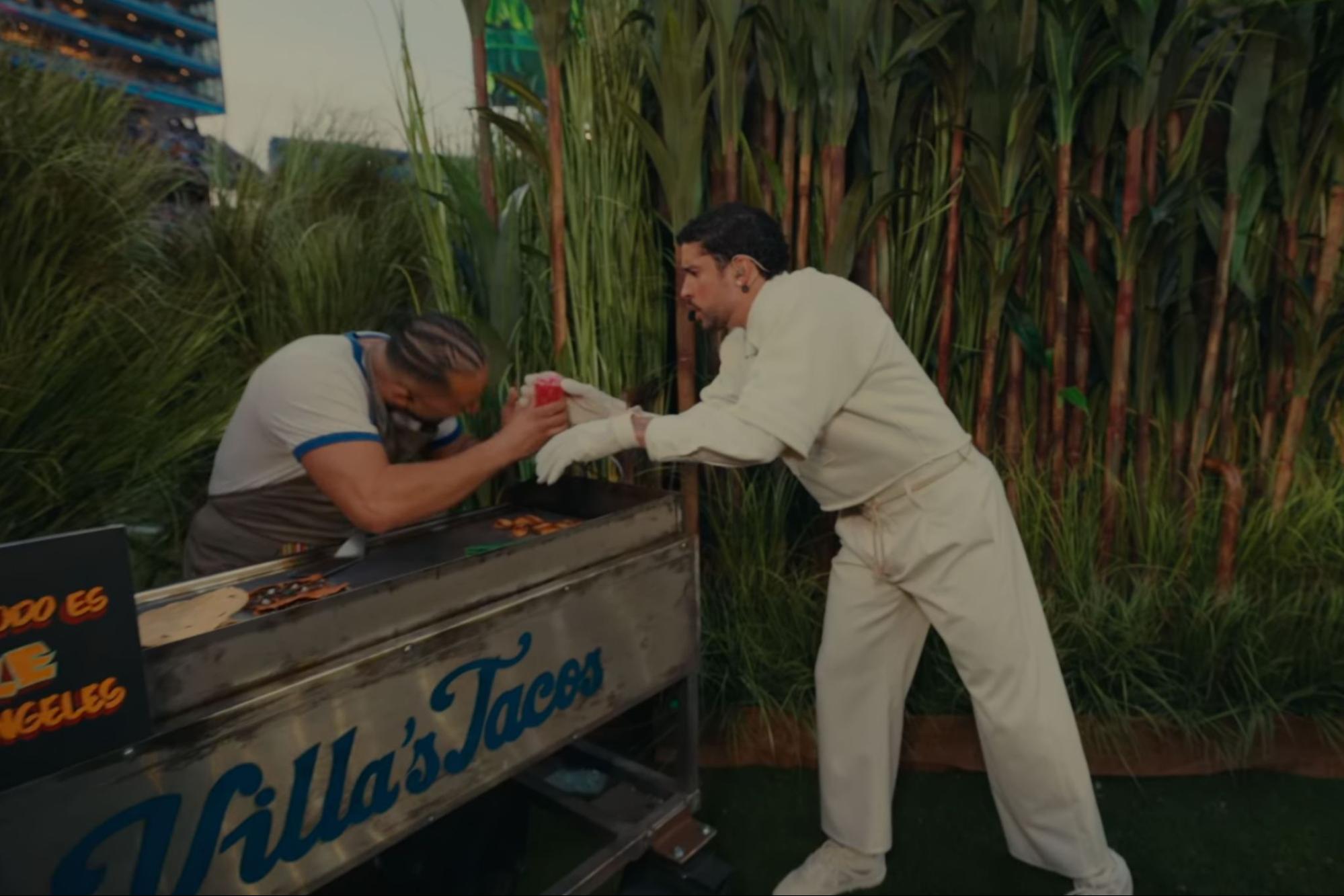
Most widely recognized was Victor Villa, owner of Highland Park taqueria Villa's Tacos, who appeared during the first song as Bad Bunny made his way through different street-vending stands and stopped at Villa’s puesto.
The moment was captured by a paused screen by many in L.A., who screamed as they tried to confirm what they had seen: “Omg, was that Villas!?”
It was the taquería’s blue lettering and logo, along with Villa’s notable energy and smile, that were instantly recognized by many. The moment was special for Villa, who, before becoming a three-time L.A. TACO Taco Madness champion, starring on Netflix, and being featured in the Super Bowl, was simply a street vendor with a dream.
“What an absolute honor it is to have been part of such a special moment,” Villa wrote on his Instagram that night, following the thrilling experience. “We sold our first taco in the front yard of my grandma’s house in Highland Park more than 8 years ago, and I feel that every taco along the way brought me here.”
Like many who participated in the show, Villa is a son of immigrant parents from Jiquilpan, Michoacan, and expressed that this moment was not just for him but for his family and the sacrifices they have had to make along the way.
“I couldn’t have sold that 1st taco if my parents didn’t make the difficult decision to leave their homeland for a better life & immigrate to the U.S. This one is for all the immigrants who paved the way before us to make this moment possible,” he added.
Another L.A. family that took to social media to celebrate their loved one participating in the Super Bowl was the family of the coco-vendor seen on screen, when Bad Bunny passes by her stand and says hello.
While this tia’s name is yet to be revealed, she has become everyone's “Ti Ti.” Her niece, Fabiola, a content creator in Los Angeles, captured the moment her family reacted to seeing their aunt on the screen. As Bad Bunny turned the corner, her family only got louder as they saw her chocolate-brown hair peeking out from behind the coco stand.
“She was the first to immigrate from El Salvador, then married a Puerto Rican. She brought my great-grandma, which led to my abuelo and my mom immigrating to Los Angeles during the civil war,” Fabiola said on her Instagram reel. “It took one person to make a sacrifice, and now we’re living the American Dream, making history with Bad Bunny.”
Also representing the city of L.A. was the couple who tied the knot on stage right before Lady Gaga performed. Elly Aparicio and Tommy are Covina residents, who, according to several sources, had originally invited Bad Bunny to their wedding. Instead, the Puerto Rican artist invited them to his show to get hitched.
Another easter egg from the now-iconic show was La Casita, a small-scale, salmon-colored, and yellow signature replica of a traditional Puerto Rican home used as a central stage piece for Bad Bunny’s 2025 Puerto Rico residency.
The interior of the casita that was showcased at the Super Bowl was designed by none other than Federico Laboureau, co-owner of Exposition Park’s Argentine restaurant Fuegos, home of some of L.A.’s best empanadas.
“This is what I do when I don’t do empanadas,” he joked when he posted a clip of La Casita.
The co-owner and production designer said he came to Los Angeles from Argentina several years ago to work in what he described as the mecca of the film industry. As jobs in the film industry dwindled, he decided to open Fuegos L.A. to help share his culture through food and earn extra income. But then, last December, he got a call about a big set design project; no details were given other than that it was top secret.
He joined the first meeting and learned he would be designing the interior of La Casita for Bad Bunny’s performance. His job was to turn the interior into an abuela’s living room.
“As Latinos, the house is where everything happens with family and friends,” he told us over the phone. “I was raised by one of my abuelas, so I took a lot of inspiration from those memories and other Latino living rooms.”
When Benito crashed through the ceiling into the living room of la casita, you can see Laboureau’s work: the wooden furniture, plates on display in a dish cabinet, religious figures like the Last Supper painting hung on the walls next to family photos, and, of course, the plastic mantel (tablecloth) that many grew up seeing in their homes.
Other details included the food on the table, which any abuela will always have at her home, and the floral drapes and designed flooring, each detail resonating with those who watched.
“This Super Bowl went far beyond a game, with everything that is happening right now in this country, it was a message saying we are here and we are not leaving,” the set designer said. “We have passion, we have love; every detail of the show was a representation of us. It was epic. I still have goosebumps.”
Tosstones Aponte, born Jhan Lee Aponte in San Juan, Puerto Rico, and now a Los Angeles resident, was also among the talent performing alongside Benito. The percussionist thanked God for the opportunity to perform with the legendary artist, while his followers rejoiced in the comments.
Among the musicians included in the show were also members of Mariachi Divas, most of whom played the violin for Bad Bunny’s “Monaco” song, which starts with the stringed instrument. Several of the women involved, like Julissa Dominguez and Patricia Martin of East L.A., are from Los Angeles and took to social media to reflect on what that moment meant to them.
Others included a Peruvian dancer, Kandrex Millones, a Guatemalan dancer and model, RataGoHard, and a Mexican dancer, Daisy, all of whom are baddies from Los Angeles.
“Thank you, Bad Bunny; your music, dance, culture, and identity tonight was a message that our presence is resistance,” Millones said on her Instagram post. “This show united us Latinos, loud and proud. Our diversity, our story, our courage, and our resilience is celebrated today and always!”
William Surian, a Nicaraguan model and stylist based in Los Angeles, also took to social media to share his role in the show. He was one of many who walked out with a flag representing the Americas; he proudly waved the blue-and-white Nicaraguan flag during Bad Bunny’s “Debi Tirar Mas Fotos.”
Like many of those watching, tears ran down his face as the sea of people chanted and walked next to Bad Bunny, who ended the show with an empowering moment, saying straight into the camera, “Seguimos Aqui” (“We’re still here).”
“Thank you, Bad Bunny, for bringing your heart, your sound, and your people into the spotlight in a moment marked by raids, ‘ICE out’ energy, and national conversations about who belongs and why,” Surian said online. “What you put out there, your voice, your joy, and your courage, reminded us that art still moves hearts and is something bigger than fear.”