This article was co-published with LA Public Press, an independent, non-profit newsroom whose journalism interrogates systems of power, while supporting those trying to build more equitable and resilient communities.
From above, Los Angeles can look like a circuit board: gridded streets pulsing with traffic, power lines stitching together neighborhoods, utility poles rising at regular intervals like exclamation points in wood and steel.
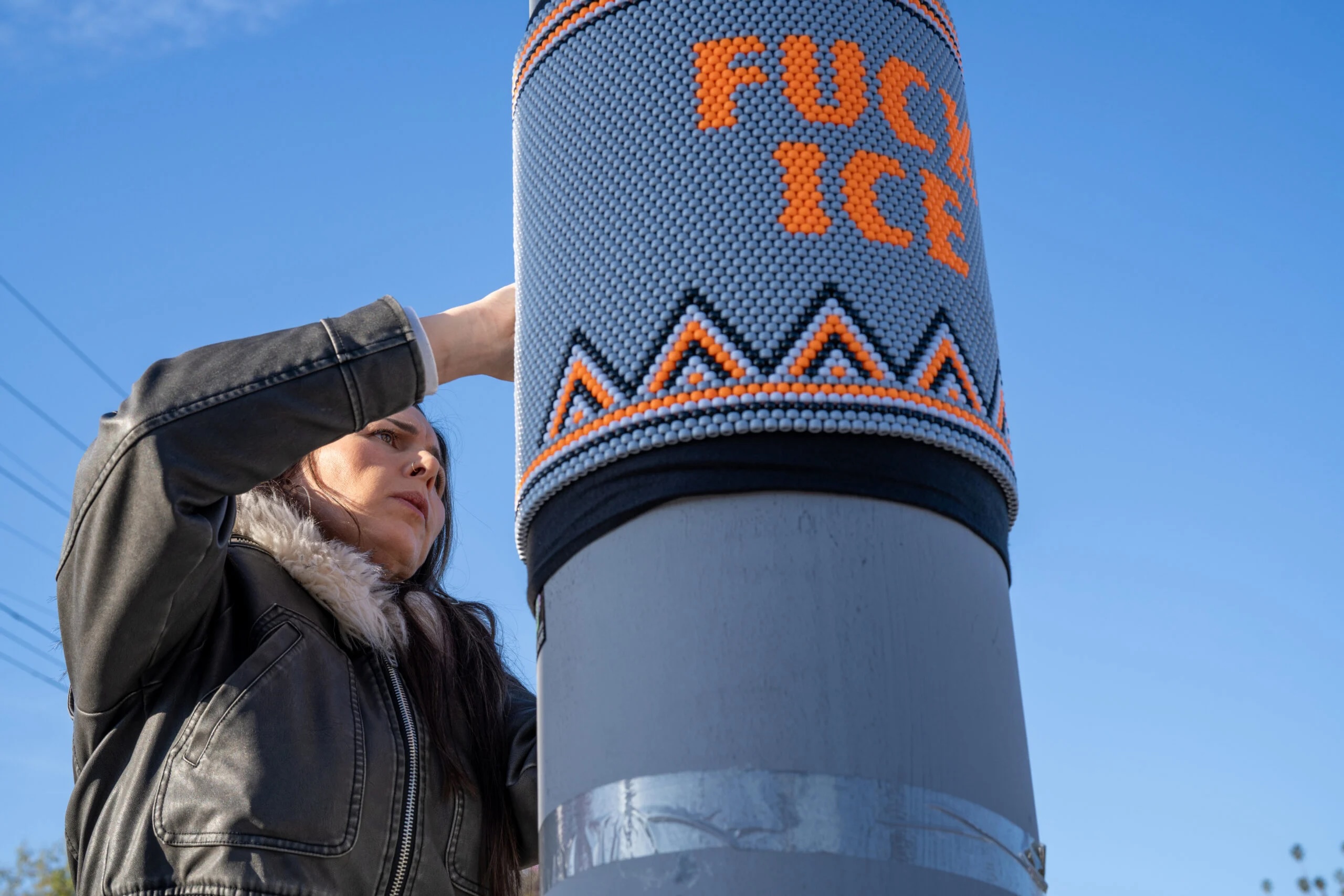
In Cypress Park, at the edge of a Home Depot parking lot where federal immigration agents have violently detained vendors and others, one of those poles carries a band of color with a fluorescent sheath that, on closer inspection, is made up of 10,000 pony beads spelling a message in block letters: “FUCK ICE.”
The intervention is one of three installed in L.A. by Kimberly Dawn Robertson, a citizen of the Muskogee Creek Nation who describes herself as “a Native artist” and “a Native feminist.” Metzli Projects, an Indigenous arts and culture collaborative, supported the series.
Robertson, who is a professor in the American Indian Studies program at Cal State Long Beach, is also a co-founder of Metzli Projects. Installation of the three “bead bombs” was completed with the help of co-founder Joel Garcia, program manager Kenneth Lopez, apprentice Miguelaxel Burrola, and filmmaker Mario Torres.
Over several months, Robertson peyote-stitched roughly 30,000 pony beads—about 10,000 per piece into what she calls “bead bombs”. She fastened them to utility poles across Tovaangar, the Tongva name for the Los Angeles basin.
Mia Marquez and Maria Salazar, residents of Boyle Heights, paused on the sidewalk on February 25 to take in one of the “bead bombs” at the southwest corner of East Cesar Chavez Avenue and North Soto Street.
“I love the beading. It’s Chicano culture, and it reflects how every ethnicity makes up Los Angeles,” Marquez said.
“It reminds us that we are for each other, not against each other,” Salazar added.
Jesus Chavez, a Boyle Heights resident, was momentarily speechless when he spotted the bead installation while crossing East Cesar Chavez Avenue. Then he let out a burst of laughter.
In a city known for its screenprinted protest graphics, Robertson’s medium offers a compelling contrast. Screen printing, a cornerstone of Chicano movement art in East L.A., was built for speed and circulation: bold iconography, reproducible designs, posters wheat-pasted by the dozens.
Its power lay in multiplication. Beadwork, by contrast, resists haste.
“I definitely was worried about the time it was going to take me to get the beads done,” Robertson said.
Each panel, she said, required between 20 and 30 hours of labor, stitched row by row using peyote stitch, an off-loom technique in which beads are woven in a staggered, interlocking pattern so that the surface grows like brickwork. The method produces a flexible textile strong enough to wrap a pole, but it demands patience.
The slowness is not incidental.
Robertson is a single mother and a full-time professor. Much of her practice unfolds at her kitchen table after her children have gone to bed.
“Beadwork is very healing for me,” she said. “To decompress from the struggles of being a single Native mom in L.A., in the evenings after I put my kids to bed, I would bead.”
There was, Robertson said, “a sense of urgency” and a desire to respond quickly to what she describes as an escalation of authoritarianism. The logic of protest art in L.A. has often favored immediacy. But Robertson reconsidered.
“ICE activity in L.A. is not something that just began under the Trump administration,” she said.
Anti-immigrant enforcement, she noted, has spanned centuries in this country, entangled with the longer history of settler colonialism and the surveillance of Native peoples.
“I thought to myself, OK, it may take me a couple of months to get these out in the street,” Robertson said, adding that understanding the long history of violence allowed her to work slowly. The slower method insists that the moment is ongoing.
In this way, Robertson’s bead bombs quietly invert the logic of mass production. Where screen printing enabled the rapid dissemination of a single image across a neighborhood, beadwork concentrates attention on the singular object and the labor embedded within it. She deliberately chose pony beads, larger and more conspicuous than traditional seed beads, to amplify that effect.
“I think lots of times folks see small beadwork and they underestimate the time and the labor that went into it,” she said. “It kind of gets minimized and dismissed.”
Enlarged to monumental scale and wrapped around civic infrastructure, the work refuses dismissal.
“I like to play with larger scale,” she added. “I think it better highlights the intensity of the labor.”
The three bead bombs form a series, unified by a repeating triangular motif chosen for clarity.
“I wanted the design to be clear, legible, simple, so it didn’t draw away from the text,” she said.
Color carries the nuance. The piece at Home Depot in Cypress Park adopts the fluorescent orange-and-black palette of the adjacent big-box store, blending into the commercial landscape before confronting it. Another, installed near Homegirl Cafe and the Chinatown Metro stop, was rendered in red, black, white, and yellow, colors associated in many Native traditions with the medicine wheel, a symbol of balance and wellness, and mounted against a gleaming surveillance pole. That piece was removed by someone within hours.
A third hangs at Cesar Chavez and Soto in Boyle Heights. Its “fire colorway” is a nod to what Robertson calls the neighborhood’s enduring “fire and spirit.”
Like the screen-printed posters that once blanketed East L.A., her bead bombs claim public space and insist on visibility.
“It could have been taken down by the county or by law enforcement because it agitated people,” Robertson said. “And that makes me happy, too. The point of protest art is to agitate. It’s to make people uncomfortable.”
She suggests impermanence may be part of the point: “I don’t think art should just be closed away in museums and galleries where a lot of folks can’t access it,” she says.
When the sun sets over L.A., the beads catch the last light, producing small flashes that make the poles seem electrified. At eye level, at least for now, two of them remain wrapped in thousands of beads, each stitched by hand in the narrow hours after children are put to bed. The labor is meticulous, and its presence, Native, feminist, impossible to ignore, is woven directly into the grain of the city.