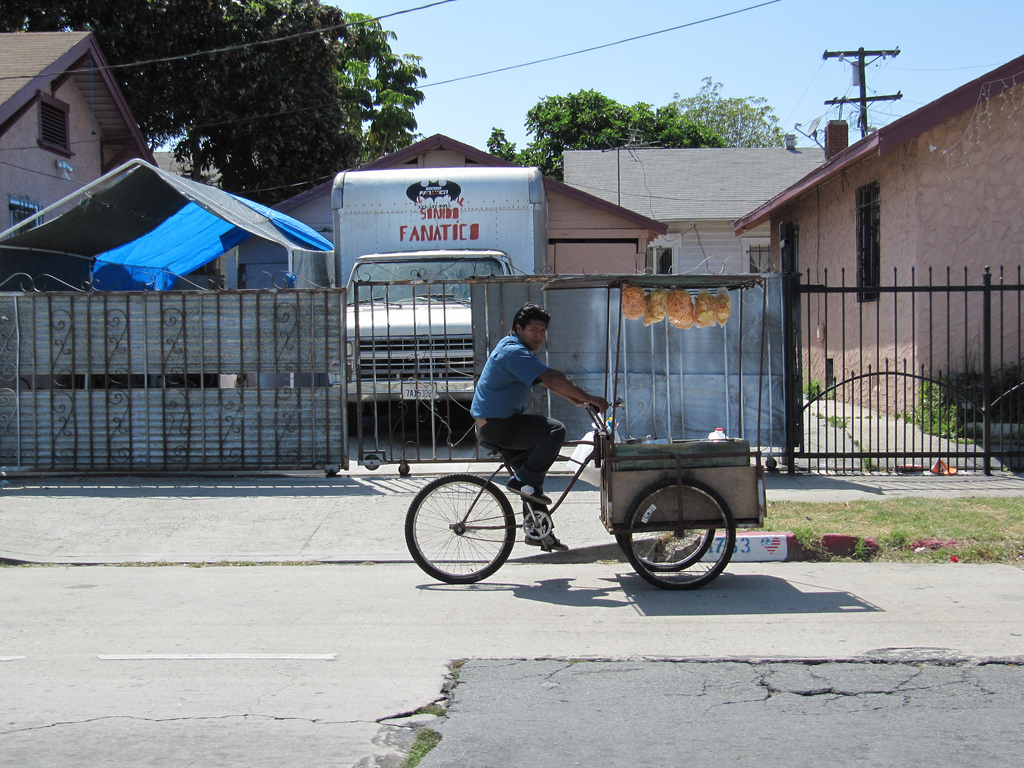
SB 972 was signed into law by Governor Gavin Newsom last Friday, and questions have been starting to pour in from working street vendors asking how exactly they will be able to apply for permits. More importantly, how soon?
L.A. TACO reached out to Doug Smith, the Supervising Senior Staff Attorney at Public Counsel, the nation's largest provider of pro bono legal services. He has been active in L.A.’s street vending legalization movement, alongside Rudy Espinoza, since the movement first gained traction over a decade ago. He filled us in on an official timeline for the law to go into effect and specifics relating to street vending equipment requirements depending on street vendors' type of food.
L.A. TACO: How soon, more or less, do you think we will start seeing any application process for local health departments like LA and Long Beach?
Doug Smith: All street food vendors will benefit immediately from decriminalization. As of January 1, any violation of the state food code, including operating without a permit, will be punishable only by a non-criminal administrative fine. No misdemeanors or arrests will be permitted.
Eventually, the law will allow higher fines for vending without a permit compared to other violations, but those higher fines will not be issued for a one-year grace period until January 1, 2024. And any first-time offense may be reduced down to 20% of the base fine for low-income vendors (generally meaning only a $20 fine).
While the law allows monetary fines for violations, we hope jurisdictions will embrace a different approach grounded in opportunity and inclusion. The best way to address unpermitted vending is to help vendors get permits. Health departments have an opportunity to shift their model and invest in technical assistance and support, which we believe will ultimately be a far more effective tool for compliance than relying on punitive practices.
For vendors selling foods that are cooked off-site and then reheated and served from a cart, it will take slightly longer for permits to become more accessible. Essentially, now that the bill is law, the manufacturing sector will need some time to design and produce new, smaller, and more affordable carts that meet the new SB 972 standards: carts without three-compartment sinks, smaller water tanks, no water heater, and holt-holding and reheating equipment.
The law also creates an opportunity to approve smaller and more affordable carts without any integral sink equipment as long as the vendor operates in close proximity to an approved auxiliary sink. So the law creates an opening for creative design and manufacturing that will meet the applicable health standards but be smaller and available at a lower price point.
These local regulations may vary from city to city, county to county, but they must be related to legitimate health and safety considerations and cannot be based on economic competition or discrimination against vendors.
Our coalition plans to engage manufacturers and designers in the coming months to make sure they have the information they need to scale up production. This may take a little time, but once those new designs come on line, we hope the actual permit approval process will be accelerated by the law allowing pre-approval of blueprints. Essentially, this means that cart design blueprints will be evaluated and approved once, and then any vendor who buys a cart that is certified as being constructed according to these pre-approved blueprints can skip several expensive steps and go straight to final approval. Finally, while these carts will be less expensive than they are now (and in many cases, they don’t even exist now), some vendors will still need financial assistance. We hope to tap into existing and new resources for small business development in order to help vendors access the capital to obtain a permitted cart.
An important note here is that the benefits of smaller and more affordable carts are limited to vendors that do NOT prepare raw meat at the cart. Vendors who still want to cook meat on the cart itself will still benefit from many other parts of the law, but the smaller carts are only available if vendors cook the meat at an approved kitchen and then reheat or hot-hold on their carts. In talking to vendors, we expect some (maybe many) will shift their model to cook in a kitchen and reheat at the cart in order to get a smaller and more affordable cart design.
Long story short, we will need to ramp up manufacturing, and commissary approval before the more complex operations will be able to obtain permits for cheaper and smaller carts.
But we are committed to making this work as soon as possible. Rudy and I were on a call with public health officials to talk about implementation minutes after the Governor signed. But we need to be realistic and transparent with vendors that there are still some steps between now and a wealth of permitted and affordable carts on the market.
In January, when SB 972 goes into effect. How should street vendors go about finding their local health department’s applications?
We will be creating and putting out materials on how to obtain permits under the new rules and offering other technical assistance. People often talk about the need for “outreach and education” for street vending laws, but they usually mean educating vendors. To me, education is not a one-way street.
While it is important to create materials to help vendors navigate a complex process, they are not the only ones that need education. As the laws change to recognize and support vendors, City and County officials also need to be educated about the rights that vendors now have and the best practices to support this part of the economy. Changing laws is the first step, but it needs to come with a culture shift in our bureaucracies. In addition to helping vendors, we also intend to educate local officials and monitor local programs to make sure they are designed to support vendors, as the law intends.
Just to double-check, this SB 972’s ways of legalizing street food will apply to all counties in California, correct?
Yes, SB 972 applies statewide! In every jurisdiction, health permits for street food vending will be issued in accordance with SB 972. Here, it is important to clarify that there are now two separate legal frameworks for sidewalk vending. The California Government Code establishes guidelines for local jurisdictions creating rules on where and when any type of vending (merchandise and food) can occur in a city. These local regulations may vary from city to city, county to county, but they must be related to legitimate health and safety considerations and cannot be based on economic competition or discrimination against vendors. This is the result of SB 946. Now, separately, sidewalk vendors that sell food can apply for health permits under the new standards in the California Health and Safety Code. This is what SB 972 changed.