

Fists and feet are flying at William James Adams Jr.’s teenage face and body. He’s from one of the few Black families living in Boyle Heights’ infamous Estrada Courts housing projects. It’s the mid-80s, cholos run the block and William thinks it’s a good idea to get jumped in.
Too bad his mom is the real gangster.
“I got jumped in, jumped out, and then my mom jumped me,” he tells me. “That one was the real one. The other one was just ... playing with your friends and getting initiated. But my mom? My mom kicked my ass.”
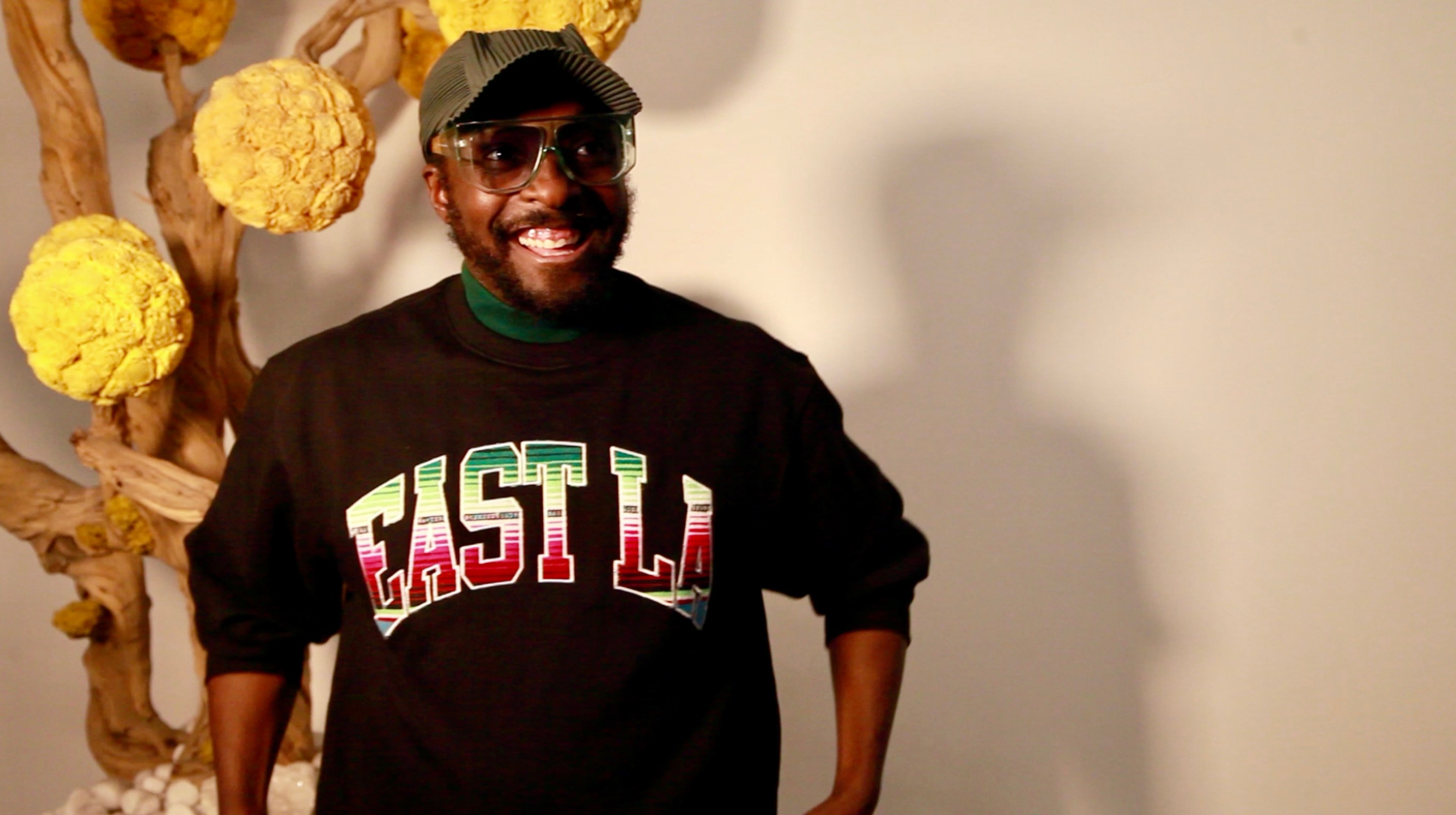
That’s more evidence that William James Adams Jr., AKA will.i.am—the Grammy-winning frontman of the Black Eyed Peas—is an honorary Chicano; at least according to me. Even before he told me that story, I could tell. It’s in the way he throws up old-school ’90s hand signs—snapping his forearms to his chest like he’s still posted up at Estrada Courts.
We spoke recently at FYI, his futuristic HQ in Hollywood, where he hosted a private event celebrating East L.A., a new track and music video with his Peas bandmate, Taboo, all while a fruta lady made Tajin-covered fruit cups, a taco lady served tender al pastor, perfectly refried beans and bright orange rice, and a woman scooped out Jalisco-style, vegan nieves de garrafa—pillowy soft ice cream traditionally hand made in a large wooden jar.
While food and staff swirled around us, our conversation ranged from tacos to ICE raids, from old-school high school football rivalries to the sacredness of the Sears building in East L.A.

“This song is about the past and the right now,” says Will. “My upbringing—how beautiful it was. The OGs who fed me, encouraged me, made me feel like I was good. Boyle Heights. Estrada Courts. They were the first people who acknowledged my talent.”
He gets emotional talking about Posadas, dancing in the front yard and being included in sacred traditions like carrying Baby Jesus from house to house. He names names: Sio Jr., Lalo, Fabian, Zavala (RIP). These people helped shape him and he’s never forgotten.
“It’s the reason why Black Eyed Peas became what we are—multicultural, global. We’re bigger in Mexico than we are in America,” he says.
ICE Raids and Third-World Tactics
When I ask Will about the recent wave of ICE raids across Los Angeles, his tone shifts from nostalgic to sharp.
“It makes me feel like there’s deliberate hate,” he says. "Like there’s an alternative plot to fill up prisons or camps. Somebody’s profiting."
He compares it to tactics he’s seen while touring the globe.
“Masked people grabbing anyone who looks Latino and throwing them into unmarked cars? That’s not America. That’s a third-world country,” he says.
And as someone who writes rhymes for a living, he’s quick to connect the dots.
“You’d think there’d be a peaceful process to turn people into citizens,” he continues. "For what? So more people pay taxes. Instead, it’s bad policy with worse execution."

In many ways, his new song is a direct response to the moment.
The East L.A. music video is a lush, cinematic love letter to the community that raised Will and Taboo. Among the most stunning images is Will and Taboo standing in front of the now defunct Boyle Heights Sears building, an Eastside rite of passage for generations of immigrant families. Another repeated image is of the "Orale Raza" mural on one of the buildings on the Lorean Street side of Estrada Courts.
“Orale Raza … My mom was raised in that building,” says Will. “My grandma too. All eight of my uncles and aunts. Then I was raised there until I was about seven. Then we moved to another part of the projects.”
He really wanted the video to feel like his memory of living there. The casting was intentional, real people from the neighborhood.
“When the Santana sample plays—Maria, Maria—I wanted to show what Chicano Latinas looked like from my childhood memory,” he says. "Not stylized. Real."
Taboo: “This Was a Homecoming”
Taboo, who has a Mexican father and a Native mother, also grew up on the Eastside, bouncing between Rosemead and Boyle Heights. The East L.A. project wasn’t just a music video—it was a reunion tour with meaning.
“My mom went to Garfield High. Will’s mom is from Roosevelt. So we’ve always had this friendly rivalry—especially during the East L.A. Classic,” he explains while eating a couple of asada tacos. “To be part of something that shines a light on where we come from? That’s a blessing.”

For Taboo, the video is also a space to highlight his Indigenous identity.
“I wore the ‘Stolen Land’ shirt for a reason. I’m Shoshone, Hopi, and Mexicano. This is Tongva land,” he says. “It’s important to me to represent that, too.”
As a member of the Peas, Taboo has long used his platform to speak out—from Indigenous Peoples Day to Standing Rock to this video. “We’ve always believed in being of service,” he says. "Our song ‘Where Is the Love?’ wasn’t just a hit. It was a mission statement.”
So, where does a vegan from Boyle Heights go for his favorite taco?
“Growing up, it was the chicken one—onions, green sauce,” Will says. “But now that I’m vegan, it’s any spot that makes a bomb-ass vegan taco.”
His current go-to? Doomie’s Home Cookin’, a beloved vegan comfort food joint in Hollywood with a cult following.
“It’s all about the sauce,” Will says. “That salsa verde—that’s it for me.”
Taboo keeps it OG: “I’m gonna be biased and say King Taco,” he says, laughing between bites. “It’s a pillar of our community. I usually get the burrito with solamente: cebolla, arroz, carne asada, and un poquito salsa—always verde.”
This story is part of My Favorite Taco, a series by L.A. TACO exploring food, identity, and the L.A. dream.


