

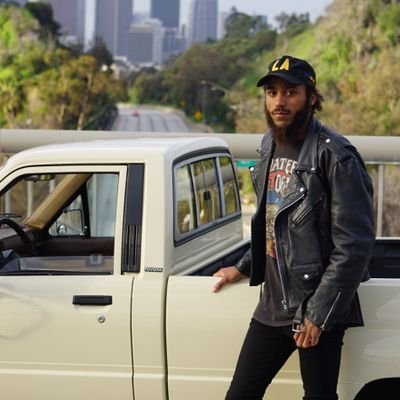
Welcome to L.A. TACO’s weekly Investigations Newsletter. I’m Lexis-Olivier Ray, the Head of Investigations for L.A. TACO. This newsletter was originally published on May 6, 2026.
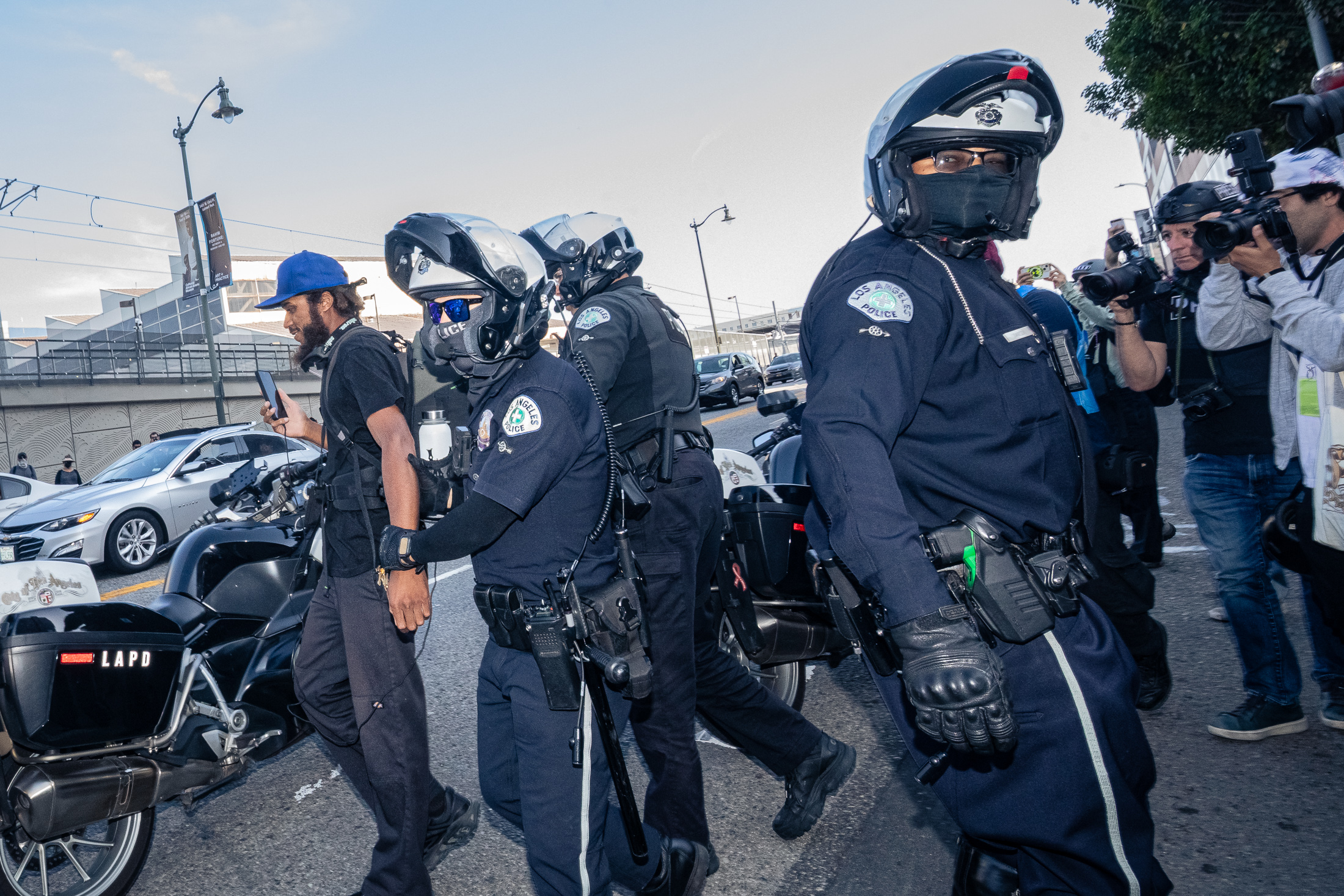
On May 1, I was covering a May Day protest outside of the federal Metropolitan Detention Center on Alameda Street in Downtown, when a motorcycle cop with a thin handlebar mustache approached me and said, “On the sidewalk, please.”
“I’m with the media,” I responded.
“It doesn’t matter,” LAPD Officer Robert E. Lockhart said back. “I’m asking you, please.”
Before I knew it, Officer Lockhart and another motorcycle cop wearing a gaiter mask that obstructed his face, grabbed me by my arms and escorted me behind their police line, near their motorcycles.
Immediately, a gaggle of photographers, streamers, journalists, and protesters surrounded me.
“Get your ID out,” Lockhart said repeatedly, while another motorcycle cop held onto my left arm.
“Do you guys know who this is?” a man holding a camera, standing in the middle of the street, yelled at the officers.
While holding my ID, leather-gloved Lockhart punched my information into his phone, then printed a citation on a small portable printer attached to his motorcycle before handing it to me.
The veteran officer—who in the late ‘90s began his career as an LAPD officer and in 2024 made over $275,000—cited me for allegedly violating vehicle code 21954, which states: “Every pedestrian upon a roadway at any point other than within a marked crosswalk or within an unmarked crosswalk at an intersection shall yield the right-of-way to all vehicles upon the roadway.”

“Sign right there,” Lockhart ordered. “If you don’t sign, you go to jail, it’s simple.”
After a brief conversation with an LAPD supervisor, I reluctantly signed the infraction when it became clear that I was likely seconds away from being handcuffed and hauled off to jail.
Shortly after citing me, Lockhart and the rest of the bike cops jumped back on their German-made motorcycles and rode off. And I went back to doing my job, documenting the protest from both the sidewalk and the street.
It did not appear that police cited anybody else for allegedly stepping into the street, despite the fact that dozens of other journalists and protesters were clearly standing in the street before, during, and after my detention.

While speaking to an LAPD spokesperson over the phone after the incident, I repeatedly asked, “Why do you think I was the only person who was cited?”
“I’m not going to speculate,” the public information officer told me.
Later, towards the end of the protest, dozens of heavily-armed officers formed a tight circle around a small group of mostly press that I was with, closing off all of our possible exits.
When officers violently arrested a protester contained within the group, LAPD Officer Veridiana Cisneros Escoto batoned me in the chest while I filmed the arrest. A few moments later, when I calmly approached Cisneros Escoto and asked her for her serial number (I had asked her earlier but couldn’t hear her over all the noise), she immediately jabbed me in the chest again.
“Back up, back up,” she said while manically gnawing on a piece of gum.
After it became clear that LAPD officers were planning on making arrests, civil rights attorney Weston Rowland—who drove across town to take a look at my citation but now found himself on the verge of being arrested—began requesting a supervisor to ensure that officers were not planning on arresting members of the media (again).
“This is going to be the last time that I ask for a PIO [public information officer] or lieutenant,” Rowland told police. “After this, I'm going to do what you say, but we are going to file contempt on you.”
Weston Rowland isn’t just any civil rights attorney.
Rowland is one of the attorneys currently representing members of the L.A. Press Club, as well as the independent publication Status Coup, in active litigation against the Los Angeles Police Department over press rights violations stemming from recent protests.
Last year, a federal judge overseeing the L.A. Press Club lawsuit issued a court order prohibiting LAPD officers from interfering with journalists while they are covering protests.
“We’ve now shown you the law, we’ve talked about the law, we’ve effectively asked for a PIO [public information officer], we have effectively asked for a lieutenant,” Rowland told the cops. “If you don’t do what the law says you're supposed to do, then you’re going to be in contempt of court.”
After refusing to get a PIO, despite repeated requests, an LAPD sergeant approached members of the media one by one and began removing them from the group.
After being kettled for around 20 minutes, LAPD Sergeant Thomas Willers came up to me and cut me loose.
By the end of the protest, at least a dozen people were arrested, including freelance journalist Nick Stern, legal observer Di Barbadillo, and civil rights attorney Weston Rowland.

Nick Stern has been a freelance journalist for more than 30 years.
Before Friday’s May Day protest, the only other time that he found himself in a detention center was when he broke into a prison for an investigative story he was working on.
“[On Friday] I was arrested, put in handcuffs, and detained in the Metropolitan Detention Center for two hours until I was released without any charge or citation,” Stern explained during a May 5 Los Angeles Board of Police Commissioners meeting.
While addressing the commission, Stern held up a July 15, 2025 letter from McDonnell ordering officers not to interfere with journalists or assault them.
“Now one of two things is going on here,” Stern concluded. “Either Chief McDonnell, your officers are ignoring your direct orders, or there's something going on in the background that we don't know about.”
“What is it?”
Earlier in the meeting, McDonnell acknowledged that the department had received complaints from members of the press about journalists being cited and arrested on May Day. But at the same time, he described LAPD’s relationship with the media as being “tremendous.”
“On May Day, an assistant chief told me she was impressed with the department's patience dealing with protesters, and I believe she was sincere,” said Adam Rose, a board member of the Los Angeles Press Club and deputy director of advocacy for Freedom of the Press Foundation, during public comment at the Police Commission meeting. “But as she said those words, she didn't know yet the press were already in handcuffs.”
Rose pointed out that there have been almost 200 incidents in Los Angeles documented in the U.S. Press Freedom Tracker, a database that keeps track of press freedom violations, in just the last six years.
“Every newspaper imaginable, broadcast station, and wire service has victims,” Rose said. “We're talking Pulitzer winners and Emmy winners.”
“LAPD leadership appears detached from these realities.”
Prior to Friday, I’d been involved in 14 incidents documented in the Press Freedom Tracker here in Los Angeles.
Being cited for allegedly standing in the street while covering a protest definitely ranks as one of the more petty ways that an LAPD officer has interfered with me doing my job.
Thankfully, about a half dozen high-profile attorneys have offered to help me with the citation and have all but assured me that the City Attorney is unlikely to file a case.
It’s not the citation that I’m worried about, though.
I’m worried that shit like this keeps happening.
At almost every protest I’ve covered this year, I’ve either been shot with “less-lethals” by police, detained or threatened with arrest.
It’s gotten to the point where family members have practically begged me to stop covering protests.
“They know who you are,” my girlfriend told me recently. “And they’re not going to stop targeting you.”
During the May Day protest, freelance journalist Mel Buer turned to me while we were standing together in between two lines of heavily armed LAPD officers and federal agents, just like we had done at many other protests over the past 11 months.
“This is like Groundhog Day,” she said to me.
After covering protests, we tend to our injuries. We get rest. We talk about our experiences with fellow journalists over beers. We follow up with the people fighting for our safety. We file complaints and lawsuits that result in court orders. We retell our stories to fellow journalists and public officials. And in newsletters like this one, to help process what we went through.
But nothing changes.
To receive this weekly newsletter in your inbox, sign up here.


