

Skip to Content
Drink

Craft Breweries Are Struggling. So How Does This One Keep Expanding?

Everything there is to know about the hyper-dank and extremely brave brewery opening at Union Station’s iconic Fred Harvey space tomorrow.

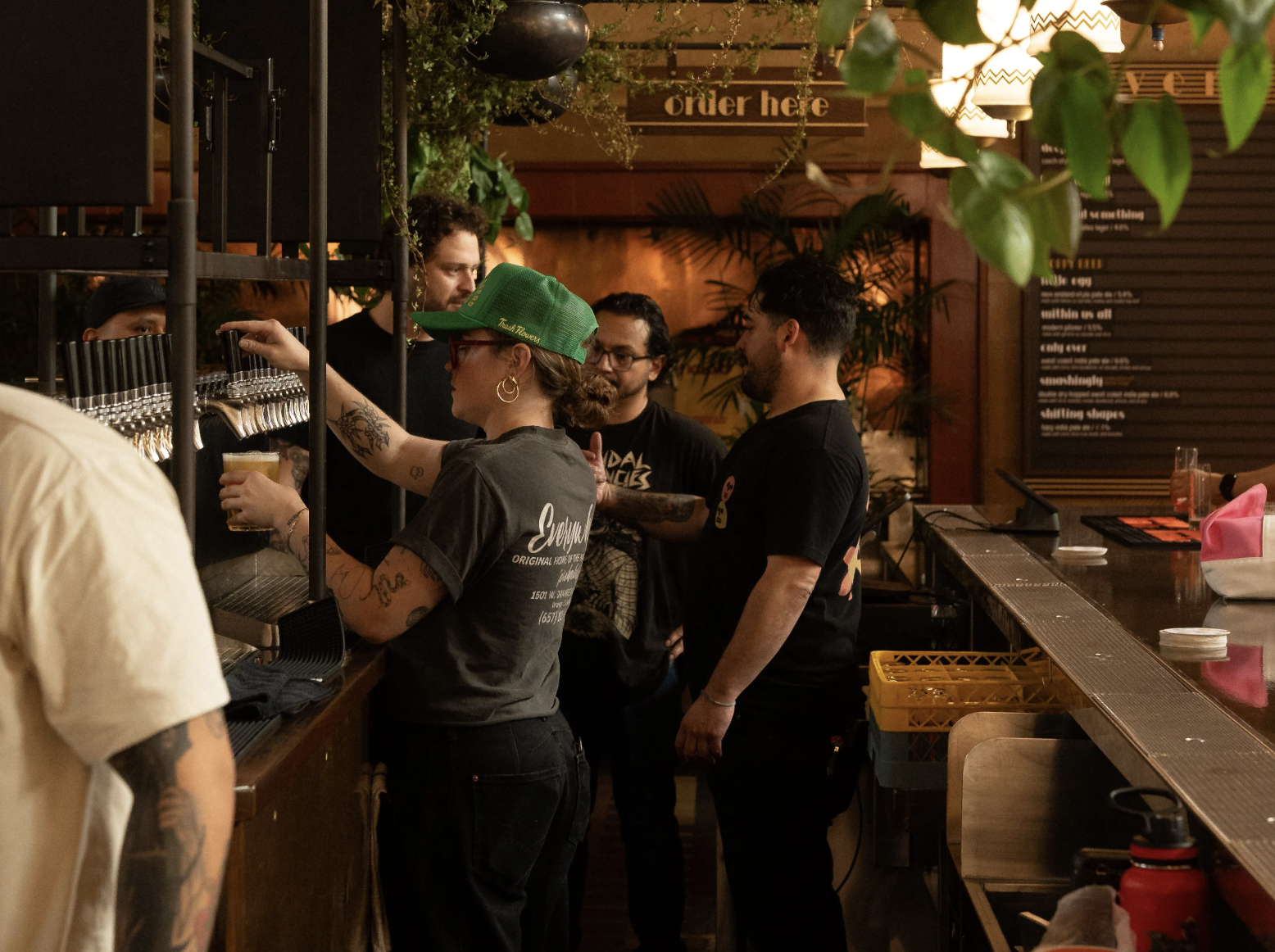
bartenders behind a bar

Staff behind the bar at Everywhere’s location inside L.A.’s Union Station. Photo via Everywhere Brewing Co.

How crazy do you have to be to open not one, but two massive brewery locations in Los Angeles County in the same two months? 

Just ask the team at Everywhere Beer Co.: Daniel Muñoz, Jeremy Grinkey, Stefan Weber, and Keith Pumilia. Four dudes who cut their teeth at one of the earliest craft beer epicenters in Southern California, The Bruery, and eventually left to start their own ambitious brewery.

Fresh off launching their buzzy Long Beach taproom on 4th Street in Retro Row, which opened in April 2026 with lines out the door, a coffee partnership with Good Time coffee, and food pop-ups like Hamburgers Nice every Thursday and Friday night, the Orange County-based crew dropped another bomb in early April: a major new location inside the historic Fred Harvey space at Union Station L.A. formally opening tomorrow night. Tight in time for summer and World Cup fan zone energy.

While craft breweries across the country continue to close at a sobering rate, Everywhere Beer Co. is doing the opposite. Its two-month-old Long Beach taproom is somehow thriving. And the brand is gearing up for two other major expansions to be announced soon too.

In a tough industry where many brewers are struggling, and people are drinking less, Everywhere Beer Co. has found a formula that resonates: hyper-dank IPAs, crushable pilsners, and “super fruited” seltzers,  and perhaps their biggest game changer of all, thoughtful, bright spaces open all day that defy the brewery aesthetic—designed for more than just husky, bearded men.

Another secret? They are an extremely rare third space in L.A. because they double as a makeshift co-working space and a bright, spacious spot where you can meet up with a friend or meet someone for a date without having to drop too much cash. 

What are they doing differently to defy the odds? 

L.A. TACO sat down with co-founder Daniel Muñoz to discuss how the brewery survived brutal permitting delays, as well as their fearless rapid expansion, operator-owned model, and the bigger vision for Everywhere.

L.A. TACO: You had to wait a years, not months, for the Long Beach location due to city bureaucracy and permitting delays—what were the biggest hurdles, how deep did it get financially/emotionally, and what kept the team going through that “in the hole” period?

Daniel Munoz: Honestly, bureaucracy was definitely part of it, but it would be too easy to just blame the city. The truth is, we were inexperienced. We didn't fully understand how power actually moves through systems like permitting and licensing. Whose motivations align with yours, whose don't, and why. On top of that, this was our first full buildout at this scale. We really didn't know what we were walking into with construction, inspections, and all the different layers of approvals that come with a project like this. Learning all of that in real time was humbling. I took a lot of “Ls,” personally.

Financially, I'm just grateful we survived it. We were lucky that our Orange County location and Portland taproom were healthy enough to carry us through without taking on a ton of outside capital. A brand new business trying to open its first location probably couldn't have done that. I honestly don't know how they would have made it. Emotionally, it got heavy. What kept us going was that Stefan, my partner, and I actually live here. Long Beach is our neighborhood.

When people asked why Southern California needed another brewery, our answer was: It doesn't. What it needs is a different kind of brewery. Craft beer got really good at talking to itself. It became a closed loop where you had to already know the language to feel comfortable.

We're not operators coming in from somewhere else trying to plant a flag. We care about this place, and that connection to the city and the people in it is what kept us from walking away. The other thing I learned is that bureaucracy isn't just red tape. It's its own ecosystem, with its own economy, and it doesn't always move in the direction of what's best for the city, even when there are good people inside it. Understanding that, without becoming bitter, was probably the biggest lesson. I don't regret any of it.

When people ask me about Everywhere, I respond to them that you have intentionally “de-bro’d” the beer scene by creating a more welcoming, colorful, and less dude-bro "man cave"-like taproom. What does that mean in practice for your space design, service, events, and who you want walking through the door?

This was actually part of our pitch when we were talking to investors and banks early on. When people asked why Southern California needed another brewery, our answer was: It doesn't. What it needs is a different kind of brewery. Craft beer got really good at talking to itself. It became a closed loop where you had to already know the language to feel comfortable. And a lot of people felt intimidated, or just flat-out unwelcome. I saw that firsthand with my own dad. I remember him walking into some of those classic gastropub-style taprooms in the early 2010s and just feeling out of place. He didn't speak the language, and nobody made him feel like he was allowed to not know it yet. That always stuck with me. And it's not just older generations.

a glass of an alcoholic drink

Even now, we'll see younger drinkers walk in and feel a little overwhelmed by beer culture. So our whole mission became building an experience that says, very clearly, "You are welcome here." That shows up in the design, the people we hire, the art on the cans, the beers, the seltzers, the music. All of it is trying to communicate the same idea. Beer is for everyone. And we really mean that.

Your Long Beach space is constantly packed, with lines, which makes me so happy to see as a beer person. In an era when many breweries and restaurants are closing. What do you attribute that success to, and what lessons from Orange County and Portland are you carrying forward?

I think part of it is actually pretty simple. We're unique, and we care a lot. Those two things matter on their own, but together they're hard to fake. Every detail has an intention behind it. The music, the way the menu reads, the way the room feels on a Tuesday night. We obsess over things most people probably don't notice consciously, but they would absolutely notice if they were missing.

The music is probably the easiest way to explain our whole philosophy. When you walk in, we want you to feel like you're discovering something. But we also want you to feel like a tastemaker, not a student. That's the balance we're always chasing, introducing people to things they didn't know they'd love without ever making them feel like they're behind. The lessons from Orange County and Portland have mostly been about discipline. Knowing who you are, not chasing things that don't fit, and trusting the instincts that got you here. Long Beach validated that for us. The instinct was right. Now the job is to stay true to it.

Is Everywhere employee-owned? Can you walk me through how that structure works, why you chose it, and how it influences daily operations, decision-making, and the overall culture compared to traditional breweries? 

I want to clarify something I may have said that could be misread. We're operator-owned, not employee-owned. What that means is that Jeremy, Stefan, and I, Keith, are four equal partners, and we're fully in this. This is our livelihood. We're not investors. We're not hobbyists. We have families counting on this business to work.

I think people assume seltzers and serious beer are somehow in opposition. Like you're either a "real brewery" or you're chasing the lifestyle market. We've never seen it that way.

That creates a level of focus and accountability that I think is pretty rare. Four equal partners sound like they should be chaotic, and sometimes they are. But the reason it works is that we're all actually good at different things. There's very little overlap in what each of us brings to the table, so the friction tends to be productive instead of circular. It also helps that we genuinely like each other, which I think people underestimate as a business asset.

customers and bartenders at a bar
Photo via Everywhere Brewing Co.

You play heavily in the seltzer game (agua fresca-style, etc.) but still win major beer awards every year, including at the Great American Beer Festival and World Beer Cup. Can you remind me of your award-winning beers and the categories they won in? How do you balance producing approachable, high-volume seltzers/spritzes with crafting award-winning beers?

We make what we like. That sounds almost too simple, but that's really the whole thing. I think people assume seltzers and serious beer are somehow in opposition. Like you're either a "real brewery" or you're chasing the lifestyle market. We've never seen it that way. We're intentional about everything we put out, whether it's a 3.8% agua fresca-style seltzer or a hazy IPA competing at the highest level. We won a best-in-world medal for hazy IPA at the World Beer Cup last year and placed third this year. So we're not using approachability as a substitute for quality.

a glass of beer

We're trying to do both, because we believe you can. The seltzers are also just really fun for us. They're creative, colorful, and approachable. And then we still get to go deep and experimental through our membership program and barrel-aged beers, which is where Stefan really gets to stretch. One thing we say a lot internally is that we have core styles, not really core beers. You'll almost always find a lager, a hazy, a west coast, and a seltzer from us. They just might not be the exact same beer every time.

What’s your approach to the beer lineup? Focusing on drinkable, sessionable styles while still innovating? Any flagships or new experiments you’re especially excited about right now?

We go all-in on everything. There's no B-tier for us. If something is on the menu, it has gone through the same level of care as anything else. We don't really think in terms of flagships in the traditional sense. We think in terms of standards. Everything has to meet them.

You’re expanding fast with Union Station (in the historic Fred Harvey space) opening soon, plus Whittier and Corona on the horizon. What makes these new locations different, and how does Union Station in particular fit into your vision (food/cocktails, World Cup/Dodgers energy, historic revival)?

We've been heads-down on Long Beach for three years, and Union Station came into focus more recently, so from the outside it may look like we're suddenly expanding quickly. But in reality, these timelines have been running alongside each other for a while. What makes Union Station different wasn't something I fully understood until we got deeper into it. We walked into a space where people already cared deeply about the building before they ever considered a brewery moving in.

The Fred Harvey room carries real history. It means something to Los Angeles. That weight is something we feel, not something we're trying to leverage. And for me, it's personal in a way I honestly didn't expect. My grandmother, Hilda Salas, worked as a Harvey Girl in that building in the 1940s. Shout out to the legend. So when I say we want to pay homage to the space's history, I really mean that. We had to compete against brands bigger than ours, and Metro chose us anyway. We don't take that lightly. This isn't about making a destination brewery. It's about building a brewery, restaurant, and gathering place inside one of the most iconic spaces in Los Angeles, and doing it in a way that deserves to be there.

The food program, the cocktails, the World Cup energy, the Dodgers energy, all of that will be part of it. But the foundation is respect for the space. Everything else builds from there.

Looking ahead, what’s the bigger vision for Everywhere? How big do you see this growing while staying true to the approachable, inclusive model that’s working so well? Where else do you want to open?

Everywhere, togetherness has always been about as a concept. The idea that when you surround yourself with people you believe in, your passions and ideas can take you places you never expected. That's always been the spirit behind it. We've wanted to get into cocktails for a long time, and Union Station gave us the right opportunity to do that. We also get to approach it alongside a friend who is genuinely passionate about that world, Chloe Radel. Together we are everywhere. That's kind of the point. Beyond that, I don't think we're following some rigid master plan.

We're looking for opportunities that feel right and that let the idea of everywhere keep growing. The concept of togetherness really started to take shape at Union Station, and that's what I mean when I say "everywhere can be anywhere." One day, I'd love to operate an everywhere motel. Something 1960s-inspired and a little strange, with a great bar inside. Or maybe a bowling alley. Or a par 3. Who knows. Right now, we're focused on building a healthy business that lets us keep chasing ideas like that. We want to keep following our dreams, everywhere.

Thanks for speaking with us. Cheers.

Stay in touch

Sign up for our free newsletter

More from L.A. TACO

Daily Memo: Immigration Lawyers Overwhelmed With the Number of Detainees Needing Representation

“The system has been set up in a way to make people lose hope, to make them give up fighting their case before they talk to an attorney, before they even really know what their options are," says one of the immigration lawyers from the Immigration Defenders Law Center stepping up to help.

This WWE Power Couple Is Venturing into L.A.’s Coffee Roasting Scene

World Wrestling Entertainment stars Seth Rollins and Becky Lynch have launched AMO, inspired by their true life, non-kayfabe romance; plus, a short guide to a few of their favorite spots in L.A.

May 20, 2026

These Nine L.A. Dishwashers Are the Real Heroes of Your Favorite Restaurants

Anthony Bourdain said it best: "Everything important I ever learned, I learned as a dishwasher and as a cook." These are just a handful of the places restaurants' MVPs eat and drink at around Los Angeles.

Daily Memo: Hunger Strikes Begin in California ICE Detention Centers as Conditions Worsen

In other news, Palantir has shared the data of 20 million Americans with ICE and a former CEO of private prisons is now running ICE facilities.

A Guide to Every Congressional Candidate Being Funded by AIPAC

This article is intended to provide L.A. voters with publicly available information on pro-Israel PACs, as L.A. TACO believes transparency about political funding and endorsements allows voters to make informed electoral decisions.

May 18, 2026

Legal Coalition Prepares Restraining Orders Against Feds Who Targeted VC Defensa

Between 50 - 60 members, volunteers, and activists of the group have been targeted by federal agencies through a combination of tactics like raids, searches, and seizures, including agents allegedly following people home and flashing their lights.

See all posts