

Flavio Morales remembers his first outing to Dodger Stadium like he was Neil Armstrong landing on the moon—his heart pounding in his chest, the glove warped around his hand, gravity slightly dissipating as he finally set foot on this place he had only ever seen on T.V.
“It was the Dodgers vs. Phillies. A Sunday day game. Jerry Reuss vs. Steve Carlton.
They lost 1–0. But it was an amazing experience with our dad,” he tells me.
He also remembers how his mom got the tickets—carefully cutting the barcodes off boxes of Grandma’s Cookies.
“My mom got tickets via a promotion,” he says. “She saved a bunch of box tops.”
The way this memory jumped out when I asked him how he felt about the Dodgers tells me everything: the team means a great deal to him and his family. And yet this weekend, as the Boys in Blue begin their defense of a World Series title—after cutting down the Cincinnati Reds on their way to the NLDS—Flavio finds himself wondering the same thing I’ve been thinking a lot lately:
Is it okay to root for the Dodgers right now?
To answer this question, I decided to ask a bunch of experts for their take on that question. By “experts” I mean people like Flavio, who love the Dodgers but also hate fascism and believe Latinos and immigrants in this country have a right to due process and the protections of the United States Constitution. You know? EXPERTS!
It’s a quagmire for Dodger fans that has the potential to keep bubbling up to the owners. Their majority owner, Mark Walter, is the CEO of Guggenheim Partners, a company with over $12 million invested in the GEO Group, a major operator of private prisons and immigration detention centers used by ICE. Walter’s other company, TWG Global, also partners with tech firms that help ICE track immigrants through surveillance software. While he doesn’t directly run these prisons, his companies profit from investments tied to immigrant detention and surveillance. He also just bought the Lakers.

I conducted a survey on Instagram answered by 140 people who identify as Dodgers fans with the prompt of “How Do You Feel About Rooting For The Dodgers?”
“I’m torn. I watch but don’t yell,” Flavio explains. “But I’m definitely not buying tickets.”
My unscientific survey results showed that 47.1% of Dodgers fans were “conflicted” about rooting for the team on their 2025 playoff run. An additional 27.1% said they would not be rooting for the team this season. Only 23% said they felt “good” about rooting for the Dodgers right now.
Life long Dodgers fan Yuliana Roa says rooting for the team right now makes her feel like “shit, but it’s still my team” she explains. “Sorta like are you going to say you’re not American and don’t feel proud to be because of who’s running the country right now?”
That hesitation has become a defining feeling for many of us—Dodger blue in our veins, but doubt in our hearts. Not because we’ve lost faith in the players themselves, but because we’re being asked to square our love for this organization with what some call politics, but what I consider basic human decency—the right of Latinos, especially immigrants, to exist in this country without being terrorized, demonized, and disappeared by unscrupulous men doing shady shit.
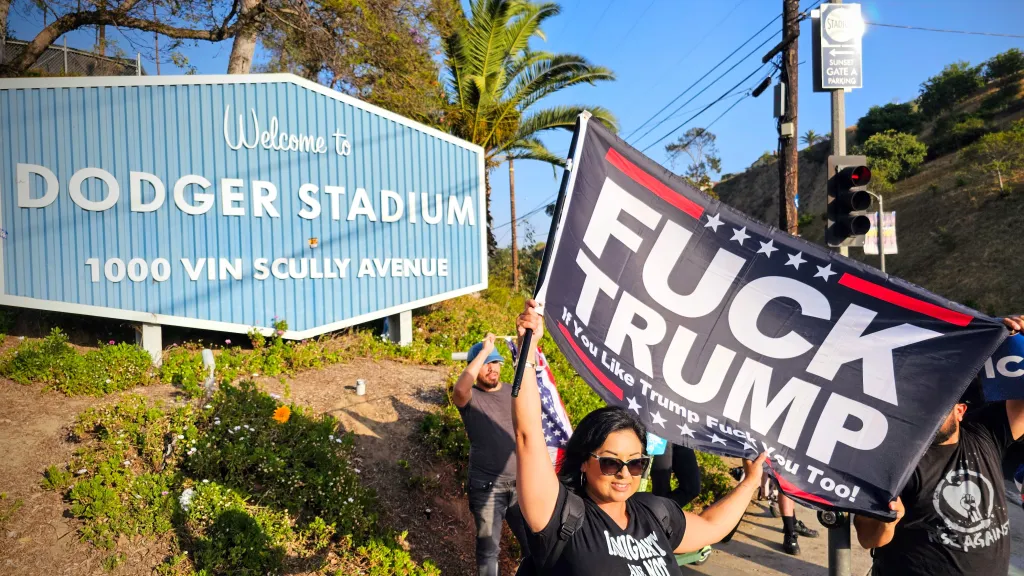
This summer, as ICE raids swept through Los Angeles—agents in unmarked vans patrolling Latino neighborhoods, families hiding indoors, streets going silent—the Dodgers stayed quiet.
Other teams in the city spoke out, even rebranded themselves in solidarity. But the most popular franchise in Los Angeles, the one that markets itself most directly to Latinos, offered only silence. And then, after weeks of pressure, a carefully worded pledge of $1 million for immigrant families—without ever once naming ICE.
To be honest, most of the season, I didn’t care about the Dodgers standing up or standing down. At least that’s what I thought. It’s a corporation after all. I don’t expect corporations to have morals, which is why it’s always so refreshing when they do, like when LAFC and Angel City FC stood with the community that stands with them.
But when the playoffs started, I found myself with this weird feeling watching the Dodgers take the field. I couldn’t quite place the feeling. But something was off. I messaged a friend of mine that I was trying to watch the game: “but I feel about it the way I used to feel about walking around North Long Beach at night: ‘Hope it’s a good night. Hope I don’t get into any trouble. Hope I’m not a sucker for doing it.’”
He assured me, I wasn’t alone.
“I feel that,” he shot back. “Maybe that's part of the excitement of sports in its own way. Sports remind us of a sense of infinite greatness. Rooting for the Dodgers in L.A. has always been complicated; however, I believe that in these dark times, if something gives you a sense of hope through escapism, then how else must we cope?”
It made me think about the last time I was at Dodger Stadium. It was Oct. 25, 2024, Game One of the World Series, Dodgers vs Yankees, and a crazy time in American politics—Trump was back on the campaign trail after surviving an assassination attempt, stoking fear and promising mass deportations. Biden had already dropped out of the race and Kamala Harris felt like the only thing standing between us and the ICE raids we now see on our streets.
The Dodgers’ legendary Mexican-born pitcher Fernando Valenzuela had just died, and the team dedicated Game One of the World Series to him. I was there with my brother, my nephew, and my father. We got to witness one of the greatest moments in Dodgers history: Freddie Freeman blasting a walk-off grand slam to win the game, the stadium shaking as 56,000 people screamed into the night.
For that instant, grief turned into joy. It was an escape, and it carried the fragile promise of a better tomorrow.
I talked to my friend, Yesi Ortiz, who knew and worked with Fernando shortly before his hospitalization and eventual death on Oct. 22, 2024, over at KTNQ 1020 AM La Casa De Los Dodgers—the home of Dodgers games in Spanish, where Fernando and Jaime Jarrín became the soundtrack of Latino Los Angeles for generations.
She has often told me about how, even in his final months, Fernando carried himself with the same humility that made him a hero to millions. For decades, his voice and presence in that booth—paired with Jarrín’s iconic calls—weren’t just about baseball. They were about belonging. They told every immigrant kid with a transistor radio that they were part of the story, that this team was theirs too.
Yesi no longer works with the Dodgers or their radio station but I thought she would be the perfect person to ask if it was okay to root for the team right now.
“It's complicated,” she said. “Because I respect the people that go to games for the joy and love of baseball. It's what brings community together but at the same time, showing up for community comes with responsibility.”
Yesi has spent the ICE siege of L.A. working with the East LA YMCA to donate food to families who are afraid to go work or even shop at the grocery store.
“For me, it's less about judging the fans and encouraging people to think about their own values and choices of the team or organization they are supporting,” she explains. “And for those people that say ‘keep politics out of sports,’ I’d point out that the start of every game is the national anthem, proof that politics play a role.”
The Dodgers’ silence during Trump’s raids cut especially deep because no franchise has profited more from Latino loyalty. They bulldozed Chávez Ravine to build their stadium, then spent decades marketing to the very communities they displaced—through Spanish-language broadcasts, mariachi nights, heritage jerseys, micheladas.
When ICE vans circled the stadium gates as raids swept through L.A., Latino families panicked. The Dodgers, meanwhile, seemed more worried about angering the president—who publicly brags about wanting to be a dictator and going after his opponents with the entire force of the U.S. government—than standing up for the fans who fill nearly half their seats.
When the Dodgers beat the Reds on Wednesday night to advance to the next round against the Philadelphia Phillies, I definitely cheered. And for some reason, I thought about The Sopranos. In the HBO mega-hit, I always found myself rooting for Tony Soprano—even though he was obviously, deeply, morally compromised.
I don’t know exactly what that says about me. But maybe Yulliana’s right: maybe that’s what it means to be American right now. Maybe it always has. Maybe it always will. A complicated compromise.
Like the song says, you “root, root, root, for the home team” because you want them to win. So yes, it’s okay to root for the Dodgers right now—even if you feel betrayed by the organization. But it’s also okay to fight like hell for their moral soul. Just like it’s okay to love the most powerful country in the world and still hate the injustices that made it so.


