

One of the most common misunderstandings about democracy—whether in East L.A. or Eastern Europe—is the belief that is defined solely by voting. It doesn’t.
Voting is like picking a restaurant and thinking your work is done. Like a restaurant, real democracy means you still have to show up, place your order, eat the meal, pay the bill, and decide whether you’ll come back.
In that sense, voting is just the appetizer in a long, messy, participatory meal.
Governments – from local city councils to the halls of Congress – prefer it when we vote and then stay quiet, out of the way. They hand us an “I Voted” sticker and hope we shut up for several years. That’s not empowerment – it’s pacification. And for communities like ours, it keeps power far from our neighborhoods.
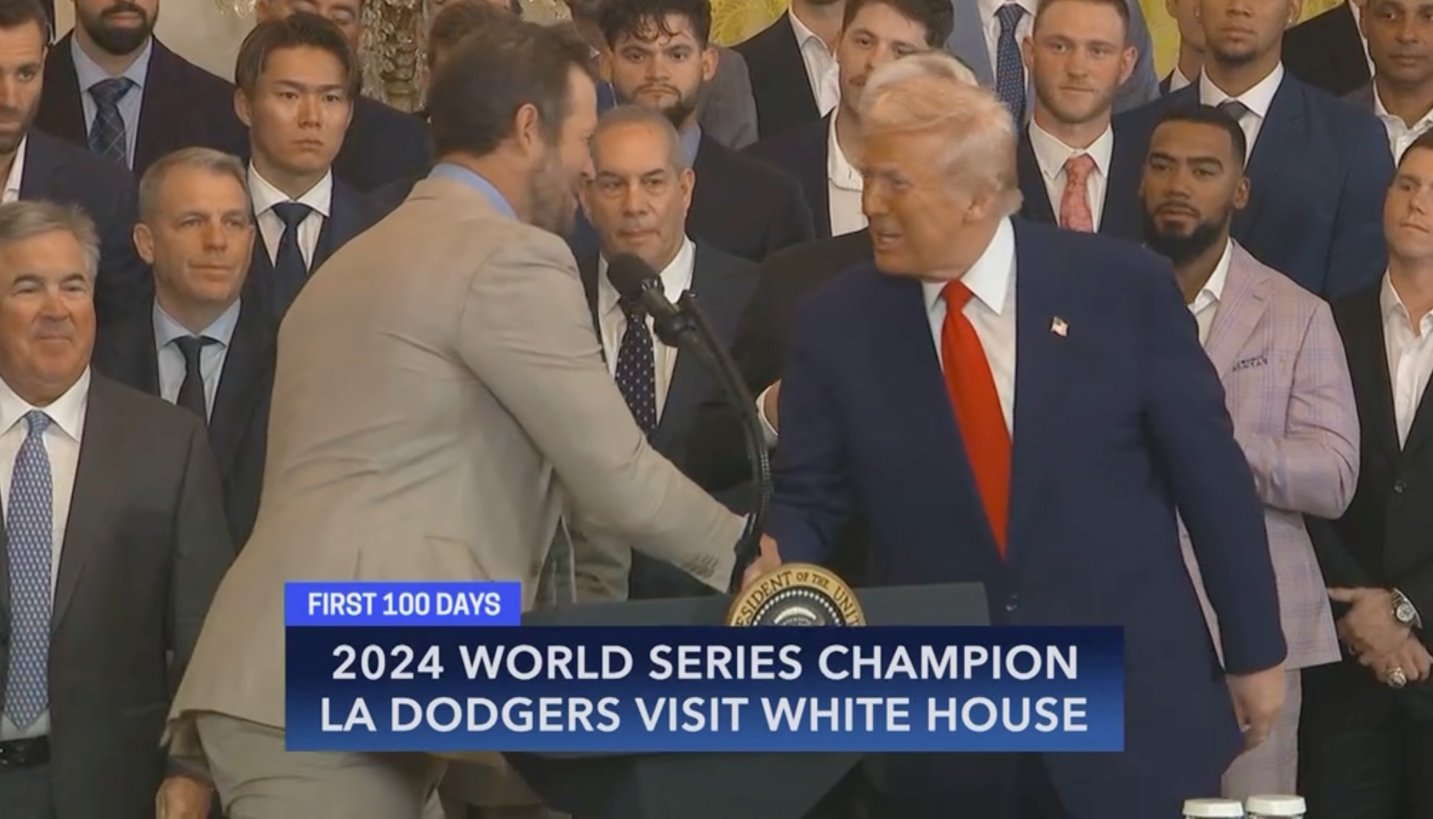
Which brings us to the Los Angeles Dodgers.
Some will argue that the Dodgers are just a private enterprise – simply minding their own business, so to speak. But the history of Los Angeles tells a more painful truth. The Dodgers and their stadium were built on the bulldozed backs of Mexican families in Chávez Ravine. Entire communities were displaced, as Mexicans and Chicanos were dragged from their homes and their neighborhoods erased. The black-and-white photographs of those forced removals eerily mirror today’s images of ICE raids – Brown bodies torn from the only homes they’ve ever known.
As Brown, Black, and Asian communities in L.A., we’ve grown used to being treated as expendable. We’re welcome when we’re cheering in the stands or sweeping up after the game—but we turn invisible the moment we demand respect, accountability, or justice.
Our elected officials—some of whom look like us—too often act more like Spanish viceroys than defenders of our dignity. The city loves to flaunt its Hollywood shine while burying its Mexican roots. It wants us to stay quiet. It wants our labor, our culture, our money—but not our voice.
It wants us to remain invisible. And we can’t let that happen.
In this respect, the Dodgers have become a very painful symbol of this twisted relationship. We love them. We stood taller during Fernandomania. They made us believe this was our team. But our relationship is complicated. While many of us adored the fact that Nezza sang the Star-Spangled Banner in Spanish, making those words real and meaningful for those who don’t grasp it well in English, some among the Dodgers management were not too happy. Or, at least couldn’t get their opinion straight.
While many of us applauded the Dodgers fan who had a placard saying “ICE Out of L.A.” to show their solidarity with Latinos facing ICE, some in the Dodgers management felt it was offensive.
But to whom was it offensive? Was that fan too much of a contradiction for the Dodgers to handle? Can a fan love the Dodgers and Latinos and be disgusted by ICE at the same time?
Mexicans and Latinos make up forty percent of the Dodgers fan base. We buy the jerseys, the beer, the overpriced nachos—yet we're still treated like background noise, like we don’t belong in the very stadium we helped build. And now, as Dodgers ownership sets its sights on buying the Lakers, who are valued at $10 billion, they’ve said nothing about the very community that made them rich enough to dream that big.
This community, however, is waking up – reminded daily of its vulnerability and how easily it can be discarded. A new generation of Chicanos, Latinos, immigrants, and allies is demanding that the Dodgers finally reckon with their debt – not just financial, but moral. But since morality seems to be in short supply, and often treated as negotiable, many are now awakening to something else: their value to the economy.
According to the CATO Institute, removing just the immigrants who entered the U.S. in the last four years would shrink the economy by $1 trillion annually. That’s real money. Remove long-term immigrant labor and the impact is even more devastating.
If you don’t believe us, have you noticed the increasing quiet in the streets of Los Angeles? The absence of vendors in public spaces? The slow pace of clientele in restaurants? This is going to have devastating consequences – city-wide, not just in ethnic specific communities.
So let’s talk about the costs of mass deportations. According to one estimate, that bill might be as high as $170 billion. The cost to incarcerate – including the building of detention camps – would be an additional $50 billion. By the time Trump’s second term ends, significant federal law enforcement may be redirected to immigration raids.
Where do the Dodgers stand on these issues? Is this the kind of economic investment we need, or want? Is it even sustainable? What about the cost to human lives? Families? Communities? Who’s going to pay those costs?
Under these circumstances, what is a major sports franchise to do? For starters, with its billions of dollars in valuation, and with plans for expansion, the Dodgers could invest, say, $25 million into a legal defense fund to help those being whisked away into the night by ICE.
Furthermore, the Dodgers could assist in organizing other major city-wide businesses to pool their resources and raise those funds to even greater heights – say, to $250 million. This is not charity. This is taking care of their community. That’s what history demands.
Next, Nezza should be invited back to sing the national anthem in whatever language she chooses. And while we’re at it, why not have the anthem sung in all the beautiful languages spoken throughout our incredible city? Just imagine that. What other nation can say its anthem is performed by voices from around the world, right at home? Soft power, anyone?
These are just a few ideas to get the ball rolling. But ultimately, it’s on the Dodgers to step up. Time to take a real swing at doing the right thing.
At this very moment in history, whatever nonprofit work the Dodgers are doing – it’s not enough. The house is on fire, and they must help put it out. If the Dodgers have the resources and ambition to buy the Lakers franchise, then they certainly have the means to show up for their fans – their neighbors, their community – the people of Los Angeles who have always shown up for them.
Or maybe they're just not interested, considering the owner of the Dodgers is CEO of a financial firm with a reported investment in GEO Group, a private prison company that operates ICE detention centers.
Bottom line: The message about the need for shared responsibility is not limited to the Dodgers. It extends to many more business enterprises that have failed to stand up in defense of the human dignity of those scorned by the White House. But the Dodgers are an important symbol – an institution steeped in our collective memories, one that many feel a deep sense of loyalty, identity, and belonging toward.
But just like that, dreams can – and as the current state of affairs are making quite clear – turn into nightmares. And they certainly have for many of us.
Our Mexican father loved the Dodgers. From 1958 until his passing in 2023, Los Angeles was his home. He raised his family here. He worked for close to forty years as a furniture worker and janitor. He was a proud union member. And the Dodgers were his team.
He spent plenty of his hard-earned dollars on tickets, cerveza, hot dogs, and all kinds of team paraphernalia. But he had no patience for corporations that disrespected our culture and history.
We remember clearly when he stopped drinking Coors. It was the late 1970s, early 1980s—a powerful turning point in his life, especially since Coors had long been his beer of choice. He joined the boycott and never looked back. That moment awakened his palate to the rich and growing world of Mexican beers.
He was our hero.
If our father were alive today, he would be heartbroken – not just by the Dodgers, but by every business that turns a blind eye to, or worse, aligns itself with ICE and the MAGA agenda. In a democracy, differing opinions are expected. But when families are torn apart without regard for their well-being, and detainees are whisked away to remote, poorly-built, off-limits incarceration facilities – like the so-called “Alligator Alcatraz” – without due process, this is no longer about politics. It’s about blatant, shameless inhumanity.
And when far-right activist and Trump confidant Laura Loomer mocks the suffering of immigrant detainees by declaring “Alligator lives matter,” and then suggests that Florida’s alligators will be fed 65 million meals, it crosses the line into something far more sinister. That number – 65 million – is no coincidence. It’s a chilling reference to the estimated Latino population in the United States.
Life is usually lived in shades of gray. But not now. Not when basic human rights – and more and more, the rights of everyday Americans – are under attack.
As renowned historian, prolific author, and widely acknowledged godfather of Chicano Studies, Dr. Rudy Acuña, once wrote: “Sometimes there is no other side.” This is clearly one of those moments. Either you stand with ICE and MAGA—or you don’t.
To illustrate this point: four food trucks – Kona Ice, Churromania, Elote Lovers, and Ms. Cheezious – were recently discovered catering at the Alligator Alcatraz detention facility. The news quickly went viral, prompting one of the vendors and one of the companies behind a food truck franchise to take to social media and issue profuse apologies for their involvement.
This is where the power of the people comes in. We now have the opportunity to act as discerning consumers – choosing where to spend our money and where to withhold it.
There’s no doubt – we are at an inflection point. The Dodgers, like every business rooted in our communities, must make a choice. Trump has passed his “Big Ugly Bill,” pouring billions into ICE and the military while slashing support for the poor and working class. His administration has openly declared war on American cities.
This is where their twisted game is unfolding. It’s a dangerous gamble – for all of us, as a nation. And at the center of it all, under the spotlight of the world, are the lives of Brown bodies.
When the president calls your city “occupied territory,” believe him. There are no neutral positions in moments like this. The coming months will test the will and resolve of our families, our friendships, and our collective courage. Yes, the next round of primary elections is just around the corner – but they won’t be the panacea some imagine. And for many whose lives are already being upended, they’ll come too late.
If we don’t want to be treated as expendable, we have to act now. Get involved – because by the time the next election cycle rolls around, our fate might already be decided without us.
Ultimately, the same people who created the chaos of the Trump era won’t be the ones to clean it up or build a better future—they lack both the will and the vision to do so. Real change will have to come from those with the capacity, commitment, and imagination to make it happen.


