

In one instance, a registered nurse with a cart holding medical supplies was treating wounds and head injuries during a “No Kings” protest in June, when a 40mm projectile allegedly shot by a Los Angeles police officer suddenly ripped the flesh from the outside of his thigh.
In another instance, a photographer showed up to the same protest with a camera and left with a fractured cheekbone and ruptured eye that swelled shut, after allegedly being shot with a so-called “less-lethal” by an LAPD officer.
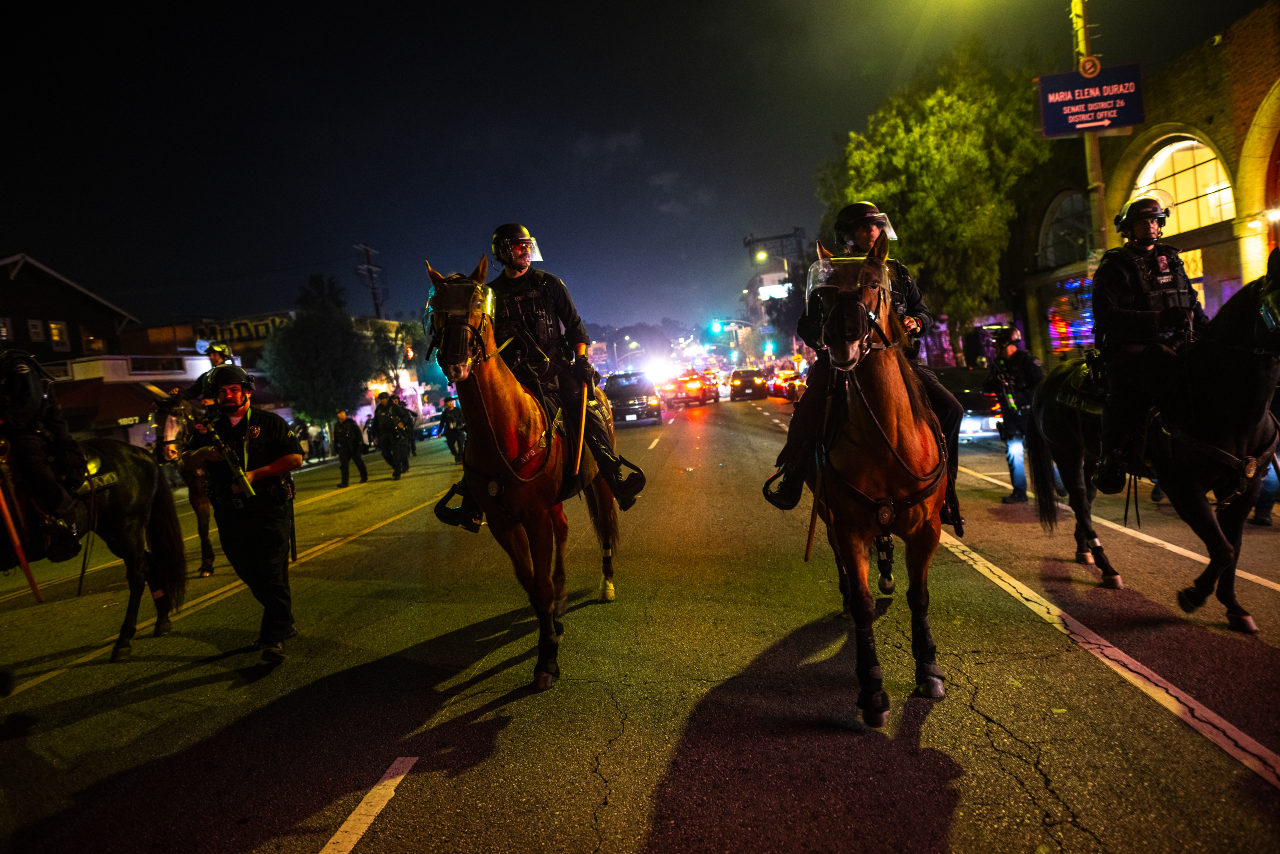
During a different protest, a woman was allegedly hit multiple times with LAPD’s “less-lethal” munitions, then pummeled by officers on horses as they wielded wooden samurai swords known as bokken, before she was trampled by a police horse and dragged off to the sidewalk.
These are only a few examples of the more than 120 claims for damages associated with protests and public gatherings that have been filed against the city of Los Angeles since anti-ICE protests broke out on June 6 of last year.
The claims range from less-serious allegations of Los Angeles Police Department (LAPD) officers allegedly destroying personal or public property to much more substantial claims of protesters, journalists, street medics, and bystanders sustaining serious or life-altering injuries as a result of allegedly excessive police force.
These claims for damages—the first step in pursuing a lawsuit—come at a time when the city is in a financial crisis, largely due in part to the number of past lawsuits filed against the LAPD that the city has been forced to settle in recent years.
Since 2019, the city of L.A. has paid out more than $430 million in liability claims related to policing, according to Los Angeles City Controller Kenneth Mejia’s office. More than 40 percent of those payouts are listed as “civil rights/excessive force” claims.
“The city and the county take this approach of ‘Our officers can do no harm,’” says Greg Kirakosian, a civil rights attorney who has filed multiple claims for damages and lawsuits against the city in recent months. “I don't understand that approach, especially when you look at how much money the city is spending on losing these cases and fighting these cases.”
But this violence occurs beyond protests.
Kirakosian is representing a man who was hit in the head with a wooden police baton while standing in line outside of The Short Stop bar in Echo Park, while hundreds of people celebrated the Dodgers’ second consecutive World Series victory last October. Kirakosian said that his client was walking away from officers and had their back turned when they were hit over the head.
“They seem to be using the mounted unit to push a skirmish line, to push groups,” Kirakosian says. “I've really never seen that before. It now seems to be the norm.”
The claims referenced in this story were obtained through a public records request filed with the Los Angeles City Attorney’s Office and cover all claims filed against the city related to protests and public gatherings between June 6, 2025, and March 14 of this year. The records that we received do not include any claims related to the most recent “No Kings Day” protest on March 28.
Claims for damages and lawsuits continue to be filed against the city.
Just earlier this week, two attorneys and a community organizer filed a joint lawsuit against the city and an officer named Rick Linton, who allegedly shot all three plaintiffs after they requested the officer’s name and serial number during a protest held last summer.
“I was shot twice, both times in the groin, because I asked the officer to identify himself,” says Shakeer Rahman, one of the civil rights attorneys who was struck by a “rubber bullet,” in an interview with L.A. TACO. “He told me, right before he shot me, that he was going to ‘pop’ me, and his reason was because I was taking away his focus.”

Rahman said that among all the officers lined up, the one who shot him was the only one without any identification on his helmet, and also the only one with a 40mm less-lethal launcher. When the officer began firing at protesters from a few feet away, Rahman asked for his serial number.
Ricci Sergienko, the other attorney in the joint lawsuit, had joined Rahman in documenting the protests against immigration enforcement. He was filming on his phone when community organizer Jason Reedy was struck by the same officer, just inches from his groin.
“It was one of the most painful experiences of my life,” Reedy tells L.A. TACO. “Immediately after being shot, I crouched down in pain. Had Ricci or Shakeer not been there, who knows if he would have kept unloading on me.”
Still recording with both hands, Sergienko backed away as the officer reloaded his weapon and fired at him, tearing a large, golf-ball-sized wound in his stomach.
This psycho shot me in the groin twice with 40mm munitions because I asked him for his name (which was ripped off of his helmet) after he shot others in the groin at close range too
— Shakeer Rahman (@sh4keer) June 10, 2025
Watch him tell me he’s going to shoot me just for asking who he is: https://t.co/IoqQBbRSIJ pic.twitter.com/flXaMWhUnl
“This is like a decades-long pattern of abuse and violence from LAPD towards the people of L.A.,” Sergienko says. “And it's an intentional tactic, because if they shoot enough people, injure enough people, maim enough people, that people will be less inclined to go out and protest.”
The three men expressed frustration with the lack of accountability that LAPD officers face, adding that reform may not be a viable solution. When claims are filed against officers, the settlement funds don’t come out of the LAPD’s budget but from the city’s.
“The message from the city, the mayor, City Council, is that LAPD is free to go out and attack and assault Angelenos, and their budget will remain the same,” Sergienko says. “The city will continue to go broke paying these settlements. It's just ridiculous.”
LAPD Chief Jim McDonnell did not respond to a request for comment.
‘Intimidating People Out Of Protesting’
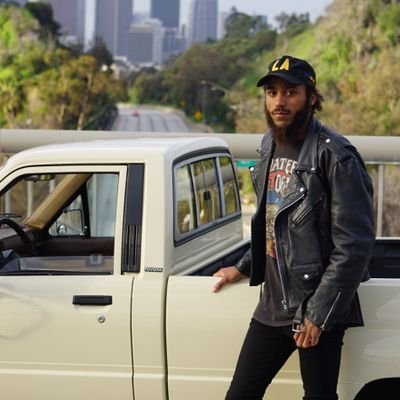
Twenty-five-year-old Micah Moore is one of dozens of protesters suing the city for excessive force.
After joining several “No Kings” protests on June 14 of last year in the San Fernando Valley, Moore made his way to City Hall in Downtown. At City Hall, officers in thick tactical vests and dark, masked helmets sat mounted on horses, with more armed officers positioned in large vehicles behind them, all staring down at the protesters waving flags as they chanted, “Peaceful protest!”
“I felt more like a military presence than a police presence,” Moore says during an interview with L.A. TACO.
As Moore turned to leave the scene, he was allegedly hit directly in the right side of his head with a rubber bullet. Immediately afterward, he felt ringing in both of his ears, and he fell to the ground, while bleeding from his ear. He recalled nearby civilians pulling him to the curb, bandaging his wound with gauze.
After being taken to the hospital, he found out he had a concussion. The ringing in his ears eventually stopped, but his hearing in his right ear never came back.
“I got the sense that there was kind of the goal to intimidate people out of protesting,” Moore says. “We're exercising our right under the Constitution, which [is] the Constitution they're supposed to be protecting.”
He shares that in an atmosphere where LAPD officers heavily gear up to face unarmed civilians, it appears as if the people using the First Amendment are seen as “the enemy.” He notes that officers are aware of the likelihood of deploying these less-lethal weapons, but injured individuals are “left helpless to their own devices.”
Moore said that the lack of providing medical aid contributes to the effectiveness of LAPD violence. Still, he continues to go to protests, not knowing if a bullet will come again.
“Well, if I stop, they've won,” he says. “That's the point of police brutality and political violence: to intimidate and trigger.”


Rahman, Sergienko, and Reedy echo that they will also continue to attend protests to document and support the community as a form of resistance.
“It's our duty to keep showing up,” Sergienko says. “As people that care about civil rights, care about humanity, that want to stand up against fascism, there's no other choice than to keep showing up.”
Even as they continue to show up, the LAPD's lack of accountability raises questions about what changes could prevent further harm in the community.
Late last year, the city council shut down a proposal that would have removed tear gas and 40mm foam launchers from the LAPD's seemingly endless arsenal of “less-lethal” weapons.
Then, in January of this year, a federal judge overseeing a lawsuit between the city and Black Lives Matter L.A. barred LAPD officers from using 40mm hard foam launchers in crowd control settings. So far, it seems like the LAPD has complied with that order.
“They should absolutely be banned from using these less-lethal projectiles, shooting at head level in a protest crowd control situation,” says V. James DeSimone, the attorney representing Moore, in an interview with L.A. TACO. In his experience, people rarely pose an imminent threat that would justify the use of such deadly force.
Others believe that rather than funding the police department’s budget, the money could be poured into community resources, which could limit access to weapons that put people at risk.
“I think [LAPD’s budget] should be diverted to the kinds of investments that actually keep our community safe, such as housing, such as healthcare,” Rahman says. “Instead, they act with impunity.”
Moore says he is an example of the violence inflicted by the LAPD. Yet, he hopes his experience will encourage others to continue showing up to protests, without letting the risks diminish their importance.
For Moore, still without hearing in his right ear, the experience was traumatic, but it has encouraged him and his friends to “get out there and change things.”
“Losing heart is almost as bad as losing my hearing,” he says.
Sign up here for the L.A. TACO Investigations weekly newsletter.


