


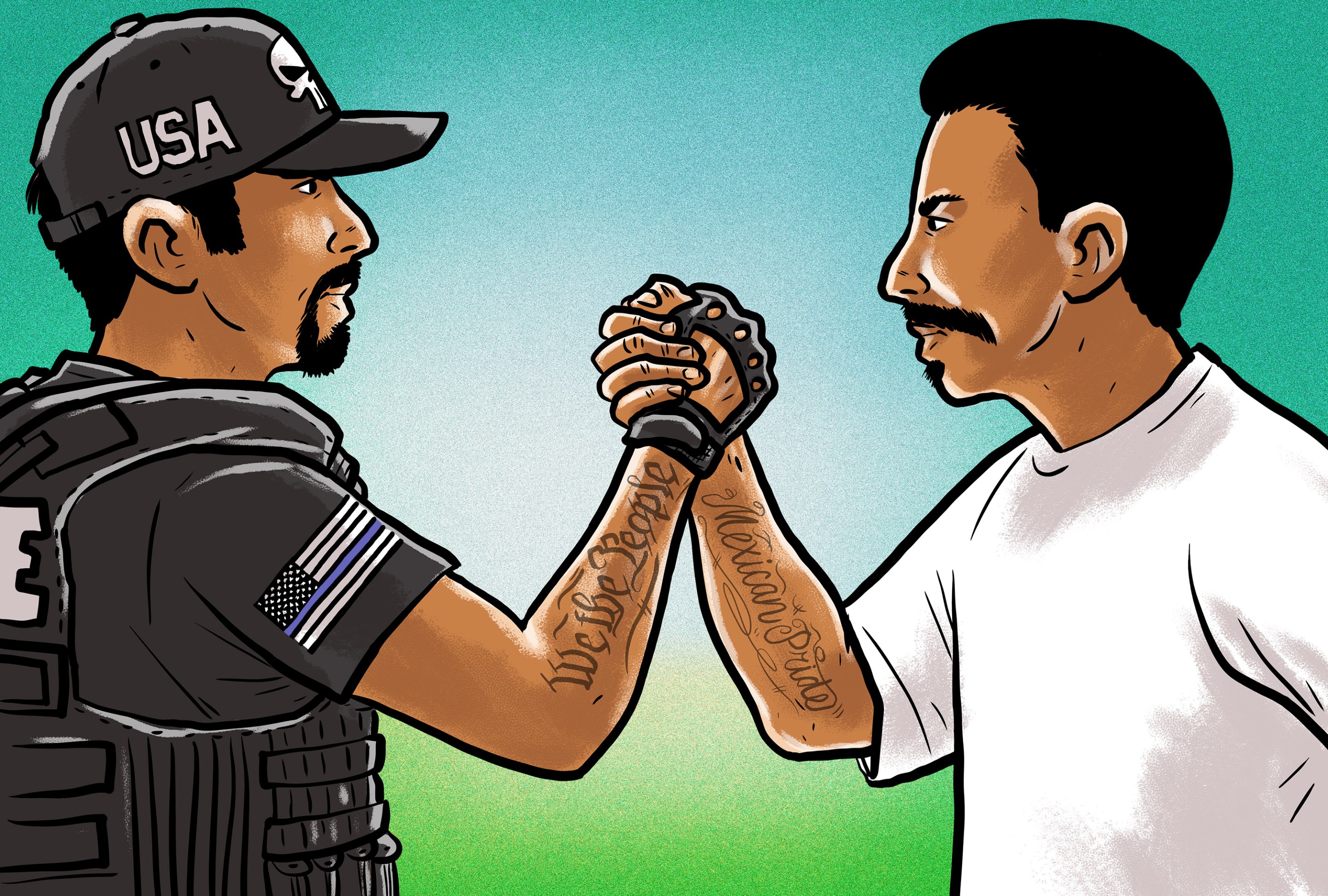
For many people, seeing a Latino working for ICE or Border Patrol can feel contradictory.
For many decades, Latinos were often viewed as a monolith by politicians and political strategists. While Latino voters have never been politically identical, there was a widespread assumption that immigration politics alone would keep most Latinos aligned with the Democratic Party.
That assumption was challenged in the 2024 presidential election when Donald Trump won an estimated 42 percent of the Latino vote, up from 32 percent in 2020 and 28 percent in 2016. Particularly among Latino men, his support reached an estimated 47 percent, surprising many political observers.
After all, Donald Trump built much of his political identity and ensuing presidential campaigns around promises of tough immigration policies. During his first presidential campaign, Trump famously stated that Mexico was sending people who were "bringing drugs," "bringing crime," and that some were "rapists."
"When Mexico sends its people, they're not sending their best,” he said in the infamous speech. “They're sending people that have lots of problems, and they're bringing those problems with us. They're bringing drugs. They're bringing crime. They're rapists. And some, I assume, are good people."
Trump's campaign was largely fueled by promises of stronger border security and mass deportations. Many of these messages were heavily associated with Mexican and Latino immigrant communities.
Many assumed this rhetoric would permanently push Latino voters away from Trump, but instead, millions voted for him.
After returning to office in 2025, Trump continued delivering on many of his immigration promises. Across social media, Americans watched ICE raids and immigration operations unfold in real time. Videos showing aggressive arrests and families being separated spread across the internet.
Supporters argued that ICE agents were simply enforcing federal law, while critics viewed the operations as cruel and inhumane.
As these videos spread across social media, a different conversation began to emerge. People were not just focused on the arrests themselves, but who was making them. Many of the agents looked just like the people they were supposed to be arresting.
Today, Latinos make up a significant portion of both Border Patrol and ICE personnel. Latinos represent roughly 50% of all Customs and Border Patrol agents and 20% of Immigration and Customs Enforcement agents.
Naturally, people began to ask the same question: “Why are so many of the people carrying out these operations targeting Latinos, Latinos themselves?”
The answer is vastly more complex than you think.
"I think for them they viewed it as, 'Look how successful we can be without college,'" he said. "We make good money."
People join ICE and Border Patrol for many reasons. Former Border Patrol Agent Alejandro Gonzales tells me that for many Latino families, federal employment means upward mobility.
"For Hispanics at least, working for the federal government is kind of like the top," Gonzales said.
Gonzales observed this mindset within his own family. Several of his uncles worked as Border Patrol agents, while his aunts worked for ICE in administrative positions, in the border town where he grew up.
"They got paid relatively well, and only have to have a high school degree," Gonzales says. "They have to be able to run a certain distance under a certain time, and really as long as you can shoot somewhat straight, you qualify for the job. It's not difficult to obtain."

Looking back, Gonzales believes the jobs were symbols of success within his family.
"I think for them they viewed it as, 'Look how successful we can be without college,'" he said. "We make good money."
"Do you think it was an attitude of 'I made it'?" I asked Alejandro.
"I think so, yeah," Gonzales responded immediately.
Economic opportunity remains one of the most important explanations for why Latinos pursue careers in institutions like Border Patrol and ICE. Throughout my reporting, stable employment, good benefits, and upward mobility emerged again and again.
Another theme kept emerging: Belonging.
But what interested me was not whether economics mattered.
It clearly did.
What interested me was whether economics was the entire story.
As my conversation with Alejandro continued, it became clear that economic opportunity was only part of the story.
Another theme kept emerging: Belonging.
Alejandro was born and raised in Nogales, Arizona. Following the September 11th attacks, he enlisted in the Marine Corps and later earned the Navy's Humanitarian Medal before spending much of his adult life serving U.S. institutions as a deputy sheriff, Border Patrol agent, and attorney.
By most definitions, his life reads like a classic American success story.
Yet Alejandro described moments where people still questioned whether he belonged.
"I don't think I've ever felt completely accepted,” he said. "A lot of people do see me as an American, but a lot of people don't see me as an American because of the color of my skin or because of my accent. Even though I served in the military, I was a police officer, I was a Border Patrol agent, I have a bachelor's degree, and I have a law degree."
Earlier in our conversation, I asked whether stereotypes about Latinos being “foreigners” can create a desire to prove one's acceptance in the U.S.
"I think that's how I would definitely put it," he replied.
Alejandro's story highlights a tension that many Mexican Americans understand intimately.
Ni de aquí, ni de allá.
Neither from here, nor from there.
It is a common phrase used to describe the experience of existing between two cultures and two identities.
Growing up in a border town, Alejandro frequently traveled to Mexico, where he said people often viewed him as a gringo.
"Although I'm Mexican American, people in Mexico still called us gringos. It was kind of weird because when we think of a gringo, we think of somebody who's white, blonde-haired, and blue-eyed. I think there was a little bit of an implicit status there," he said.
In Mexico, Alejandro was viewed as American, not Mexican.
In the United States, he was Mexican, then American.
Perhaps that also helps explain why institutions like the military, law enforcement, and the federal government carry such prestige within many Latino communities. They are among the most visible symbols of authority and national belonging in American society.
With that context, one uncomfortable question emerges.
If society often views Latinos as foreign, can service in institutions like the military, Border Patrol, or law enforcement become a way of demonstrating that one is not the outsider people assume them to be?
How much must someone do before they are fully accepted as American?
Cristina Mora, a sociologist at the University of California, Berkeley, who studies Latino identity and immigration, believes that dynamic is very real.
When I asked whether these governmental institutions could serve as a way of signaling, "I'm not the foreigner you think I am," Mora's answer was immediate.
"Yeah, 100%," she said.
"The Border Patrol probably does the things that are commonly associated with the military and government service that creates a sort of brotherhood. A sense of higher duty. A sense that what you're doing is some level of protection and some level of doing good," she continued.
"The brotherhood is not about, 'Oh, you're just Latino,'" Mora said. "The brotherhood is about you are American, and you are a special kind of American that is tasked [with] protecting America."
The question seemed to linger beneath the surface: How much must someone do before they are fully accepted as American?
When I described Alejandro's story to Mora, she immediately thought of Felix Longoria, a Mexican American soldier who was killed during World War II.
When Longoria's body was returned to Texas in 1949, his family was denied the use of a local funeral home. The funeral director reportedly told the family that "the whites wouldn't like it."
Longoria had died serving the United States.
"So what's it going to take?" Mora said. "Even in death you're not going to be acknowledged?"
More than 70 years later, Alejandro described a similar tension. Despite serving in the military, law enforcement, and the federal government, he still felt that some people viewed him as foreign because of his skin color or his accent.
To understand why institutions tied to authority and government carry such prestige in many Latino communities, we have to go much further back in history.
Long before the United States acquired the Southwest, the region was part of the Spanish Empire and later Mexico. Under Spanish colonial rule and the Spanish Caste System, social status, economic opportunity, and legal protections were often tied to how closely a person could claim European ancestry or align themselves with European identity and culture. (Source: Khan Academy)
The message was simple.
Moving closer to the people in power increased your chances of success. Under the Spanish Caste System, that often meant moving closer to European identity and whiteness.
Colonialism rewarded assimilation.
When the United States acquired much of the Southwest following the Mexican-American War in 1848, it inherited not only vast territory but also the people who already lived there. Tens of thousands of Mexicans suddenly found themselves living within a new nation without ever crossing a border. (Source: Library of Congress)
The new dominant society operated under a very different racial framework. While Mexicans were legally classified as White under the Treaty of Guadalupe Hidalgo, that legal status often existed more on paper than in practice. (Source: UC Davis)
Many Mexicans faced segregation and discrimination throughout the Southwest. They attended separate schools, were excluded from businesses and neighborhoods (Source: History.com), and in some cases became victims of lynchings and racial violence (Source: PBS).
Legal whiteness did not necessarily translate into equal treatment.
I saw myself as American and didn't really identify as an immigrant."
Throughout the Southwest, Mexican American children were frequently discouraged or punished for speaking Spanish, and many families came to view assimilation as a way to avoid discrimination and improve their opportunities. (Source: UC Davis)
To be clear, this does not mean Latinos join ICE because of colonialism.
People join ICE for many reasons.
But it would be difficult to ignore how these historical forces shaped generations of Mexican Americans and the choices they made to survive and succeed in American society.
For critics, the question still remains. How can someone enforce policies against people who often share their language or culture? But that question assumes that Latino identity is the primary lens through which these agents see themselves.
Many do not.
When I asked Alejandro whether he saw undocumented immigrants as "his people" during his time in Border Patrol, he paused.
"Looking back, I probably did not," he said. "I saw myself as American and didn't really identify as an immigrant."
At first glance, the answer may seem surprising.
Alejandro's answer reflects a pattern identified by Irene Vega, a sociologist at UC Irvine and author of “Bordering on Indifference: Immigration Agents Negotiating Race and Morality.”
"All of our identities are situational," Vega said.
In her research, Vega found that some Latino immigration agents reconcile the tension between their ethnic identity and their role in immigration enforcement through what she calls "defensive nationalism."
Rather than rejecting their Latino identity, they emphasize their American identity when defending their participation in immigration enforcement.
"I used to get a kick out of it because it was exciting," he admitted.
"I'm Hispanic, or I'm Mexican, but I was born here, and therefore I'm American," Vega said.
For these agents, being Latino and being American are not necessarily contradictory identities. But when their role in immigration enforcement is questioned, their Americanness often moves to the forefront.
Years later, Alejandro still reflects on his time in Border Patrol and law enforcement.
When I asked whether he regretted it, his answer was complicated.
"Yeah, I regret being a police officer as well," he said.
Then he paused.
"I guess not necessarily a regret."
Instead, he described it as reflection.
"I definitely reflect on it."
He recalled stopping vehicles carrying undocumented migrants and the excitement he once felt during those encounters.
"I used to get a kick out of it because it was exciting," he admitted.
Today, he sees those moments differently.
"I could have focused my energy on something more different . . . I never caught the person who was smuggling. They would always take off running and leave everyone behind. And I always stayed with the people that were just trying to, at least in my opinion, make a better life."
When I asked what changed, he pointed to education.
"La escuela no te hace inteligente, te quita lo pendejo."
School doesn't make you intelligent. It takes the ignorance out of you.
Then he laughed.
"I don't think I'm smarter. I just don't think I'm as dumb anymore," he said.
Viewed through that lens, the question becomes less about why “Pedro” is arresting “Juan” and more about what people are willing to do to build a place for themselves in American society.
Many Latino families inherited the same lesson generation after generation: When society views you as foreign, proving your Americanness can become its own form of survival.
Maybe the real question is not why Pedro arrests Juan.
Maybe the real question is what people are willing to do to prove they belong in a country that has spent generations debating whether they do.
And if a Marine Corps veteran, former deputy sheriff, former Border Patrol agent, attorney, and recipient of the Navy's Humanitarian Medal can still say that people do not see him as fully American because of the color of his skin or the sound of his accent, then perhaps the question is not whether Latinos belong.
Perhaps the question is why America still insists that they don't.


