The biggest question of all at the moment might be whether or not your rights are being respected. The truth is, we don’t entirely know how each federal abduction is going to unfold.
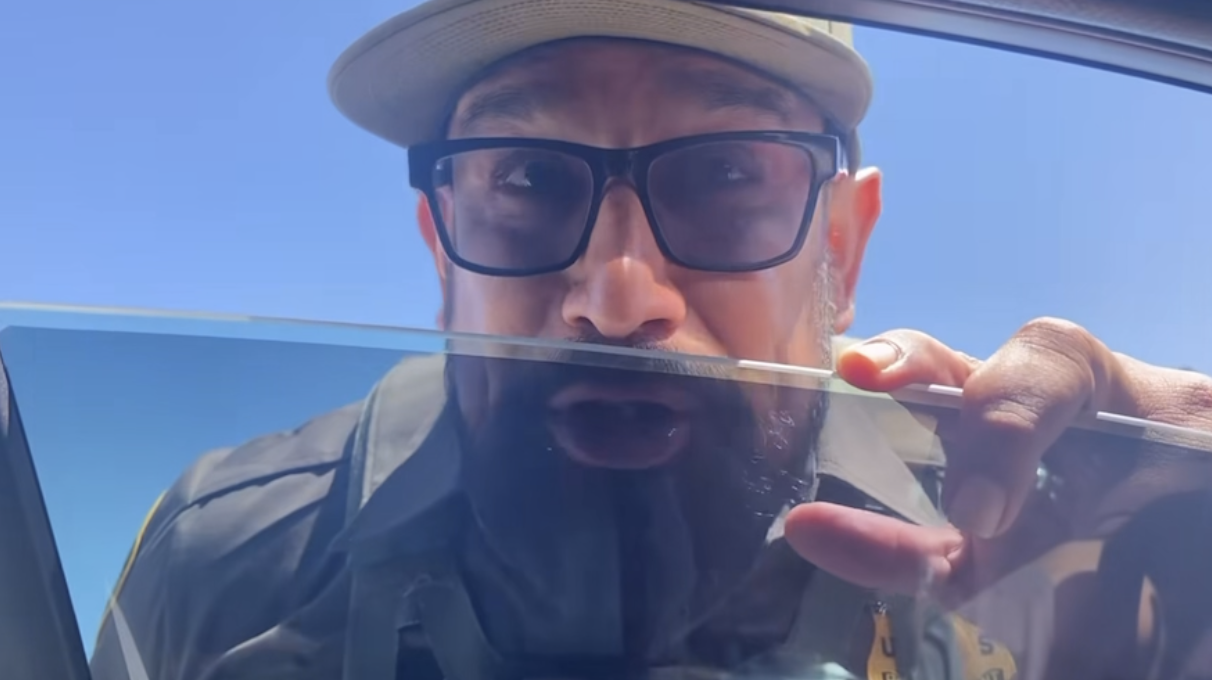
Whether a masked man may just smash your car window and drag you out, screaming, then use an alleged warrant to take you for expedited removal, as we’ve seen in some cases.
Or if loudly and clearly expressing your Constitutional rights might put the breaks on a detention, as we’ve also seen.
Regardless of an uncertain fate, you can’t attempt to use your rights if you don’t know what they are. And how they are supposed to protect you against a forced abduction, search, or seizure when being pulled over or stopped in Los Angeles. In the hopes that this could save you from disappearing, we’ve put together this guide, using information provided by the ACLU.
The Fourth Amendment of the U.S. Constitution affirms the right of people to be kept safe from unreasonable searches and seizures, be it their own persons, houses, papers, or belongings. Warrants for searches can only be obtained with probable cause and must specify the place that will be searched, along with the items and people targeted for search and seizure.
Currently, our federal government is asserting the power to conduct warrantless searches, provided the search occurs within 100 miles of a U.S. border. Federal law says that U.S. Customs and Border Patrol (CBP) agents can board vehicles and vessels in the hunt for undocumented people, “within a reasonable distance from any external boundary of the United States," including international land borders and the entire U.S. coastline.
REASONABLE SUSPICION VS. PROBABLE CAUSE
These terms may seem similar, but they are distinct and are vitally important, as both can serve as the legal basis for why you’re being stopped, pulled over, searched, or detained. Knowing the difference can also be an important part of any future legal defense when facing federal charges.
Reasonable suspicion means that a reasonable individual would suspect a specific crime is being, has been, or will be committed, based on articulable facts or circumstances (as opposed to an anonymous tip). If an agent has a reasonable suspicion, for example, they see someone who fits the description of a sought-after individual, they have the right to frisk your person for weapons and briefly detain you without a warrant. They do not have the right to search you or your vehicle, unless you are on school property.
Probable cause is held to a higher standard, in which a reasonable person would believe a crime is being committed, has been committed, or will be committed based on specific evidence. It is not based solely on suspicion. Probable cause legally justifies a warrant for search or arrest, as in a case where an officer or agent witnesses a crime in the process of being committed or finds evidence of a crime having been committed.
If You're Pulled Over
If you’re stopped and pulled over by one of CBP’s “roving patrols,” the agents are required to have reasonable suspicion that the driver or a passenger has committed an immigration violation or a federal crime, as per the Supreme Court.
The basis for this determines which line of questioning the agent is allowed to take. You are allowed to ask why you are being pulled over. The questions should be limited to those covering the basis of their suspicion. Any questions outside of that are a sign the stop is being prolonged, which requires probable cause; in this case, you should ask the agent what the probable cause is and be told.
If you have immigration documents that prove you’re where you’re legally supposed to be, go ahead and show those.
In either case, you should assert your right to remain silent when it comes to any questions. If the agent is detaining or arresting you or another passenger, politely insist on seeing a lawyer before answering any questions about immigration or anything else, until you are in the presence of an attorney. This applies to the driver and any passengers.
If ICE detains you, you still have the right to consult with a lawyer; however, the government will not be required to provide one. Here is a list of pro-bono and low-cost attorneys you should be familiar with.
Being questioned by federal agents or police is a very stressful situation. It’s tempting to consent to a search or answer questions in the belief that doing so will get you out of the situation, when in fact, answering questions or consenting to a search can make it much worse.
Remain as calm as possible. Although the burden is not on you to de-escalate or control the situation, but on law enforcement. Never lie, run, resist, present a fake document, or obstruct an agent or officer from their duty. Always remember, it is your right to remain silent until you have an attorney, and you never have to consent to a search.
At a Checkpoint
Permanent and tactical checkpoints have appeared on both major and smaller U.S. roadways. They may be operated by agents with dogs, and they may be covered with cameras. You may be stopped and questioned about your immigration status, which is entirely legal for federal agents to do at these checkpoints without suspicion or probable cause, as well as a visual inspection of your vehicle. Never run away or try to flee from a checkpoint, as this is a felony that could result in imprisonment.
You have the right to not say anything, except to politely tell the agent questioning you that you prefer not to answer any questions and will not answer questions without having a lawyer present. This is likely to result in a secondary inspection of your vehicle and further questioning. You still do not have to answer questions and have the right to remain silent.
If the agent holds you for an extended period or asks you questions not related to immigration enforcement, he or she is required to have reasonable suspicion that you’ve broken an immigration or federal law, in order for their holding you to be legal.
If the agent questioning you seems to be holding you beyond a brief questioning, you can ask them if you’re free to leave. If they say no, they need to have reasonable suspicion. You may ask them to explain their basis for the reasonable suspicion.
To detain or arrest you, or to search your belongings or vehicle that they can’t see from where they’re standing, the agent must have probable cause that you violated a federal or immigration law for your detention. You may ask them to explain their basis for probable cause.
On a Bus or Train
In practice, CBP agents have boarded buses and trains, both at stations and while in transit, asking passengers about their immigration status and requesting to see their documents. You are not required to answer any questions asked of you, no matter how you’re made to feel or what orders are given to you. You do not have to answer questions about your immigration status.
You have the right to stay silent. Be as polite as possible and express that you wish to remain silent. Your silence is not incriminating, nor is it cause for suspicion or a search of you or your stuff. Your silence may lead to more questioning, but stay strong and remember your right to stay silent if you choose.
If the agent continues to ask you questions despite your silence, you may ask, “Am I being detained?” Or “Am I free to leave?" To detain you, the agent needs reasonable suspicion that you have committed an immigration violation. If you’re not being detained, you are free to go. If an agent is detaining you, you may ask why, and they should tell you. Staying silent is your right and the best way to stay out of trouble.
Tell the agent you will only answer questions with an attorney present with you. This is your right whether you are undocumented or a fully documented U.S. citizen.
You have the right to refuse an arbitrary search of your person or your belongings and do not have to give away this right. The Fourth Amendment protects you against unlawful search and seizure, even within 100 miles of the border. An immigration agent is prohibited from searching you without your consent or probable cause. You have the right to say “no” when asked if an agent can search your body or belongings.
Immigration agents are prohibited from arresting you without probable cause. Probable cause means they have facts about you that tell them you have violated or are violating immigration or federal law. Your silence, protected by the Fourth Amendment, does not count as probable cause.
*One exception: People with permission to be in the U.S. for a dedicated or specific reason, most likely for a temporary, finite period of time, such as those who are nonimmigrants on a visa, are required to disclose information about their immigration status when asked. You can still express your right to remain silent, but could face legal penalties, including arrest.
If you are asked about anything else, including crimes such as drug possession or smuggling something over the border, they need to have reasonable suspicion to detain or remove you from the bus or train. This cannot be just a “feeling” they have, but they must have specific facts leading them to believe you’ve committed a crime or violated a law, be it an immigration or federal law. An agent should tell you why you’re being detained.
Expedited removal, in which a person is sent back without standing before an immigration judge, is intended to apply only to individuals who have entered the U.S. without inspection by an immigration official within the preceding 14 days, or within 100 miles of an international border or coastline, and meet other specified criteria. If you don’t fit that criteria or fear that being sent back to your country of origin endangers you, inform the agents immediately.