

Skip to Content
People

Meet the Legendary Chicano Mortician Behind 1-800-AUTOPSY Who ID’d the Night Stalker

The dude also protested during the Chicano Moratorium and created an iconic art piece representing East Los Angeles.

1:13 PM PDT on July 27, 2026

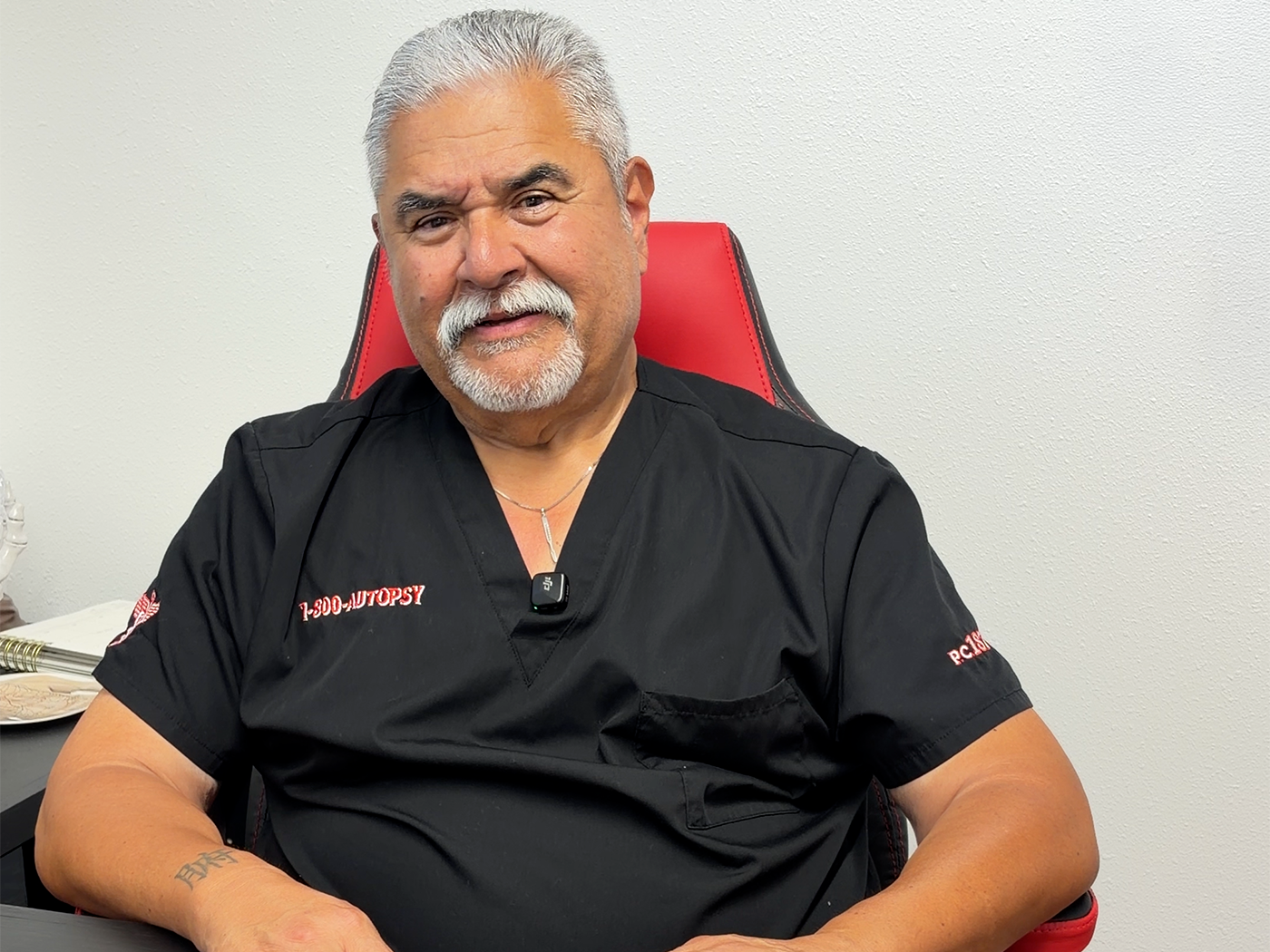
a man sits in scrubs that say "1-800-AUTOPSY"

Vidal Herrera, a private medical investigator. Photo via interview recorded by Erwin Recinos for L.A. TACO.

L.A. TACO met with medical investigator Vidal Herrera, 74, at his headquarters, discreetly tucked away in El Sereno. Entering through the gates, we found ourselves surrounded by beautiful copper sculptures, while a back fence was lined with barbed wire and copper figures of male torsos.

Towards the gate, a large graffiti mural read, “1-800-AUTOPSY.”

Herrera’s long rap sheet as a medical investigator spans from identifying the corpse of “the Night Stalker” to creating coffin furniture for the vampire series “True Blood.” In addition to Herrera’s corpse-flaying skills, his hobbies include showcasing a bright red 1946 Studebaker as part of a lowrider club and painting, as seen here in his famous illustration detailing East Los Angeles.

Herrera’s roots are solidified in Los Angeles’s soil, having ancestry going back to the Mexican-American Repatriation Act, an operation during the Great Depression that targeted people with Mexican ancestry, including United States citizens, to deport them to Mexico. Over a million people were deported, and it is estimated that at least 60% were citizens.

“My grandmother, my grandfather, my father, my uncle, and my two aunts. All born here at General Hospital,” Herrera tells L.A. TACO. “They were rounded up at the Plaza De Cultura on Olvera Street. They were taken by train, forced to Juarez, Mexico. My uncle was killed while he was there.”

He says that the deportation operations that occurred on June 6, 2025, mirror those that impacted his family years ago. Last year, Border Patrol raided Ambiance Apparel, more than a mile away.

“It was a reenactment of what they did back then,” he says. “But everybody forgot about it. While my family was forced to relocate.”

Herrera says he has tried to exhume and repatriate the skeletal remains of one of his young cousins who died during these deportations, but that is currently at a standstill.

He says this relocation caused many rifts and separations, so much that he still discovers cousins he didn’t know existed. He describes how he found out at a funeral that Lupe Ontiveros, who played Yolanda Saldivar in the movie “Selena,” was his cousin.

Herrera tells L.A. TACO that his upbringing was far from perfect. 

When he was very young, his father abandoned his family. When he was roughly four-and-a-half years old, medical doctors believed that his mother had contracted tuberculosis amid a major outbreak, leading to her quarantine and placement in a sanatorium in the Valley. Because of this, Herrera was placed in a foster home for two and a half years in Boyle Heights.

“It was sad, difficult. We were punished daily. They hit our hands if we spoke Spanish,” he says.

The husband of his foster family was a carpenter. After laying concrete, the family began building a new floor, and made Herrera sleep in that empty area overnight, alone. 

Herrera recalls an instance where he walked over to his grandma's home, near the neighborhood in which he was fostered, seeking to get away from the abusive household 

When he walked to the doorstep, he was crushed by the striking words he heard: “You don’t live here. Go back.”

“At that time I was almost seven years old. I was scared. I walked back,” Herrera says.

He returned to the nightmare home only to discover police officers around it. Herrera tells us he jumped over a fence into his Japanese neighbors’ yard and fell asleep in their vegetable garden. When he awoke, he went back to the cold and gloomy concrete flooring where the family found him and interrogated him, telling him that they called the police to search for him.

He told the foster parents that Godzilla took him.

They also had a son with polio and metal braces on his legs, while the father had a drinking problem, and would beat Herrera’s older brother, Pete, out of jealousy of his able body and capability of walking, he says.

Herrera also describes a harsh tale of sexual abuse by one of the older female foster children. And says he was not the only one, before relating the story that her deceased body was found outside in another neighborhood, multiple needles punctured throughout her body. 

“Like a voodoo doll,” he says.

After being removed from the home eventually, he was able to reconnect with his mother and live with her in Echo Park.

After that, Herrera was a student at Belmont High School in Westlake, and a participant in the High School walkouts during the late ‘60s. 

On March 5, 1968, he joined in the massive, almost 2,000-student walkouts, known as the “Blowouts” in East Los Angeles, a coordinated protest over inequality in the educational conditions for high school students in the area.

”Sal Castro was our teacher. He taught us, back then, to believe in ourselves. So, at 10:00 a.m. simultaneously, eight high schools decided to walk out,” Herrera says. ”That was the day we became Chicanos.”

Castro’s leadership in the walkouts was a pivotal moment for all Chicanos. The Blowouts remain among the largest walkouts in United States history. This would not be the end of the Chicano Movement, but a continuation.

Herrera says that after finishing high school, he moved out of his home, which he calls “one of his biggest mistakes.” 

“1970, August, when they killed Ruben Salazar,” he says. “We were there protesting at Laguna Park. We got tear-gassed and went over to Whittier Boulevard, and then he got killed. They had a riot. We were all there when it happened.”

Salazar was an award-winning Latino journalist. On August 29, 1970, Salazar was resting inside the Silver Dollar Bar on Whittier Boulevard and La Verne Avenue. A deputy sheriff fired a tear gas canister into the building, hitting Salazar and killing him instantly.

”Chicanos started protesting the Vietnam War,” Herrera tells us. “A lot of the inductees were Latinos and Blacks. As well as the fatality rate. My brother, he was in the Marines. My other brother was in the Air Force, my cousin was in the Navy. At that time, I had other cousins who were always running away, so they used our address as a source of residence.”

Herrera says he wasn’t drafted. He never understood why until he saw the movie “Saving Private Ryan” and discovered it was because he was the fifth man in the household.

Herrera graduated with a GPA of 1.9 in 1967 from Marshall High School. During this time he was a dishwasher at a pizza shop in Silverlake.

“There was a part-time bartender. His name was Roger Andres,” he says.

Roger was given a draft notice, but his father took it up to the higher courts to dispute the order, and was successful.

“He didn’t have to serve the military, but he had to serve four years of civil service . . . they placed him in the worst place possible, the county morgue.”

While working at the restaurant, Andres would tell the young staff to go to college if they wanted to make more money.

“People don’t understand the reality of the time,” he says. “If you were Black or Latino you had no future. The majority of the people being drafted were Latinos and Blacks. The fatality rates were larger. In school they didn’t direct us towards college. We were going to be laborers, they had shops, welding, wood, carpentry. I was washing dishes. My dream was to open up a diner.”

During this time, he was waiting to be drafted, an apprehensive fear that would never materialize, while the owner of the pizza shop moved to Australia amid the draft. 

“He was gone. Everyone was leaving,” Herrera says. “At this restaurant, I saw people coming in waves from the Midwest and East Coast. They all wanted to come to California because of the Summer of Love. Society was changing.

Herrera says he also took part in this pivotal shift, hitchhiking up and down to San Francisco for a year. After he returned to Los Angeles, he told himself, “I gotta do something with my life.”

A graffiti mural outside medical investigator Vidal Herrera's lab. Photo by Izzy Ramirez for L.A. TACO.

This was when the East Los Angeles Occupational Center opened. Herrera applied and got a job. 

“They placed me in a men’s psychiatric unit and they had me at bedpan,” he says. “They said I was going to clean a guy up, and I said ‘no, I’m not going to wipe anybody’s ass.’” 

Herrera says he believed he was going to wheel patients around, and was moved to the X-ray department after refusing to stay in psych.

He was then transferred to the county morgue, he says he met with people from the coroner’s office who notified him about a new training program he can volunteer in. 

He says after working in the X-ray department he was transferred to a women’s hospital as a float, performing multiple positions. “Emergency intake. Information desk. Abortion clinic. Labor and delivery, and then eventually in the central supply where you sterilize the instruments.”

Herrera’s dance with death finally began, he was 23 and volunteering under famed Los Angeles County Coroner Dr. Thomas Naguchi, a prominent name who was given the responsibility of determining the cause of death for high-profile figures including Marilyn Monroe, Robert Kennedy, Natalie Wood, Janis Joplin, John Belushi, as well as historical figures, such as Ruben Salazar.

It took two and a half years, working 20 hours a week, to become an autopsy assistant. He then landed a role as an in-house crime scene photographer, before being named a deputy medical investigator, one of the first Spanish speaking people to do so.

At the time, Herrera says he was the only Spanish-speaking medical investigator, meaning he was given more cases. 

At crime scenes, Herrera says that community members who recognized him and knew he spoke Spanish would ask officials to speak with him. 

“Queremos hablar con el senor con los muertos,” meaning, “We want to speak with the man with the dead.” He says this sparked a nickname, “El Muerto.”

“I developed a trust with the Latino community, as well as the funeral homes,” Herrera says.

His two-year trajectory came to a harsh stop in 1984 during a suicide investigation, when he suffered a serious back injury while lifting the body, causing partial paralysis. 

Herrera suffered through intense physical therapy. Not only did this incident leave a dent in his career, but it also drove him to suicidal ideation. He only escaped this one night after hearing the cries of his infant son as he stuck a gun to his own head. 

Before Herrera’s injury, there was a specific case that he could forget about that, unbeknownst to him, would lead to the identification of Richard Ramirez, aka “the Night Stalker,” who terrorized Southern California for over a year with brutal serial murders.

Herrera says the case was unexpected, he happened to be in the same neighborhood after being dispatched to Fletcher and Glendale Boulevard for a motorcycle accident with a man who was decapitated by a mile marker, head still inside his helmet.

After collecting the body, he called in, saying he was going to lunch, then took a visit to the Dinah’s Chicken in Glendale on San Fernando Road and went over to a friend’s house to eat. After eating his macaroni and gizzards, he was given a new address, just two blocks away. 

Herrera dashed over, lifted up the yellow caution tape, and was met with a reporter who asked him, “What do we have here?”

“I understand . . . there’s a dead person here,” he said. “You probably have more information than me.”

Upon entering, he says the homicide detective on scene spoke to him, asking where he had been. The detective said they had been on scene for seven hours. The victim was an elderly woman. Butchered.

After a short conversation, Herrera says he was asked if he could just collect the body so they can leave. He refuted, stating he has his own investigation to do and needed to do his job.

“Two days prior, I had just returned from the Armed Forces Institute of Pathology in Maryland. They were training us for fingerprint identification and trace evidence. So I took my magnifying glass, and because of the way they treated me, I decided to milk it. Took my time,” Herrera says.

Vidal Herrera's ride. Photo by Izzy Ramirez for L.A. TACO.

He says he was in the residence for six hours. After wrapping up and preparing to leave, he noticed a smudge on a window; a print.

He asked a fingerprint technician on scene to please lift the print, and they answered, “You don’t tell me what to do.”

So he walked to his van to radio a supervisor, Eddie Day. After a series of calls to a medical examiner, who called the chief of police, who called the chief of robbery homicide, they told the fingerprint technician to lift up the print.

Herrera says he was then dispatched to pick up the body of an overdose at Burbank Community Hospital.

“I had three cases [in] one day. Again, that was not uncommon for me… to me it was just another homicide,” he says.

At the time, there were at least 10 active serial killers, Herrera claims. 

“The Night Stalker was just one of them. We had a lot of experience with homicides. Brutal murders. Sexual assaults. This was an elderly woman,” Herrera says.

30 days later is when Herrera had his tragic incident.

“I was attempting to remove the body of a suicide victim in Temple City. Gunshot wound to the head. She actually had a notorized suicide note lying next to her,” he says.

He says the sheriffs refused to help him. After calling in, he was told to do the best he could.

He ruptured three disks in his spine, he was retired in 30 days. 

“It took me three and a half years to regain my ability to walk,” he says.

He says about six months after his incident he received a knock on his door. It was LAPD.

They were there to congratulate him and also apologize, asking him if he remembered a print from an old case. He says because of recovery he was in pain. “I was literally addicted to pain medication, I was perspiring. I said no, I don’t remember”

After his memory sparked and he remembered the butchered elderly woman in Glassell Park, he asked, “What about her?”

“They identified the perpetrator 10 minutes ago,” he says. “He was arrested.”

Herrera says months later, sheriffs escorted him to testify in court. One of 14 murders.

He says he could not even sit up and waited in the district attorney's office by laying on a table, he was wheeled in to testify.

“As I was testifying, Richard Ramirez was staring at me,” he recalls. “He took off his glasses to try and intimidate me. I just winked at him.”

Herrera affirms, “It was just another case. Nothing unique about it. Didn’t move me in any way. I was just doing my job.”

Herrera is thankful that, after his injury, he was given a new position at the VA West La Medical School as an agent facilitator to help teach first year pathology residents how to perform autopsies.

While he was there, The National Neurological Research Specimen Bank would send Herrera to funeral homes to remove brains, spinal cords, and relevant body parts for research. He says he was recognized at these funeral homes from his investigator role.

“They’re the ones who referred families to me, and that’s when I started 1-800-AUTOPSY. That was 40 years ago,” he says.

Aside from his skill at flaying open a corpse, Herrera has also created various art pieces, straying from the macabre.

Herrera says his famous painting of East Los Angeles erupted out of frustration. On the 40th anniversary of the Chicano Moratorium in 2010, an event was scheduled at a park; he expected thousands of people to show up in East Los Angeles. He went over with his wife to find almost no one there. Just 10 people.

One man was present with a table showcasing photos of the massive walkouts, with a group of young men unfortunately antagonizing him, leading to a short altercation with Herrera.

“Young men, this was a historical event for Latinos,” Herrera recalls telling them.

The words would not get through.

“They all had skateboards; they were approaching me aggressively. And since I’m a retired peace officer, I took out my gun,” Herrera says before they walked away.

On his way back to the train to head home, his wife reminded him about a friend named Sal, who spoke to them once about how “Mexicans don’t vote. They don’t read, and they don’t give a shit. That’s why nothing's ever going to change.” 

The reminder of those words was like a knife in his heart.

On the Metro, a group of kids had a boombox that just happened to be playing "Shades of Gray" by the Monkees, a song about the age of innocence, specifically during Herrera’s era. This sparked his desire to create the mural representing East Los Angeles. It took two years to make. 

Art by medical investigator Vidal Herrera. Photo by Izzy Ramirez for L.A. TACO.

After rejecting some offers from gallerists, he sent free copies to each person who was included or inspired in the art. Soon, he was getting calls left and right to sell the posters, kicking off a new side hustle.

Another famed art project of Herrera's is his infamous coffin couches. We spoke with him about how this concept came to be.

“I rented a lot of equipment from many of these shows, like CSI shows, horror films. I did consulting on those.”

He explains that at the conclusion of one of these shows, there was a wrap party he was invited to on Hollywood and Las Palmas.

He said the set directors had seen many of his coffins, and one day they cut one up for a set. He was asked by one of these directors if Herrera is able to convert one of these into a couch. Herrera says yes, it’s doable.

He then describes how these directors showed up at his front doorstep a week later asking for the couch.

Herrera responds, “What are you talking about?”

“You promised us a coffin couch,” a director said.

“I didn’t promise anything. You asked me a question; I said it CAN be done,” Herrera says he explained.

After they stated their urgency for the couch, Herrera went down to a neighbor who does upholstery and to a welder; he put the couch together with them and dropped it off at Paramount Studios, and it was later used for the fantasy horror drama series True Blood.

Herrera says he was asked if he ever sells these. He thought the idea of selling them was comedic. “Who would want to buy these?”

It was then explained that taking it to a goth show in Burbank would be a good idea to showcase the couch. After Paramount Studios allowed him to take the couch, he took it to the show, and it became a huge photo-op. After he returned it to the studios, he says staff told him he now has six orders.

“That’s how it started. I ended up making about 120.”

Herrera says he gave away most of the profit to local organizations, schools and colleges for free tuition.

“For me, you have to give back to the community.”

He says that after a Chinese company began selling the same couches, that business slowed. He no longer makes them.

Recently, Herrera has set out on a new venture. After the Trump Administration ordered that hospitals are no longer obligated to conduct autopsies, there has been an overwhelming need for funding and help in “deathcare.”

It all started with the murder of 14-year-old Celeste Rivas Hernandez, a teenage girl who was allegedly killed by singer/songwriter David Anthony Burke, known professionally as d4vd. Hernandez’s dismembered body was discovered on September 9, and an autopsy was performed on September 10.

The autopsy report was not released for seven months and 15 days, Herrera says. The day it was released, he says that a news outlet reached out to him as a source to help interpret the autopsy.

Herrera says the deathcare industry includes medical hospitals, medical examiners' offices, researchers, tissue procurement, hospitals, and the private sector. He happens to work in the private sector.

“When they call me for an opinion, I make it perfectly clear to them, number one, I’m not a doctor . . . I never profess to be anything that I’m not,” Herrera says.

He interpreted the autopsy report without compromising any of the work that’s already been done. The report was 28 pages long. Because of the time it took to get the report out, he says he called a friend at the local coroner’s office out of sheer curiosity to ask how many autopsies had been done during that period of seven months and fifteen days and for the full details.

The back of Vidal Herrera's lab. Photo by Izzy Ramirez for L.A. TACO.

“How many homicides? How many suicides? How many accidents? How many gunshot wounds? How many sexual assault cases? How many pathologists do you have? How many morgue attendants do you have?” Herrera asked.

Herrera says the number was staggering.

The day Celeste's report was released, the Los Angeles County Chief Medical Examiner’s office completed 4,230 autopsies between September 9, 2025, and April 24, 2026. 

Vidal says the National Association of Medical Examiners (NAME) recommends that a forensic pathologist perform no more than 250 autopsies per year to maintain quality standards, with an absolute maximum of 325 to retain office accreditation.

Based on these figures, in 2025 the LA County Medical Examiner’s pathologist individually performed a “staggering” 889 per year. NAME also recommended that the number of autopsies forensic pathologists perform should be limited to around 250 to allow for administrative duties, such as testifying in court, per year.

During Donald Trump’s first presidential term, he eliminated the federal mandate for hospitals to perform autopsies as a condition of participating in Medicare.

Herrera has made it his recent mission to present his findings to help overturn this mandate. 

“I’ve been in this vocation for 50 years,” he says. “I've had my company in the private sector for 20 years. I’ve assisted in over 20,000 autopsies. The hardest blow and the hardest injustice to the public was September 25, 2019. No warning. Nothing. Trump decided to eliminate the autopsy, completely, nationwide. Hospitals are no longer required to do them, and they’re not. This caused a huge burden on all medical examiner systems and coroner systems in the country.”

Los Angeles is recognized as having one of the busiest medical examiner offices in the world.

Herrera explains that during the COVID pandemic, this order caused a huge rift. Hundreds of bodies went through the medical examiner’s office. Nonstop. 

Herrera says he will be conducting a presentation with various chambers in the industry detailing a crisis in lack of funding for what he calls the “last responders,” medical examiners, pathologists, medical investigators, and the influx of bodies coming in after the removal of the requirement for hospitals to conduct autopsies. 

Stay in touch

Sign up for our free newsletter

More Stories

Los Angeles Holds Funeral Procession for Recent ICE-Related Deaths

Various organizations and volunteers gathered at Los Angeles City Hall for a funeral procession to Placita Olvera in memoriam for the people who have died due to ICE detention, post-deportation, and ICE-related shootings under the second Trump administration.

July 26, 2026

Sunday Taquitos #30: Flock This!

Sunday Taquitos! Art by Pulitzer Prize Finalist Ivan Ehlers.

July 26, 2026

Scoop: Former L.A. Sheriff’s Deputy Sent Dick Pics To ‘Vulnerable’ Women That He Met While On Duty

A criminal case for “misdemeanor sexual battery” was presented to the Los Angeles County District Attorney’s Office. However, “the case was declined due to insufficient evidence,” a spokesperson for D.A. Nathan Hochman tells L.A. TACO.

July 24, 2026

10 Rising L.A. Directors You Need to Follow

From local short film screenings to Sundance Film Festival, these are the city’s emerging directors keeping the industry alive.

July 24, 2026

Get These Smoked Guinness Chili Burgers For One Day Only In Boyle Heights

The chili is made with Guinness Extra Stout, fire-roasted chiles, chipotles en adobo, spices, dark chocolate, and a beef ball that is smoked over the chili, allowing its fat to drip into the pot, before the meat is folded back in.

July 24, 2026

The Country’s Most Famous Strip Club Hosted Its First Trans Night and We Were There

This wasn't a queer venue making room for trans performers—that already exists. This was one of the country's most recognizable strip clubs deciding that supporting trans dancers is just . . . normal.

July 24, 2026