

Skip to Content
Taco Members Only

Meet Mid-City L.A.’s Third-Generation Oaxacan Baker, Who Still Makes Traditional Hand-Drawn Pan de Muerto

As an increasing number of Dia de Muertos fans begin to build their altars this year, establishments like this bakery, owned by a third-generation panadero, still makes pan de muerto the painstaking hand-drawn way, making it as crucial as ever in Los Angeles. 

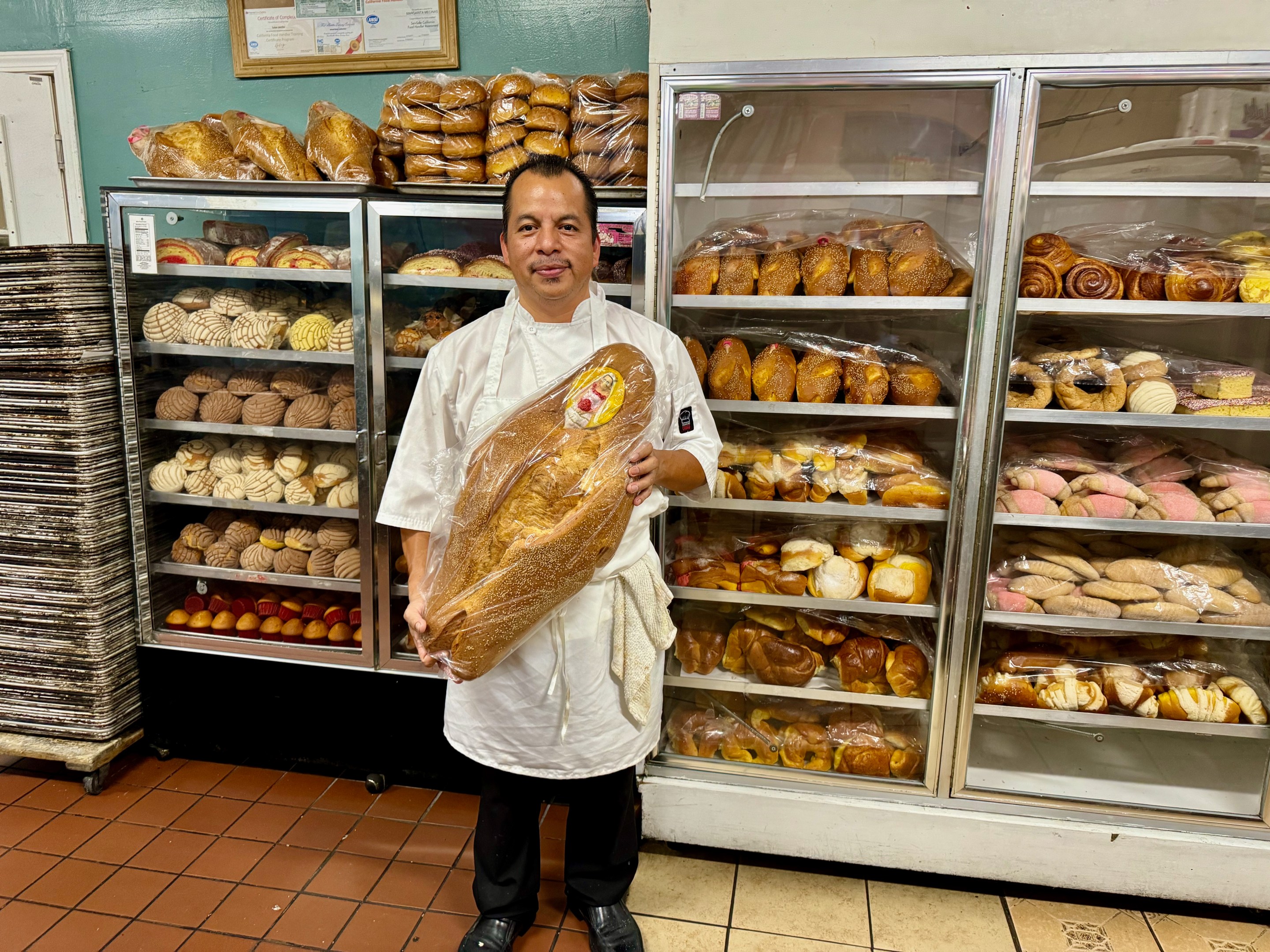
Sinecio Mecinas holding up his pan de muerto. Photo by Javier Cabral for L.A. TACO.

Sinecio Mecinas holding up his pan de muerto. Photo by Javier Cabral for L.A. TACO.

Thirteen colorful caritas (faces) etched on hardened corn masa look up at 48-year-old Sinecio Mecinas as he adds the finishing touches on the first batch of this season’s pan de muerto.

The smell of freshly baked, egg yolk-enriched dough is dense inside his cramped bakery, which is incorrectly labeled “Venice Bakery” on Google, but is really called “La Yalaltequita,” an homage to the small mountain town in Oaxaca’s Sierra Norte where he comes from.

Mecinas is crouched over, carefully drawing ornate designs on his pan de muerto. His colorful outlines on the human-shaped dough figurines resemble something between papel picado and huipiles; every design he makes is unique.  

Sinecio Mecinas' hand drawn pan de muerto at La Yalaltequita. Photo by Javier Cabral for L.A. TACO.
Sinecio Mecinas holding a tray of his pan de muerto at La Yalaltequita.
Sinecio Mecinas with his pan de muerto at La Yalaltequita. Photo by Javier Cabral for L.A. TACO.

The bakery is a bonafide L.A. strip mall gem that sells tortillas made from nixtamal—they ranked high in Gustavo Arellano’s Tortilla Tournament—as well as traditional Oaxacan dishes, available through counter service. It also offers dozens of other varieties of pan dulce.

In the first week of October, however, it’s the calm before the Muertos storm. Every week leading up to Dia de Muertos, Mecinas will sell dozens of his traditional pan de muerto that many Oaxaqueños use in their altars.

“Ya se siente el frio de los muertos,” he tells L.A. TACO, using a popular expression that Oaxacans use, as the summer season transitions to the colder Dia de Muertos season. ("You can already feel the cold of the dead.")

Hand-painted pan de muerto at La Yalaltequita
Pan de muerto at La Yalaltequita. Photo by Javier Cabral for L.A. TACO.

Mecinas’ oblong pan de muerto, with hand-painted art, or those masa caritas, are unlike most of the circular pan de muerto found in every other bakery, covered in sugar and topped with a symbolic “skull and bones” X-formation.

The dough is similar, lightly perfumed with crushed anise and cinnamon, but Mecinas' style is more like the pan de muerto you'll find in Oaxaca. He also makes medium-sized, and an extra jumbo pan de muerto that's about the size of a two-year-old child.

Mecinas is originally from Hidalgo Yalalag, where residents speak a Zapotecan dialect more commonly than Spanish. The small municipality is located three hours south of Oaxaca City. The baker recounts one of his biggest challenges in leaving his hometown.

“Learning Spanish is one of your biggest struggles when you leave the pueblo," he tells L.A. TACO. "It’s not our first language, but you learn fast here while you work.”

Pan de Muerto from Panadería La Yalalag
Pan de Muerto from Panadería La Yalaltequita. Photo by Javier Cabral for L.A. TACO.
Pan de muerto on the racks at La Yalalag Bakery.
Pan de muerto on the racks at La Yalaltequita Bakery. Photo by Javier Cabral for L.A. TACO.

Like many Oaxaqueños who moved to Los Angeles, lovingly called “OaxaCalifornia,” he found work among L.A.’s vibrant Oaxacan food scene. He started as a dishwasher, but only worked as an employee for four years before saving his money and risking it on his small business opportunity at La Yalaltequita, carrying the baking legacy of his parents and grandparents to his new home. 

La Yalaltequita is a bonafide strip mall gem in Los Angeles. Photo by Javier Cabral for L.A. TACO.

His son, Jeffrey, has shown interest in the family business, following in his father’s footsteps and starting to work with him.

“Since I was a kid, my father always brought me and my siblings to work, and I remember I used to put on a small apron to help my father," says Jeffrey, who oversees the bread and tortillas while Sinecio manages the restaurant. "I’m grateful for my father for maintaining this bread-baking tradition. It’s our roots. It makes me so proud to keep my family’s legacy alive."

As more Dia de Muertos fans begin to learn how to build their altars this year, establishments like La Yalaltequita, which still makes pan de muerto the painstaking, hand-drawn way, are as crucial as ever. 

1531 Crenshaw Blvd. Los Angeles, CA 90019

Stay in touch

Sign up for our free newsletter

More from L.A. TACO

SoCal Day Laborers Increasingly Targeted By Scams, Wage Theft, and Deportation Threats

"It's not just about always being on alert, but sometimes, if [employers] hire us, they threaten us with ICE so they don't have to pay us," a laborer named José says in Spanish.

January 20, 2026

Sunday Taquitos #11: Rock Bottom

It’s a good question. Sunday Taquitos! Art by Ivan Ehlers.

January 18, 2026

DAILY MEMO: Ten-Year-Old Child, Gardeners, and Vendors, Among the More Than 88 Kidnapped in SoCal This Week

Memo answers the complicated question, “Isn’t it against the law now for ICE to be masked?”

Weekend Eats: ‘Fuck ICE’ Pop-Tarts In Highland Park; Palestinian Movie Night and Falafel Nachos in Watts

While the first taquero to win a Michelin star lands for one night only, Pioneer Chicken pops-up in the Valley, and bone marrow-and-wagyu paella arrives on the Westside.

January 16, 2026

Which Of These 11 L.A. Running Clubs Is Right For You?

There are running clubs across the city for activists, athletes, mothers, food lovers, different skill levels, and those seeking community, as well as a little company on the road.

January 15, 2026

City Council Backs Limits On LAPD’s Use Of ‘Militarized Police’ At Protests, Activists Are Skeptical

The “graded response” model calls for police officers in regular uniforms to be deployed at protests before sending in heavily-armed officers in riot gear and specialized units such as SWAT, if needed.

January 14, 2026
See all posts