Editor's Note: You can read this article in print (!) in the L.A. TACO Post. Copies are available at over 90 locations throughout L.A.
Ronald Reagan’s face is decaying.
Bruise-purple skin sagging. Eyes squirming to the side. Lips wrinkled and puckered like an angry arsehole. The zombie president’s lacquered hair ever-perfect.
Glued to the gray flank of some civic structure between the pun: “CONTRA DICTION,” the image remains imprinted as one of my earliest L.A. memories, our family’s gray Datsun station wagon flying across town.
Like many in L.A., the 80s were my introduction to the wicked work of guerrilla artist Robbie Conal, legendary for spackling the distorted visages of our ghouls-in-power onto the city’s streets.
Conal’s gruesome black-and-white posters of wannabe despots, set deep with creases, plagued grimaces, human rot, and screaming puns, laid these sociopaths bare as the monsters they are, stinging with all the “Me Era” satire of a savage Dead Kennedys song.
A besuited skull before a camouflage backdrop stamped with “CONTRA COCAINE.” Embezzling preachers Tammy Faye and Jim Baker looking syrupy sweet above the words “FALSE PROFIT.” George W. Bush dissolving in an acidic, skull-bobbing sea, trapped in the phrase “PATRIOT INACTION.
If you were too young or bubble-wrapped to know your politics, Conal’s images pierced through, tendering strange proof that not everyone worshiped the mad kings in our land of confusion.
If you were too young or bubble-wrapped to know your politics, Conal’s images pierced through, tendering strange proof that not everyone worshiped the mad kings in our land of confusion.
They let us know that someone was angry about things. And perhaps more importantly, doing something about it.
With art, humor, and fire.
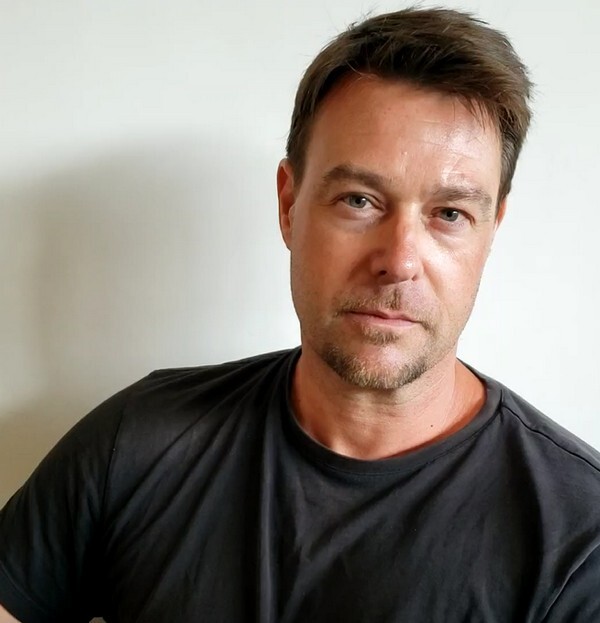
The 81-year-old’s career and infamy span four decades. But he’s been driven by making art since he can remember.
Raised by Communist, union organizer parents on Manhattan’s “Upper Left Side,” he grew up drawing his family’s two Siamese cats and various sports stars. After school, he was “hanging out with Guernica” and political works by Orozco, Rivera, Posada, Daumier, and Goya at major museums.
After graduating from Fiorello H. LaGuardia High School of Music & Art and Performing Arts, Conal landed in Haight-Ashbury in 1963 to attend San Francisco State, devoted to making abstract expressionist works like his heroes Matta and De Kooning and selling weed and psychedelics to pay tuition.
“I was totally cosmic, dude,” Conal kids. “Making art, but not about social and political issues directly. It took me a long time to get my personal issues about politics and social conditions in the world as subjects of my art.”
The Gipper’s election changed everything.
“Ronald Reagan happened,” Conal tells L.A. TACO. “I really felt the need to address these, you know, little issues like ‘democracy,’ little issues like, you know, in what the government was doing to us that I didn't like.”
Conal was kicked out of SFSU for protesting, ending up in Canada to play semi-pro baseball, before returning to the Bay Area to get his MFA at Stanford and subsequently moving to L.A. in 1984.
“Ronald Reagan happened,” Conal tells L.A. TACO. “I really felt the need to address these, you know, little issues like ‘democracy,’ little issues like, you know, in what the government was doing to us that I didn't like.”
In September 1986, as the Iran-Contra scandal dominated front pages, Conal was living in Venice with a collection of what he calls “nasty little black and white oil paintings of Ronald Reagan and members of his cabinet,” which he’d shown at a gallery, but was craving a more public forum for.
Familiar with the history of political street art and postering, he teamed up with the first baseman of his co-ed Mar Vista softball team, a Santa Monica printer by trade, who taught Conal how to make what he calls “this little pathetic poster.”
“I put one word: ‘men with no lips’ under each of the portraits, and broke the piggy bank, and got about 1000 of them, and I talked my best friend into coming out with me in the middle of the night and putting them around the town,” Conal recalls.
He wasn’t afraid of cops, tagbangers, gangs, or legal repercussions, noting, “It's a minor form of civil disobedience, which I totally believe, but also because of my background coming from this family, and their perspective on the capitalist cultural economy.”
Nonetheless, by the time of Contra Cocaine, he’d enlisted a "tigress mother” lawyer who also represented the creators of "The Simpsons" and "SpongeBob SquarePants."
“She took care of me and kept me out of jail. Most of the time,” Conal adds.
For L.A.’s 80s babies, Conal’s art is indistinct from the city we glimpsed it in, repurposing our concrete landscape in the name of resistance.
Conal remembers starting out fairly “green” in L.A. Notably, when he kept seeing signs for “tacos al carbon” everywhere he looked.
“I'm driving around, and I keep seeing all these King Taco establishments,” Conal says. “And ‘taco this,’ and ‘taco that,’ and, and all of them say, you know, like ‘King Taco, Al Carbon, Al Carbon,’ and I'm thinking, ‘Who is this guy, Al Carbon?’”
Nonetheless, Conal feels L.A. played an indispensable role in spreading his work and feelings.
“The Bay Area seems to think it's in France . . . it's like a closed cultural system, so even if I had, you know, produced this art there, there would be very little chance that it would get anywhere else,” he says. “Los Angeles, as far as I'm concerned, is the capital of popular culture production in the United States, if not the world, and so I did have this sense that if I did this in L.A., it would have a larger reach, more distribution, and be paid more attention to. And I think I was right about that.”
Over the last four decades, Conal has made over 100 political posters, with his work featured in major magazines, books, and gallery shows while being praised worldwide.
“People who come out with us in the middle of the night, volunteering for this kind of midnight mischief for the cause,” he says. “I've been pleasantly surprised at how many people actually are willing to do this. It's incredibly heartening.”
For him, the biggest honorifics come from the involvement of his various co-conspirators, including his wife, movie title designer Deborah Ross, photographer Alan Shaffer, as well as untold numbers of volunteers who help to put the art up.
“People who come out with us in the middle of the night, volunteering for this kind of midnight mischief for the cause,” he says. “I've been pleasantly surprised at how many people actually are willing to do this. It's incredibly heartening.”
Conal is also moved by the sheer number of people who see his pieces on the street that he gets to meet and who say nice things about his work.
“Say I’m at the grocery store or something, especially around L.A. I'll get a tap on the shoulder and say, 'You're Robbie, right?’” he says. “‘Yeah, don't hurt me.’”
He continues, ”Something like, what you said to me, is like, ‘I grew up seeing your art on the streets, and you know, thanks for that, because I thought I was the only person who felt this certain way, or whatever.’ So that kind of warms the cockles of my old heart, that it’s actually getting out there, and whatever people think of it, they see it. That's my goal: to express myself in public about these issues that I really care about.”
We ask Conal whether horror movies were any kind of inspiration for his literal murderer’s row of ghastly politicians and power brokers. He wryly replies, “No, the subjects of my art are horrific enough.”
We ask Conal whether horror movies were any kind of inspiration for his literal murderer’s row of ghastly politicians and power brokers. He wryly replies, “No, the subjects of my art are horrific enough.”
Like most of us, Conal is tired of a certain orange blob who runs things, and believes we’re dealing with a different form of bloodsuckers than we were in earlier decades.
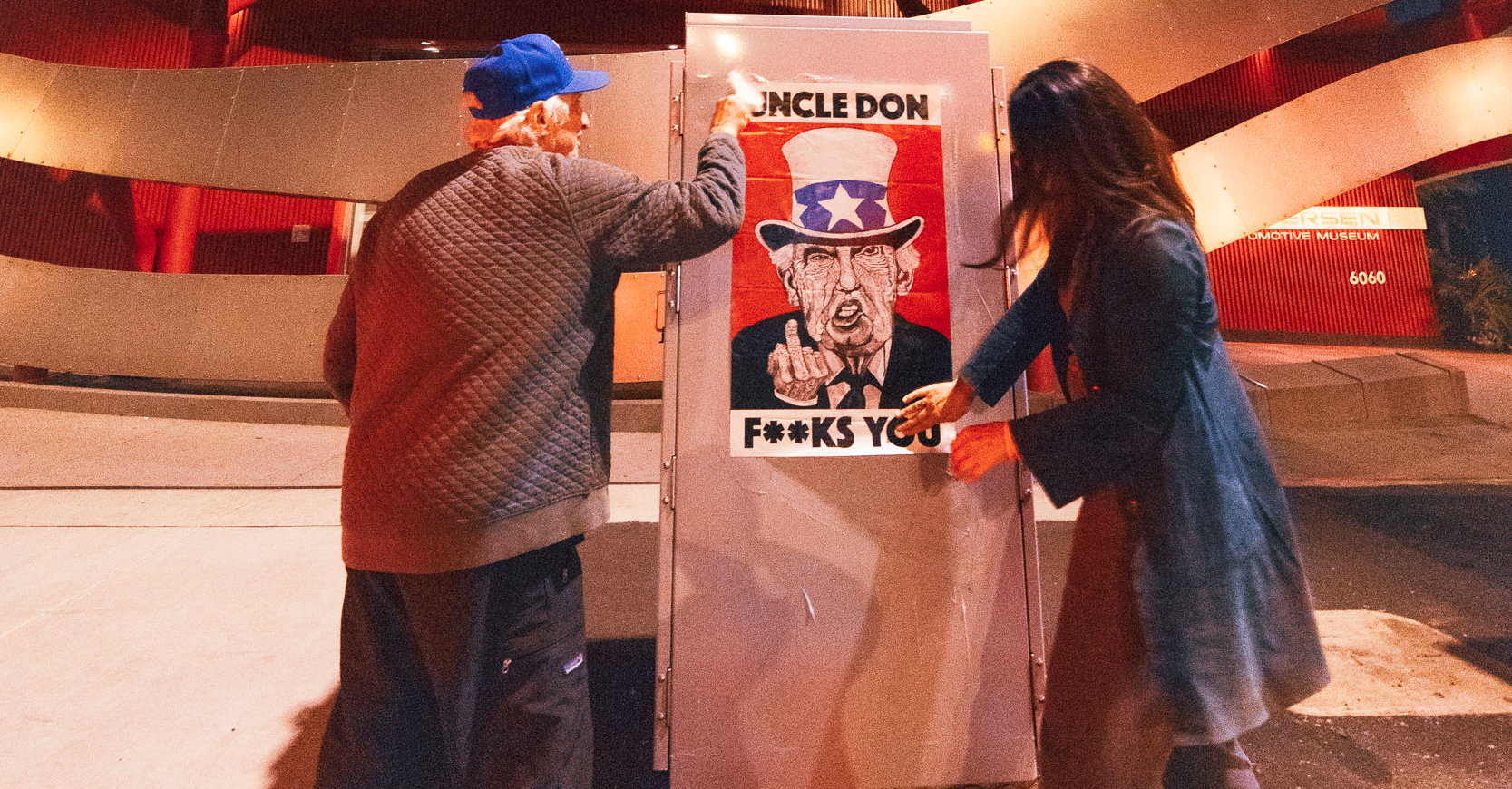
“It's gotten so much worse,” he says. “I woke up at three in the morning a couple months ago going, ‘oh no, I have to do another Trump,’ you know, like, ‘oh my, I've done him, and I don't want to ever do him.’ And I made the angriest poster I've ever made, actually . . . we just put it up in L.A. a bit last Friday night. It's 'Uncle Don Fucks You.'"
The poster features J.D. Vance on the flipside, with the words “Dick Tater Tot,” riffing on an earlier Conal piece calling Trump “Dick Tater.”
Conal isn’t without hope, however. He’s heartened by the rise of politicians like Mamdani, Kiros, and Crockett, and the perseverance of Bernie Sanders, his “brother from another mother.” Nor are all his pieces dedicated to skewering American ghouls.
“Every once in a while, my darling wife will say, ‘you know, everything you do is so negative, why don’t you do, like, something positive?” Conal says.
The exchange led to Conal’s series on inspirational women, including portraits of Angela Davis, RBG, Toni Morrison, Greta, and AOC. He’s also painted the Dalai Lama, MLK Jr., Mandela, Gandhi, Hendrix, and Bob Marley.
“The funny thing is I can't apply all my gnarly, grotesque, corrosive, painterly techniques to these lovely people, right?” he says. “So I have to use a completely different technique for painting wonderful people.”
Conal, who lives in Los Osos with Ross and their two cats, Ella Fitzgerald and Louis Armstrong, has never abandoned hope. There are always like-minded people out there willing to stand up to power. And there’s always the power art has to fire our voices at those who would oppress us.
“The ‘No Kings’ marches are fantastic,” he says. “I have this image of little old ladies sitting, sitting at their kitchen table with cardboard in their crayons, making their handmade posters, and they're fantastic, you know, like they're very creative, they're very lively, and I just love that so much. I'm so heartened by that.”