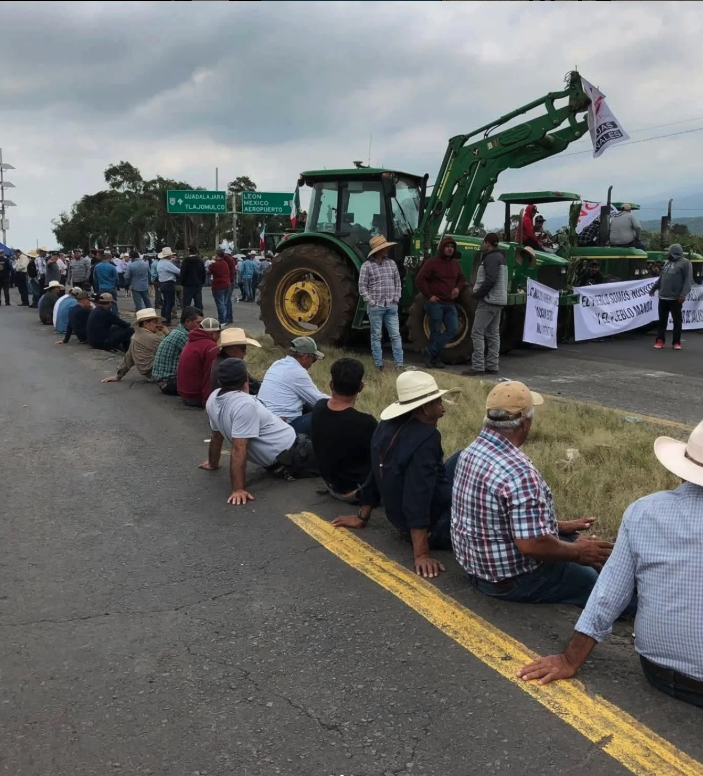
More than 100,000 farmers across more than 17 states in Mexico launched a general strike on October 14, shutting down highways and marching on government palaces from Sinaloa to the state of México.
The dramatic actions—showing farmers at times dumping their limes and avocados—are a direct challenge to president Claudia Sheinbaum's administration, demanding an end to policies that farmers say are destroying their livelihoods.
The movement, organized by the National Front for the Rescue of the Mexican Countryside (FNRCM) and backed by the National Union of Agricultural Workers (UNTA), has one central message:
"Sin Maíz No Hay País" (Without Corn, There Is No Country).
Like many other protests in Mexico throughout the years, they took place on roads meant to strategically disrupt major transit routes. In the state of México, campesinos used their tractors to block the Toluca-Atlacomulco highway but notably allowed free passage to motorists at the El Dorado toll booth—a tactical move to garner working-class public support.
Similar blockades and marches happened in agricultural heartlands like Sonora, Guanajuato, Jalisco, and Michoacán, with many convoys aiming to converge at Palacio Nacional in Mexico City.
The strikers' demands are a direct response to what they see as an existential threat.
They are calling for a fair price for corn: a guaranteed price of MX $9,000 to $12,000 per ton, a significant jump from current rates.
They’d also like the total exclusion of corn, sorghum, and other basic grains from the North American Free Trade Agreement (NAFTA), arguing it's the only way to protect local farmers from a flood of cheaper imports. They’re also demanding a farmers only-government support system for financial credit loans.
While Mexico is the birthplace of corn, its domestic production is failing.
According to the financial trade publication Mexican Business, over the last ten years, Mexico's own corn production has fallen by 4%, while its reliance on imports—primarily genetically modified corn from the U.S.—has skyrocketed by 78.4%.
They are also reporting that the U.S. Department of Agriculture projects this dependency will hit a new record, with Mexico expected to import 25 million metric tons of American corn in the 2025-2026 cycle.
Since the strike has just begun, no word has arrived yet how of how this will affect produce prices in in the U.S.
But seeing how over half of Mexico’s tomato production is exported to the U.S., as well as how so many of us following the taco lifestyle rely on Mexican limes, heirloom corn tortillas upsold to affluent customers at modern Mexican restaurants, tomatillos, and tequila, we’re willing to bet this agricultural strike will inevitably ripple its way out here as well.