

It wasn’t enough that the gringos were driving up the prices of real estate and basic necessities in Mexico City, now they were taking over lucha libre too . . . or at least that’s what some folks were bemoaning last year.
Weeks after people took to the streets to protest the gentrification of various neighborhoods in CDMX, the topic became the go-to argument to explain the many changes occurring in the city, including within lucha libre.
“Wrestling, along with the neighborhoods themselves, is being gentrified and the fight against it is on,” wrote Verónica M. Garrido in El País last year.
Ticket prices were rising, tourists and the wealthy were seemingly being catered to over locals, and influencers took up the best seats to promote lucha libre when World Wrestling Entertainment, the global titan of wrestling, announced their purchase of a controlling stake in Mexican wrestling company AAA Lucha Libre Worldwide.
It’s easy to understand the cries of gentrification under these circumstances . . . but was it actually the case?
“When it comes to gentrification, I think a lot of those comments come from seeing a lot of tourists sitting in the chairs,” says Miguel Castro, business development consultant with Consejo Mundial de Lucha Libre (CMLL). “Well, I think gentrification is when somebody goes into a bar every day and leaves $50 tips on a $50 check, and then the guy at the bar says, ‘Oh, I can start charging three times if this guy is willing to give me this tip.’ That's how you gentrify a neighborhood or a shop or a bar.”
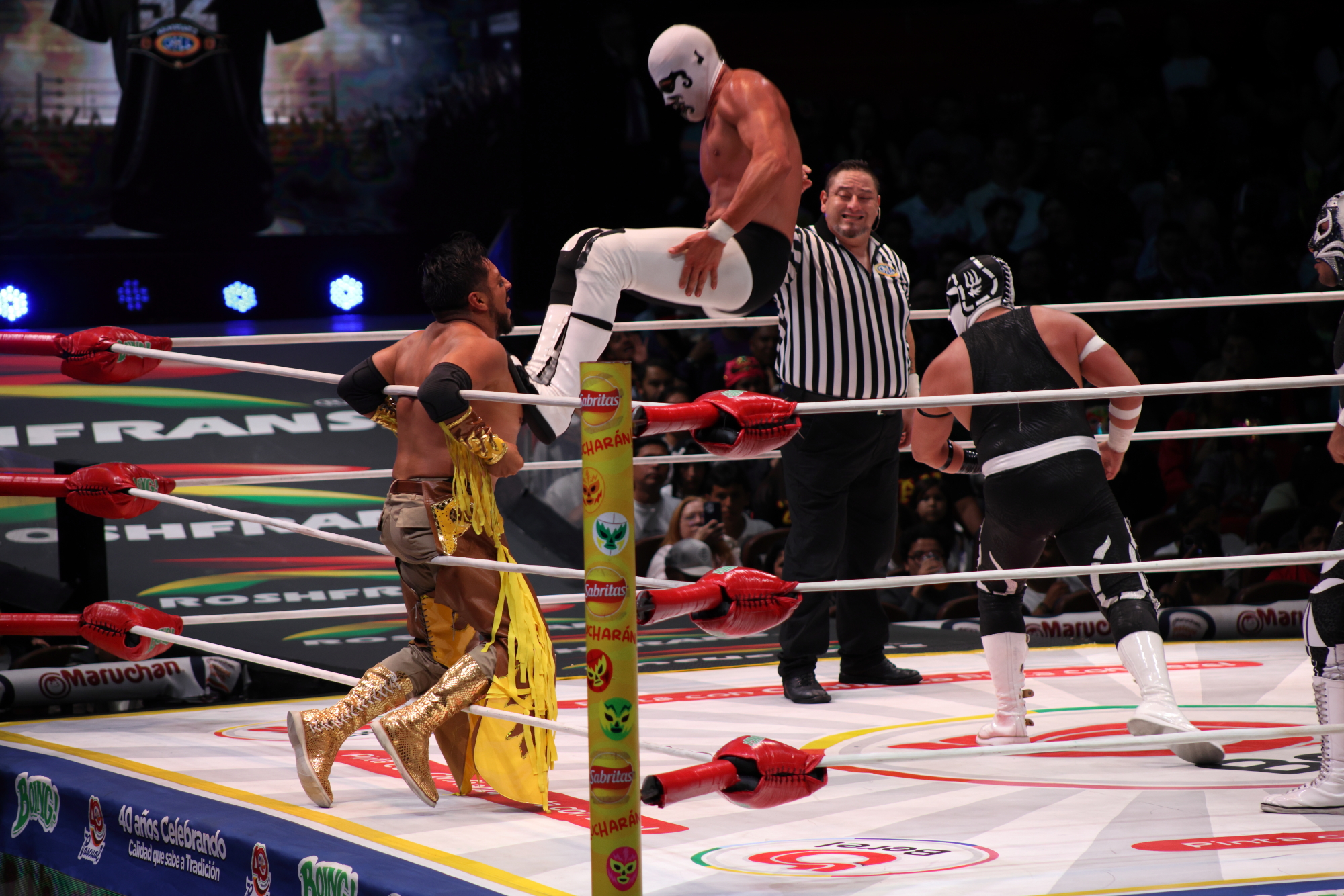
Castro and I are in his office inside the Arena México, the historic venue and headquarters of CMLL. It’s July 3 and the company’s star luchador, Místico, is scheduled to headline the CMLL’s most important, weekly event: Friday nights at the Arena México.
CMLL also owns and operates the Arena Coliseo a short distance away, the Arena Puebla in Puebla, and the Arena Coliseo De Occidente in Guadalajara, each with their own weekly schedules.
During the World Cup, CMLL hosted eight shows per week spread out across their four venues, including a lucha theater show, Mitos Del Ring, that used luchadores to tell stories about the culture and history of Mexico.
The arena appeared to be sold out on July 3 and there were a few English tourists in the audience in town for the World Cup. Ticket prices for the night range from $100 pesos ($5.74) for nosebleeds to $800 ($45.95) for front row seats.
For comparison, ticket prices for AAA’s Verano De Escándalo event at Arena San Marcos range from $406 ($23.31) to $2,878 ($165.23). There are also two VIP experience packages sold separately for $6,328 ($363.30) and $8,053 ($462.34). Meanwhile, back in the U.S., ticket prices for WWE’s Monday Night Raw event at the Intuit Dome on July 27 range from $91 to $560.
CMLL’s show is an affordable option, but Castro admits that the company did, in fact, recently raise ticket prices by a few dollars.
“I will say that any company that's growing and that wants a better life for their employees and for their talent will try and make more money,” explains Castro. “We probably raised the prices from, and this is not exact, but a Friday night, maybe from $32 to $45. We will raise the prices a little for the pay-per-views, especially when we bring international talent, because we need to pay [them], or when we have a mask-versus-mask or a hair-versus-hair. The prices are higher, but they don't go over $200 for front row.”
One reason for the rise in prices comes from the company’s growth into a global brand. Castro has not only seen CMLL’s growth in recent years, but has been part of it. He joined the company as a consultant in 2018 and currently works in the business development side of CMLL.
He is also a senior aide to president/general manager Salvador Lutteroth III (the grandson of founder Salvador Lutheroth), assists with merchandise development, manages the company’s relationship with U.S.-based All Elite Wrestling, and provides English-language commentary on the company’s pay-per-view events.
Much of his current job didn’t exist when he joined eight years ago. Three things happened that changed the trajectory of his career and, more importantly, of the CMLL: the promotion of Lutheroth III to president/general manager in 2019, Covid-19 in 2020, and CMLL’s relationship with the Mexican government, which includes cultural and promotional events with the Secretaría de Turismo Federal del Gobierno de México and the Secretaría de Relaciones Exteriores last year.
“He has an insanely good strategic mindset, and he decided to move pieces around . . . even if he is an older gentleman, he's been trying to innovate and to let the company go places that no other leadership had allowed it in years,” Castro says of Lutheroth III.
Lutheroth III guided CMLL through the pandemic like other companies did: with streamed events in empty arenas. The streams on YouTube were a huge hit and, rather than end them after quarantine orders were lifted, the company continues to use their channel to stream various events through different membership-tier packages. The packages bring in additional monthly revenue that wasn’t available before.
Another change has been the expansion of partnerships within Mexico and internationally. To date, CMLL has working relationships with AEW, Ring Of Honor, Revolution Pro Wrestling, New Japan Pro Wrestling, Maple Leaf Pro Wrestling, and Major League Wrestling. The partnerships include co-hosted, cross-promoted events as well as wrestlers from each company appearing on each other’s shows.
July 3’s headliners, for example, include Máscara Dorada and Hechicero, both of whom have appeared at AEW events as guest luchadores. Místico has a dual contract with CMLL and AEW and was AEW World Trios Champion with “Speedball” Mike Bailey and “The Jet” Kevin Knight for weeks earlier this year.
Within Mexico, the company has partnerships with other promoters in cities where they don’t have a venue. They had a successful show in Mérida in April and recently supported shows in Oaxaca and Chilpancingo.
Finally, its working relationship with the Mexican government has given CMLL a massive boost. The company promotes the tourism board’s initiatives while also promoting and performing in events nationally and internationally with the support of the tourism board. Their competitor, AAA, which was founded in 1992 by a former employee of CMLL, also has its own partnership with the government.
It has all led to a raging success for CMLL.
“I think we hit 62 sellouts [last] year to 63 for this year, so we already broke last year's record in the middle of the year. By December last year, we had sold and scanned 1 million tickets just in Arena México, which is insane...I can bet that it's very close to what WWE did an entire year, being a global brand that they are,” boasts Castro.
This partnership also led to last year’s accusations of CMLL gentrifying lucha libre. The company’s newfound focus on bringing in additional revenue from tourism has led, naturally, to more tourists attending CMLL events, which hasn’t gone unnoticed on social media or in the news.
“While the protests were happening, a couple of reporters were looking for something juicy, and they found a picture with, like, a group of 20 very white and very blonde people, influencers, and they were like, ‘see, now all the gringos are there,’” says Castro.
There are very real problems with the gentrification of various neighborhoods in CDMX, as I wrote about last summer in L.A. TACO, as well as with the cost of living, affordability, and other factors affecting residents. Tourism alone isn’t responsible for gentrification, but can play a role in it, as one academic argued is the case in San Miguel de Allende.
Castro compares CDMX to other major, global cities such as NYC and L.A. where tourism is, to use his words, “part of the magic.”
“This whole neighborhood is popping thanks to all those tourists that 10 years ago, or 15 years ago, would have been like, ‘Doctores? I’m not stepping into that neighborhood,’ and now they walk from Roma, they have fun, they have a drink across the street, they have a taco in the corner, they hang around, and it's safe,” Castro says.
There are, however, plenty of folks who disagree with the accusations of gentrification within lucha libre. Rather than gentrification, they argue, it’s a new boom and evolution of lucha libre into a global phenomenon, with CMLL just one of the companies vying to become a global brand and convert their wrestlers into world-famous superstars.
“Lucha libre is a vibrant culture that is expanding to include a global audience without excluding its traditional Mexican fanbase. The correct concept isn’t gentrification, but the commercial globalization of popular culture,” says Ernesto Ocampo, founder of lucha libre blog SuperLuchas, in a video.
For longtime CDMX resident Pablo FR, it’s also a matter of the growth of many sports in Mexico in general. Tickets for every sport available in CDMX were once a fraction of what they are today and have increased in price slowly over the years as their popularity have grown, as has also happened in cities like Guadalajara and Monterrey.
“Lucha libre spent years dealing with empty arenas and miserable television rights, and today, with the boom, are taking advantage to recover these losses,” he wrote on his blog at Medium.
“We could probably double our prices and still sell out, but it's not the main focus of this company,” Castro says. “This company wants to put a show every week, every day, and make sure that the people that love lucha libre can come as many times as they want, but also that people that have never stepped into this arena and have no idea what lucha libre is come and have the best time of their lives.”
“We're just welcoming the world and, thank God, and thanks to the help of the tourism board, we're now a must-stop in Mexico City,” he adds.


