On June 23, 2026 (a Tuesday), the U.S. District Court for the Northern District of Texas in Fort Worth sentenced Daniel “Des” Sanchez Estrada to 30 years for conspiracy to conceal documents for moving a box full of Antifa zines such as insurrection planning, anti-law enforcement, anti-government and anti-immigration enforcement documents and propaganda.
Estrada is the husband of Maricela Rueda, who was part of a protest at the Prairieland ICE Detention Center in Alvarado, Texas on July 4, 2025. Rueda was one of several protestors who received decades of sentencing, given 70 years.
Estrada was transferred to the Federal Correctional Institution, Victorville in Adelanto, California, according to a statement on July 25, 2026, from Free Des, a group of organizers supporting Estrada's release. This prison is only a short drive from the Adelanto ICE Processing Center.
Estrada’s sentencing has sparked conversation about the right to freedom of speech and expression. Zine creators are now cautious about their work, knowing the possibility of federal consequences.
The circulation of zines in the United States began in the early 20th century with science fiction zines. Counterculture movements expanded the distribution of zines when they noticed its important role in connecting people across the country.
Estrada was transferred to Federal Correctional Institution, Victorville in Adelanto, California, according to a statement on July 25, 2026 from Free Des, a group of organizers supporting Estrada's release. This prison is only a short drive from the Adelanto ICE Processing Center.
In the ‘70s and ‘80s, zine culture was engraved especially in the punk scene, and across many other cultures, adding an emphasis on aesthetics. This lets artists contribute creatively rather than as an informant. Many zines during this time combined politics, culture, art, and activism into one small publication. The copying machine’s significant presence at that time made zines easier to create than ever. Zines are circulated only through specific networks, so zines are printed in small numbers. The target audience of zines are expected to soak in unique expressions, ideas, and art.
“I have passion for the people who are often marginalized in our society, and I wanted to give them a platform and help preserve their history,” Isaias Lopez tells L.A. TACO.
Lopez is a Los Angeles-based photographer and videographer who grew up in the Westchester neighborhood. He has a background in history. He studied U.S. and Cuba relations and propaganda during his time at Cal State Long Beach. Lopez began photographing in early 2025 after he purchased his Sony A7 IV. What started off as street photography shifted toward documenting social movements throughout Los Angeles. Eventually, Lopez captured the ICE raids that hit Los Angeles last summer.
It was during this time that he was federally indicted for allegedly assaulting a federal officer with his camera during a protest outside of the Edward R. Roybal Federal Building in Downtown Los Angeles. His camera was confiscated for six months, so he was seeking a creative outlet to keep busy. His indictment motivated him to create a zine, “Belly of The Beast.” Lopez faced up to eight years if convicted.
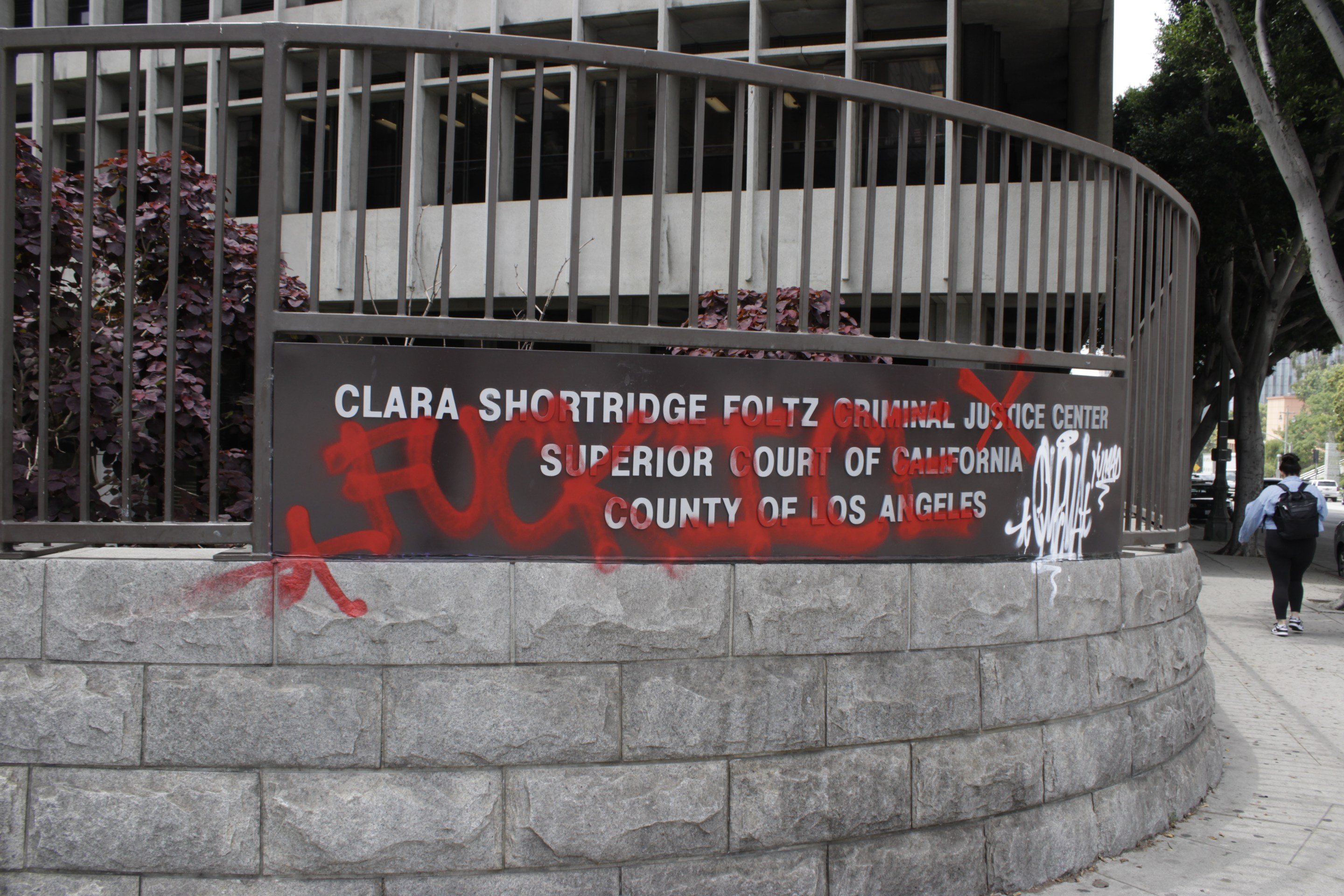
Lopez’s 44-page design included an introduction page and a combination of photographs from events he had attended, like the “No Kings” protest. One photograph shows protesters marching Downtown by the Los Angeles City Hall while waving Mexican flags and a poster that reads “The Trump Fascist Regime.” Another photograph displays graffiti reading “FUCK ICE” across a concrete wall in downtown. Above the wall, a group of people stands along a pedestrian overpass, some holding cameras and phones.
The zines were primarily shared through direct messaging, sold at in-person events, or were donated to undocumented people in ICE detention centers.
Because he was in the middle of an indictment, Lopez had to be careful of his word choice.
“I didn’t want to be blatant,” Lopez says. “My language, I had to moderate it, making sure it couldn’t be used against me in the court of law.”
Lopez’s lawyers were a part of his zine review to ensure it was appropriate and not incriminating.
Referencing Estrada’s 30-year sentencing, Lopez says, “I was like ‘wow, that’s something that potentially could happen to me . . .’ But I did it while I was under federal scrutiny and on probation.”
To block federal officers from viewing the zine he turned his Instagram account to “private.”
Lopez says he is thinking about creating a zine focusing on the Adelanto ICE Processing Center because he captured photographs during his visit. Lopez hopes to find balance for his future work.
“I was upset, emotional, I was reactive, but given everything that I experienced, my trial being acquitted, I have calmed down,” he says.
Zines (DIY pamphlets or magazines) have been used for decades to spread messages across communities and have become a flashpoint in the national conversation on whether we are truly guaranteed freedom of speech, following the conviction of Estrada for disseminating Antifa zines.
We’ve seen a surge in immigration-focused zines in recent years due to heightened enforcement activity from federal immigration agencies. Now, zines are not only shared physically, but also digitally across social media, direct messaging, websites and more.
Zine distribution is not dying, despite the very real threat of harsh consequences. However, the distribution community is not dead.
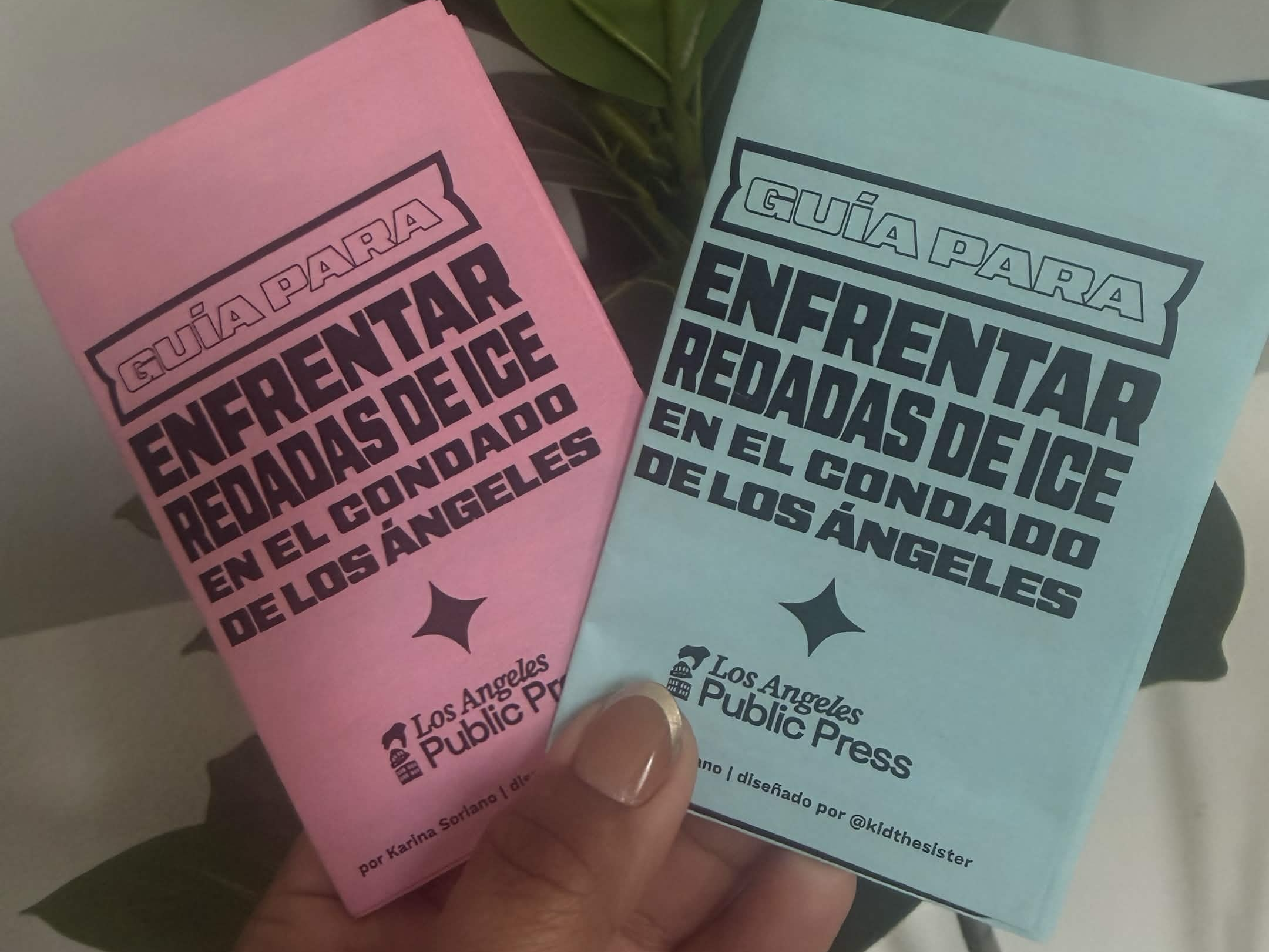
Before writing for L.A. TACO, Karina Soriano created a pocket-sized zine to help Angelenos living in neighborhoods impacted by ICE navigate how to protect their family, stay informed, and help their neighbors do the same.
“While creating the guide, I was followed by ICE officials, and it was not just for a couple minutes, it was an intentional intimidation tactic,” Soriano says. This happened shortly after her mom had a confrontation with ICE herself.
With the help of LA Public Press, Soriano was able to distribute these zines with accuracy and proper translations.
Although Soriano encountered ICE, she wouldn’t change the way it was published.
“It is what the community needed,” she says. “I wanted to be able to provide something for the community that I know needed it.”
“While creating the guide, I was followed by ICE officials, and it was not just for a couple minutes, it was an intentional intimidation tactic,” Soriano says. This happened shortly after her mom had a confrontation with ICE herself.
“What they did was fully legal, and what I’m doing is fully legal and it’s appalling,” Megan Piontkowski tells us, referring to Estrada’s sentencing.
What started off with a BlueSky post turned into a national zine phenomenon. Piontkowski is one of several zine creators who has used creativity to spread immigration focused information.
Like others, Piontkowski has asked herself, “If I see ICE, what can I do?”
Piontkowski is an illustrator who wanted to use her art for something useful; as ICE activity ramped up, she wanted to inform. Her zines provided information for individuals on what they should do if they spotted ICE officials, like the SALUTE protocol.
Her first two zines were distributed in New York and Philadelphia over a year ago. She posted the two on BlueSky, where she received a large engagement. Every announcement of a new zine would spark thousands of likes, reposts, and comments. Her zines are distributed through a Google Drive where instructions on how to cut and fold zines are posted.
On BlueSky, she asked if anyone wanted a zine for their area, and it exploded. So far, Piontkowski has covered communities across 33 states and Washington D.C. Her California zines are divided into Northern and Southern California.
For Southern California zines, she covers Boyle Heights, Long Beach, San Diego, San Bernardino, Ventura, and more. Under Northern California, there is information for San Francisco, Sacramento, Alameda, Santa Cruz, San Mateo, and others.
“I was very happily surprised by the spread of these zines across the U.S.,” Piontkowski says. She had expected the zine distribution to be more local.
“If it seemed like a high priority in the news, I would do it,” she adds. “Otherwise, as [the requests] came through, I would do them.”
Through BlueSky, she found someone to help her copyedit all of the California zines and someone else to write the Spanish-language version of the zines.
Piontkowski keeps the potential consequences of being a zine-creator in the back of her mind. Although she has received mostly positive feedback, someone has asked her to take a zine down because they were receiving spam calls to the ICE hotlines, and they felt her zine was contributing to that.
After learning about Estrada’s case, she tried not letting it affect her distribution of zines.
“I was horrified by that news, it’s absolutely horrifying,” Piontkowski says, relating also that she is thinking about creating more zines.
Although she has received mostly positive feedback, someone has asked her to take a zine down because they were receiving spam calls to the ICE hotlines, and they felt her zine was contributing to that.
According to the American Immigration Council, the number of people being held in ICE detention centers has increased 76% in one year, as of mid-January. Under President Donald Trump’s second term, the public has faced a larger presence of ICE activity and enforcement.
In 2026, there have been 28 ICE-related deaths, and 22 of them have been in their custody. These numbers alone have angered artists, motivating them to use their art as activism.
Zine creators may now move cautiously and more quietly to prevent harm, but that doesn’t mean they’ll stop. Zine creators like Lopez, Soriano, and Piontkowski keep moving forward with their work and instill the importance of spreading information efficiently, yet artistically.
Cases like Daniel “Des” Sanchez Estrada are not unfamiliar, even if bizarre. Law enforcement have been given the power to act as they’d like, even if it’s unlawful, which is where zine creators come in to spread that message.
“Art is a great expression,” Lopez says. “It helps speak to individuals and make them more aware of everything that’s going on in the moment through a different perspective.”
Lopez tells us, “Images are universal and they speak across language barriers, and I think that I will keep doing so until victory!”
To further support zine artists in SoCal and nearby, check out these upcoming events:
- CAAM Zine Making Workshop inspired by the "The Sound of Gordon Parks" ~ August 15 from 2 to 3:30 p.m. ~ California African American Museum in Exposition Park
- The Spring Arts Tower Takeover - August 15 from 10 a.m. to 5 p.m. ~ Last Book Store LA in Downtown
- OC Zinefest ~ August 15 from 11 a.m. to 4 p.m. ~ Anaheim Central Library
- Anyone Can Cook ZineFest - August 23 ~ Junior High LA ~ Glendale
- Líquenes! Festival of Zines Publications and Music - August 29 ~ Tijuana, MX ~ More details TBD
- LAZineFest ~ November 7 from 11 a.m. to 5 p.m. ~ Fashion District
Full disclosure: Karina Soriano is an intern at L.A. TACO.