

Editor's note: This article was updated on August 11, 2025, to include Willy Chavarria's statement.
The huarache that broke the internet is what fashion designer Willy Chavarría's latest collaboration with Adidas did…but not in the way they’d hoped!
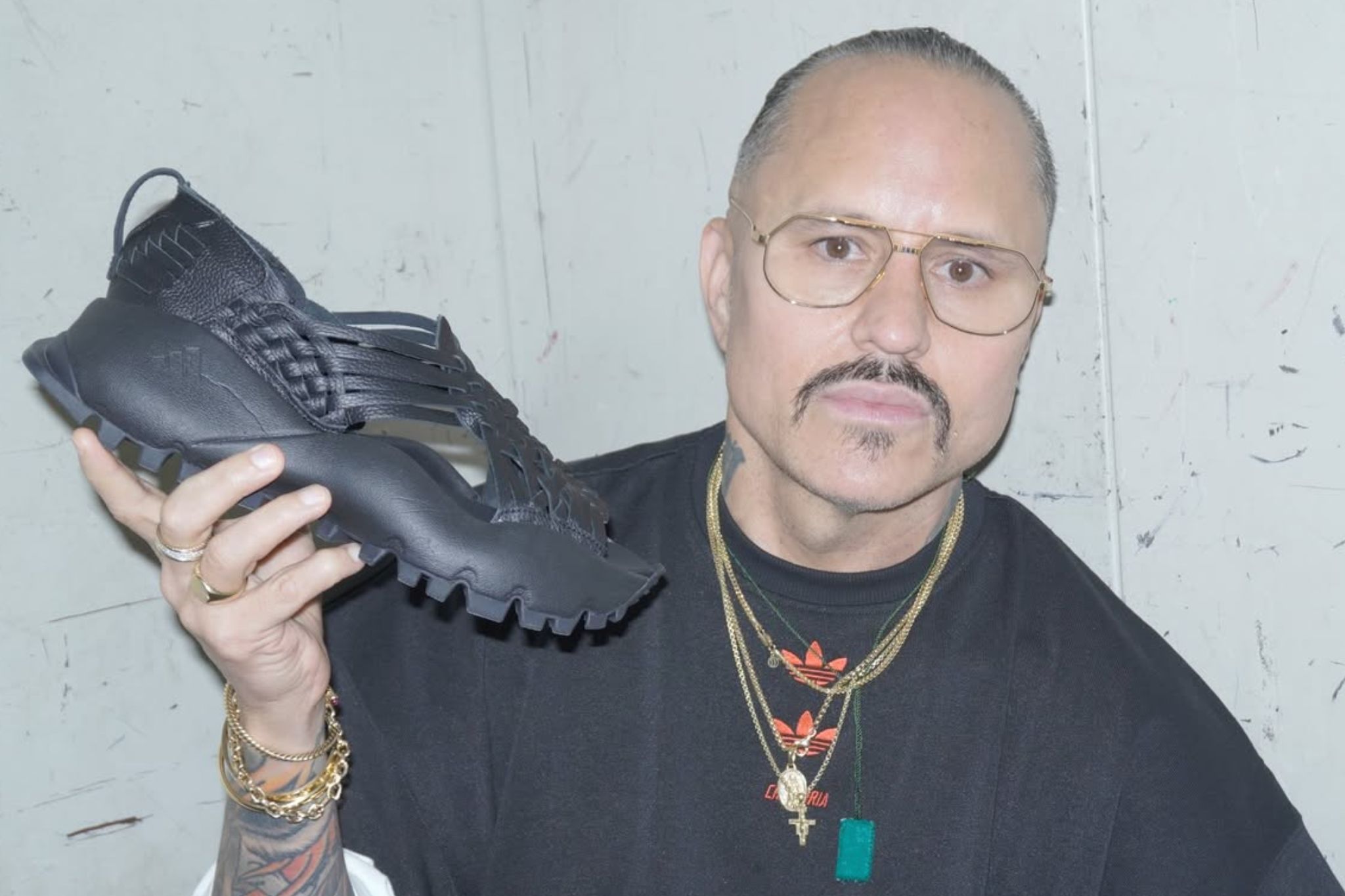
While the Chicano fashion designer debuted his sneaker hybrid huaraches at the Museo de Arte de Puerto Rico during an Adidas Originals panel, it wasn’t until he posted a now-deleted post to his Instagram earlier this week with the caption “SOON” that sparked the online discourse and backlash on both sides of the border.
Many are asking whether the huarache in question, which features black woven leather on top, a chunky sneaker base, is manufactured in China, and named “Oaxaca," constitutes cultural appropriation or appreciation.
For Los Angeles residents like Pedro Ramirez, who has been selling huaraches inside El Faro Plaza for 30 years, the collaboration Chavarría did might have had good intentions. Still, for him, it’s a disrespect to the history and cultural significance of the traditional huaraches made in Mexico by indigenous artesanos (artisans).
“We respect Adidas, but they have to respect what's ours too,” said Ramirez in Spanish as he stood behind the counter surrounded by a sea of leather huaraches. “It feels like they want to steal something that is ours, and this is a craftsmanship and art that goes back decades, and we don’t want it to be distorted or reconstructed. We want to preserve the original designs.”
Like many other local vendors and businesses in the United States that sell different variations of huaraches, Ramirez prides himself on the fact that his shoes come straight from the motherland.
“Mira, ahí esta (Look, there it is),” he said, pulling an open-toed black leather huarache that resembles Chavarría’s off the wall. He pointed at the branded “Hecho en Mexico” stamp inside the heel of the shoe and flipped it over to show the tire sole before saying, “These are the real deal.”
Across the street at the Alameda Swapmeet, Rosario, the owner of Vicky's Huaraches y Botas, expressed the same sentiment as Ramirez. As she attended to the last remaining customers before closing up shop, she said the entire situation with the shoe was unfortunate.
“I thought it was a good idea that Adidas wanted to make a huarache, but it should've been in Mexico,” she said in Spanish. “Right now, our community is feeling very vulnerable with everything that is going on and this could’ve been a beautiful thing that made us all feel seen and proud, but instead it’s made in China.”
While different parts of Mexico have their distinct huarache designs, it’s believed that the timeless shoe originated in the states of Michoacán, Jalisco and Yucatán, and dates back to pre-Columbian times. Some argue that the style of weaving on the designer's shoe is not entirely of Oaxaca but instead of Michoacán, which further fueled the online backlash.
The announcement of the new design has also reached Oaxaca. On Wednesday, Oaxacan Governor Salomón Jara Cruz joined the conversation and accused the company of copying the Yalálag design without permission or crediting the indigenous community in the village of Villa de Hidalgo Yalálag, and wrote a public letter calling out the company.
President Claudia Sheinbaum of Mexico also entered the chat on Friday and said during her daily news conference that there must be compensation and called out the design as cultural appropriation.
“It’s collective intellectual property. The heritage law must be complied with,” she added. “Big companies often take products, ideas, and designs from Indigenous communities from our country. Now we are looking at the legal part to be able to support them.”
I wish he and his team told the history of the people who make them and were more intentional about the overall project.
Chendo Jacquez
Chendo Jacquez, owner of Balam Taco in Lynwood and a clothing designer himself, feels the same disappointment many are expressing. While he applauds Chavarria’s efforts to fearlessly represent and highlight his culture in spaces that were not generally built for our community, he said it was a missed opportunity for the designer to collaborate with talent in Oaxaca and here in Los Angeles.
And as a Mexican-American who often feels “ni de aquí, ni de allá” and who is aware of the political climate here in the U.S., with the ongoing immigration raids and in Mexico with locals fighting gentrification from Americans invading the country's most beautiful towns like Oaxaca, he feels this further pushes the idea that American Latinos aren't knowledgeable or respecting of the culture.
“It’s not cancel culture and us being offended by everything, it’s just like, cabrón ponte las pilas,” he said while sitting in his Lynwood restaurant. “Huaraches are punk rock. It’s raw. It’s real. I wish he and his team told the history of the people who make them and were more intentional about the overall project.”
For Jacquez, huaraches hold special memories that go back to his childhood, where he wore them as he ran and played through the streets of Cotija de La Paz, Michoacán. Wearing the shoes or even the sight of them always brings him back to his time in Mexico.
For him, the “made in China” label meant these shoes were probably going to be mass-produced, which erases the hard work, time, and dedication that goes into making them. Artisans in Mexico produce only a limited number of pairs daily, and the process is both slow and meticulous. You have huaraches made entirely of woven leather, some with hand-sewn designs, others made out of animal fur, and all are made by hand.
Others have noted that other brands have successfully incorporated ethical standards when collaborating with major brands like Adidas. Most recently, a Texas brand named Player Under Pressure collaborated with Nike to design a slip-on shoe inspired by huaraches. According to the brand, they made sure the shoe was made in Sahuayo, Michoacán.
Others in Mexico have also taken to social media to point out that creating new modern designs of huaraches is not a bad thing but, like creator Luz Valdez pointed out, it’s something that the people of Mexico have already been doing. Mentioning the Mexican shoe line Calzado Trova, of Sahuayo, Michoacán, where she first saw the design, which merged the huarache with a sneaker in an ethical manner.
“Adidas didn’t just get inspired by Mexico’s artisans, they copied their entire design,” she said in Spanish via her social media platforms. “Our handcrafted and Mexican items are always in fashion as long as artisans do not make them. At least that is the message Adidas is sending with this latest design.”
The shoe, in its own way, also symbolizes resistance both in Mexico and especially here in Los Angeles.
One TikTok user by the name of Yulia G, who describes herself as a cultural detective, pointed to the huaraches' first arrival in the U.S., which came through the Bracero Program in the 40s. Michoacán was one of the states in Mexico that contributed one of the highest numbers of bracero workers. The workers arrived wearing, you guessed it, their huaraches.
“These sandals became a symbol of Mexican working-class identity in the U.S,” said the TikTok user. “By the 70s, huraches were embraced by the Chicano movement and these shoes became part of the civil rights protests.”
On Friday, the Mexican government said that the shoe company has agreed to meet with Oaxaca authorities. And on Sunday, Chavarria gave his first statement to the BBC regarding the backlash to the design.
“I am deeply sorry that the shoe was appropriated in this design and not developed in direct and meaningful partnership with the Oaxacan community,” he added. “The intention was always to honor the powerful cultural and artistic spirit of Oaxaca and its creative communities - a place whose beauty and resistance have inspired me. The name Oaxaca is not just a word - it's living culture, its people, and its history.”
One thing is for sure: as a community, we should be able to have these tough but meaningful conversations with each other, not to be part of cancel culture but to create dialogue and to learn and grow.
“We want to be taken seriously, and when a giant like Adidas gets to work with a Latino, it's a beautiful thing and we should cherish it and be proud of it, but let’s do it right,” said Jacquez. “The huarache is our community's sneaker.”


