

The first time I saw a burlesque dancer in real life was at Pour Vous on Melrose. The dancer wore a tight, black, bedazzled corset, perfectly sculpted hair, bright red lipstick, and eyeliner sharp enough to cut glass.
She commanded the room without saying a word. At one point, she lifted her leg onto a chair where someone was sitting, slowly slipped off her heel, and unclipped her garter belt and gradually pulled off her stocking to swing it around and place it onto someone's lap. You could feel the entire audience holding their breath.
It was more than seductive. It was powerful.
But mention burlesque in Los Angeles, and you'll often get the same reaction:
“There's burlesque in L.A.?”
There is. A lot of it.
In a city where younger generations aren't necessarily going out, drinking, or dancing the way they used to, burlesque quietly continues to thrive. It's happening in theaters, bars, neighborhood spaces, and tucked-away venues across the city. You just have to know where to look.
JESSABELLE THUNDER
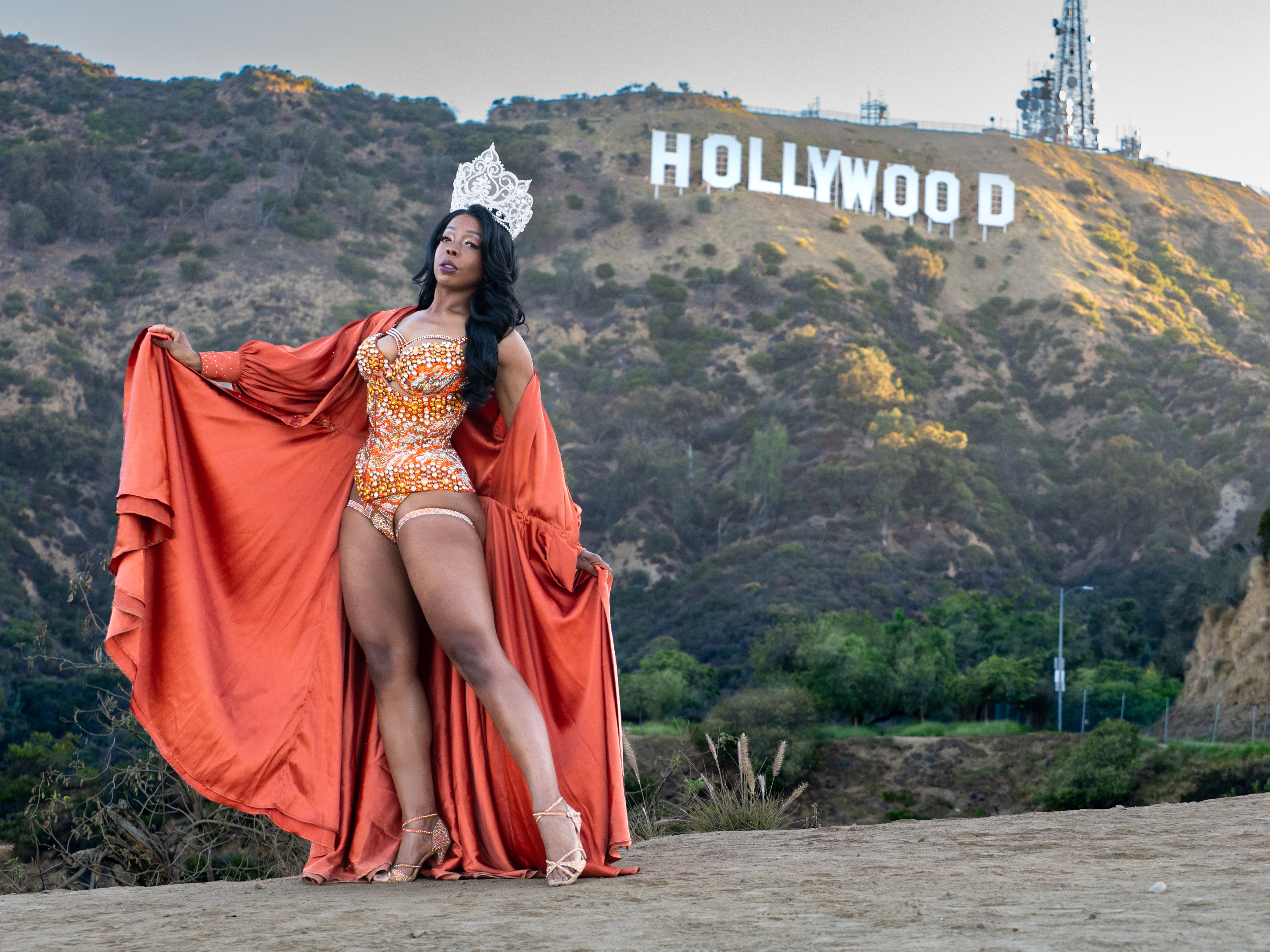
Jessabelle Thunder has heard the question more times than she can count. The Los Angeles-born performer holds the title of "Queen of Burlesque" for 2025-26, and finds the question to be almost funny.
How could a city synonymous with old Hollywood glamour, pin-up girls, and live performance still be overlooked in the conversation?
I first saw Jessabelle perform at “Tease If You Please” inside the Globe Theatre in Downtown. Every act that night was captivating, but Jessabelle had the kind of stage presence that made it feel like she was personally grabbing you by your necktie and pulling you in. It was easy to understand how she had become one of the scene's biggest ambassadors.
Her path into burlesque wasn't exactly planned.
Jessabelle had always loved dancing. She taught herself choreography from music videos, but never imagined burlesque was something meant for her.
“I had heard of burlesque classes and thought the idea was cool,” she tells L.A. TACO. “I just didn't belong there.”
Then one day, her boyfriend at the time surprised her. Instead of dinner, he'd secretly purchased a package of burlesque classes.
“He told me to put on some workout clothes and my pole dancing shoes,” she laughs. “I was like . . . where are we going?”
Walking into that first class wasn't easy.
“We realized, ‘Why aren't there any Black people at these shows?’” Jessabelle says. “Even as audience members, we don't think this is for us.”
“Everyone looked different than I had expected," she says. “But I was determined to keep going because I loved it so much.”
She had the idea in her head that burlesque was only for skinnier, white ballet dancer types. When she arrived at the class, there were all different races, body types, and genders.
At the time, she was studying to become a therapist, and burlesque unexpectedly became part of that journey.
“I said to myself, ‘If I'm going to be someone's therapist, I need to be confident in myself and push myself out of my comfort zone,’” she says. “I did it once and never looked back.”
Still, something felt missing.
“When I first started, I didn't think someone who looked like me could do it,” she says. “Growing up, if I didn't see someone who looked like me doing something, I would just walk away. But when it came to burlesque, I said, ‘Fuck it. Do it anyway.’”
Jessabelle developed her own style, neo burlesque with a twist, high energy, and cheeky style fans have come to fawn over. Her musicality and the way she emotes a radiant energy keep the audience captivated and drooling at the mouth. When Jessabelle moves, your eyes are glued to her.
As she began traveling to perform, her perspective changed.
“I got booked for a show at Jeezy’s Juke’s Joint in Chicago, and there was an entire Black cast,” she says. “I thought I was the only one, but there were so many more, and everyone was doing something different and authentic to themselves.”
The same realization came when she visited overseas.
“I saw the Cocoa Butter Club in the U.K., and it blew my mind,” Jessabelle says. “We all had a similar struggle. So why does it still surprise people?”
Part of the answer, she says, is perception.
“The people who own these venues have a narrow idea of what burlesque is,” she tells us. “They think it's a ballet dancer who is skinny and white.”
That narrow definition doesn't just affect performers. It shapes audiences too.
“We realized, ‘Why aren't there any Black people at these shows?’” Jessabelle says. “Even as audience members, we don't think this is for us.”
Those experiences inspired her and her co-producer, Mariah Kunkel, to create Brown Sugar Burlesque, a show celebrating Black artistry both onstage and behind the scenes. It gave her the opportunity to create the kind of space she'd once needed herself, she says.
She notes that the current legends in the space not only call Los Angeles home but are among the most diverse performers you can see in the world of burlesque.
“Almost everyone in the space right now is a person of color and over the age of 35,” she says.
Jessabelle has watched Los Angeles burlesque evolve dramatically since she started performing in 2009, but one thing has remained constant: the community.
Being a part of the burlesque scene in Los Angeles is paying respect to those who shimmied before you. Jessabelle recalls being inspired by another performer, Natasha Estrada aka ‘La Cholita’, who is an L.A. icon continuing to represent the city throughout her career.
“I was very fortunate to meet her at the beginning of my career and have gotten to perform alongside her many times. She is a huge inspiration to me.” Jessabelle tells L.A. TACO
Today, Jessabelle jokes, there is almost too much burlesque to keep up with.
“It's shocking how much burlesque there is now. When people don't see a show they want to join, they'll make their own,” she says.
Instead of waiting for opportunities, performers are creating them.
“The L.A. sparkle is that we have the capacity to have so many shows. When people are shocked we have burlesque, I say, ‘It's literally right up the street,’” Jessabelle says.
From intimate bar performances to elaborate theater productions and private events, there's room for nearly every style imaginable.
“That's the magic of it,” she says. “There's no lack of variety.”
I wanted to see what that variety looked like away from the stage, so we spent a day following burlesque dancers through the neighborhoods they call home.
MISS RUBY
My first stop was Long Beach to meet Miss Ruby, whose tagline is “The Mexican spitfire of burlesque.” She’s an icon who grew up in Orange County before making Long Beach home more than fifteen years ago.
Standing in front of The Queen Mary ship. Only later does she reveal that she’s over fifty years old. (A baddie through and through, whatever sunscreen she's using deserves its own endorsement.)
“I don't say I'm middle-aged because I don't want to live to be 100,” she jokes. “Burlesque has been my longest commitment I've ever had in my life. I’m celebrating being in the burlesque world for 20 years this year.”
Ruby is an alumna of the New York School of Burlesque, where she lived for three years and got to see burlesque on a larger scale before finding it on MySpace in L.A.
“My signature move is I tassel-twirl for a full minute. I can do them up and down, in circles, and individually, but I never do that one for shows.”
“It was incredible to experience the city in a different way, through the eyes of a subculture like that,” she says.
She found her community in New York, then brought her techniques back to Long Beach.
Ruby became an advocate for assisting other performers on the financial side of burlesque.
“Most performers are choreographers and teach classes on them, but I went a different route,” she says. “I made Shimmy-biz, where I teach other performers the business side of burlesque. We are entrepreneurs, we market ourselves, make our own costumes, and have to stay organized."
She even made the outfit she was wearing to meet with us that day, a two-piece set with every inch covered in green and red sparkles with a flowing removable red skirt.
“I like to connect with the audience in these tiny spaces, giving them [my] glove,” she says. “My signature move is I tassel-twirl for a full minute. I can do them up and down, in circles, and individually, but I never do that one for shows.”
GINGER
Next, I head west to Venice to meet Ginger, originally from Dallas but a Venice local for almost ten years.
She arrives wearing sweatpants, then quickly transforms into a deep purple dress covered in jewels, hair volumized to remind you she is a California girl now, but her roots are still Texan. She has a smile that, if the light catches it, will blind you. She barely has to pose before strangers stop to compliment her or ask if she’s a movie star.
She effortlessly steps into the middle of the street while the camera clicks, looking completely in her element.
“This is me just on steroids,” she laughs when asked if she steps into any kind of a character.
“I got into dancing at an early age,” she tells L.A. TACO. “My mom put me into classes because I was always making her watch me put on a little show at home.”
“When a friend invited me to watch a burlesque show, I said, ‘Wait, I want to be in the burlesque show,’” she continues.
From there, her journey began, going from bars to theatres, and also traveling worldwide to perform.
TITO BONITO
Next, I reach Hollywood to meet Tito Bonito, the Miami-born-and-raised performer with Cuban roots who has been taking Los Angeles on a journey for more than 16 years.
Tito meets us on the Hollywood Walk of Fame in his standard workout clothes, his face beaten to the gods with a smoky eye and contoured cheekbones. The beauty of Hollywood is that everyone keeps it pushing; no one bats an eye at the juxtaposition.
“I know a perfect spot to change,” Tito says.
I assumed he meant a public bathroom, or perhaps a friend who lives nearby. Instead, he directs us to a parking lot and changes between two cars, to everyone’s united laughter.
“Burlesque dancers are scrappy in this way,” he jokes.
When Tito first moved to L.A., he dressed as Robin from “Batman” and thought he would perform on the boulevard for extra money.
“Until one day a cop stopped me, asking for my permit, and I said, ‘My what?!’ Then I stopped,” he says.
His route into burlesque came after college, when he was searching for an avenue for artistic expression.
“I wanted to be able to be more in control of what I produced, and drag was one of the only outlets at the time,” he says.
After realizing drag wasn't what he wanted to pursue, his best friend, Jeez Loueez, took him to a burlesque show featuring performers of all genders, including the Stage Door Johnnies.
It was specifically Bazuka Joe who made a lasting impression.
“The rest is history!” he tells us. “At the beginning, a lot of performers would second-guess why I was there, but nine out of ten times, once I performed, they were on board. Something that I've heard many male burlesque performers experience when starting out.”
As a white-passing man of color, Tito says he understands his privilege and honors his community by showcasing his Hispanic heritage as his main marketing tool.
While some performers will spank audience members with a flogger, Tito wondered, “How can I make it Latino?” He ultimately decided, “I’ll use a chancla!” which became a signature of his acts.
MISS MARQUEZ
Our last neighborhood stop is Lincoln Heights, where we meet Miss Marquez. Originally from Yuma, Arizona, she has lived in the neighborhood with her partner for three years.
Head-to-toe in a bright, almost lime green color that stretches to her hair, outfit, and eye shadow, we’re now unable to see that color in the wild and not think of her immediately.
“I've been a burlesque performer for 16 years and had green as my signature for 15,” she says. “There was just one year of me figuring myself out.”
Instead of taking us to landmarks, she brings us to the places that make up her daily life: La Michoacana and Guadalupana Market.
Inside La Michoacana, the woman behind the counter can’t stop complimenting Marquez, saying she looks like a superstar. Outside, Miss Marquez poses in front of the shop, in their green chairs with a lime popsicle, perfectly contrasting with their all-pink entrance.
At Guadalupana Market, we shoot photos in front of the Lady of Guadalupe painted on the side of the building before getting the courage to ask if we could take a photo inside.
Miss Marquez tells the woman behind the counter that she comes to this bodega all the time but normally sees a man behind the counter. The shopkeeper explained that the man was her father, and she was filling in while he recovered from an illness.
Marquez reached out with her bedazzled glove and held her hand as they spoke, listening as she described how much her father meant to the community, teary-eyed.
When not onstage, Marquez is also an instructor for a class called “Empowerment in Heels.” The group welcomes people across different experience levels, body types, and walks of life. She was inspired to create it after Trump’s first election, when the changing political landscape made her feel fearful for the first time.
“I had been dancing for years, but it wasn’t until that year [that] I started to see burlesque differently,” she says. “It was his quote about grabbing her ‘by the pussy.’ I was at an event dancing in a bar, and I felt fearful for the first time. A few months later I met up with a bunch of other dancers, and we went to the Women’s March and found myself feeling empowered again.”
For Marquez, burlesque became more than performance. It became a way to reclaim that feeling of power.
There is a direct connection between burlesque as an art form and the political climate surrounding it. When conservatism rises, so does the need for performance, protest, self-expression, and spaces where people can take ownership of their bodies and identities. Sometimes the Venn diagram between burlesque and activism is almost a circle.
EGYPT BLAQUE KNYLE
For Egypt Blaque Knyle, who we weren’t able to meet in person that day because of her busy schedule assisting at a clinic on Skid Row, discovering burlesque completely changed the course of her life.
“My burlesque journey began with a class in 2010,” she says. “What started as curiosity quickly grew into a passion, and by 2012 I had fully committed to burlesque as my artistic path.”
She first discovered the art form after a painful breakup while attending a show at Hamburger Mary's.
“Coming from an urban exotic dance background, seeing her step onto that stage with such incredible elegance and beauty was a complete revelation. I had no idea that the world existed in Los Angeles.”
“I saw my first Black burlesque performer, Jessabelle,” Egypt recalls. “Coming from an urban exotic dance background, seeing her step onto that stage with such incredible elegance and beauty was a complete revelation. I had no idea that the world existed in Los Angeles.”
“What has kept me rooted in the L.A. scene is its vibrant energy, deep artistic diversity, and the immense opportunity to merge my movement background with bold storytelling alongside incredible local performers,” she says.
When I ask Egypt about the intersection between burlesque and drag, she describes them as “two sides of the same powerful coin,” both rooted in transformation, presence, character, and commanding a stage.
Crossing over into drag and pageantry became a natural evolution of her performance journey, giving her another canvas for theatricality, storytelling, and stage authority.
MISS ORCHID MEI
Lastly, I speak with our final act, Miss Orchid Mei, who has been dazzling the Los Angeles scene since 2004.
“I'm like vintage champagne!” she jokes about how long she's been doing burlesque. “Though I'm not from Los Angeles originally, I have been adjacent to L.A. burlesque for quite some time.”
“The [burlesque] scene was smaller back in the day with only a few showcases and troupes, so we all knew each other when we ‘worked the circuit.’ Miss Orchid explains. “But what drew me to L.A. specifically? Three words: Velvet. Hammer. Burlesque.”
The Velvet Hammer Burlesque showcase took over various underground and supper club venues across the Los Angeles area over its roughly 10-year run and was one of the driving forces behind the burlesque revival in the early to mid-90s.
“Honor those that bumped so you can grind,” she says, offering advice to anyone interested in starting in the scene. “Do your research, study the history, and respect the legends (practicing and retired). L.A. burlesque is vast, it is dynamic, and it has deep roots. Cultivate those roots like a burlesque botanist. There is a wealth of information at your fingertips, and likely backstage with you. Take advantage of that.”
After spending the day following these performers across Los Angeles, the stage feels like only one part of the story.
Burlesque is in Long Beach, Venice, Hollywood, Lincoln Heights, and everywhere in between. It is happening in theaters, bars, neighborhood businesses, and private events. It is performed by Black artists, Latino artists, men, women, people of color, performers over 35, and artists who don't fit neatly into anyone's idea of what burlesque is supposed to look like.
The performers are building their own shows, creating their own spaces, and bringing the art form into the communities they call home.
Maybe you don't have to go looking very far to find the real L.A. sparkle.
The burlesque scene is already right up the street.
To keep up with the performers, follow them on their Instagrams and consider attending Brown Sugar Burlesque August 16 at Johnny Bar in Highland Park.


