


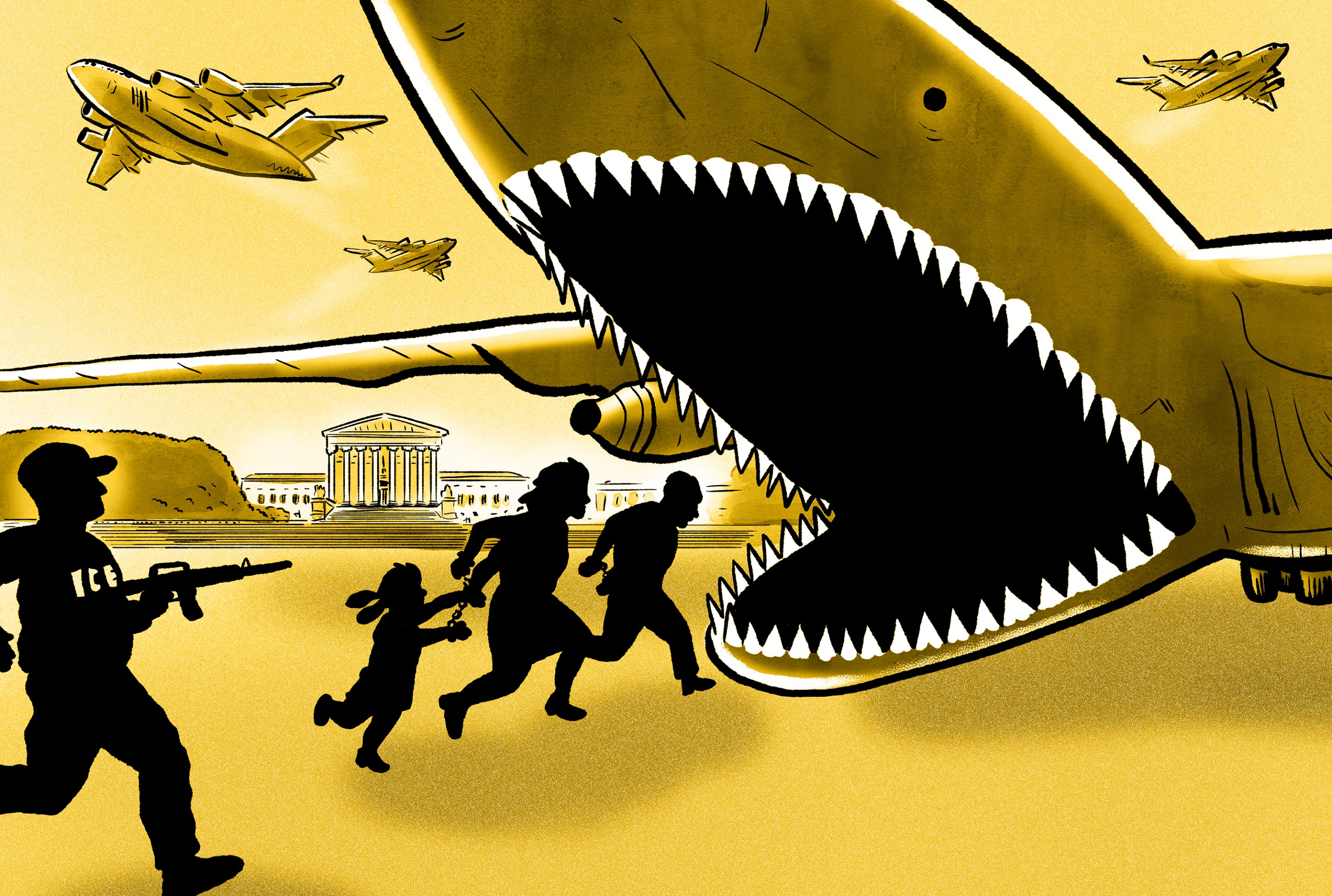
On a commercial plane filled with around 80 ICE detainees, a row of Latinos shackled by the hands and feets were approached by one of a few dozen armed guards. Dressed in full tactical gear and strapped with a rifle, the guard gave them a puzzled look and asked, “What are you doing on this flight? They don’t sell baleadas in Africa.”
The four Cubans, an Ecuadorian, and an Hondureño looked back and forth at each other with a concerned giggle before replying to the agent, “Africa? You’re joking, right?”
That’s when the agent confirmed, to their shock, that they were indeed all headed to Africa. Unable to believe it, they were forced to process this information on their own, as the guards would not allow them to speak to each other for the rest of the ride. They could barely scratch their own noses or go to the bathroom. At this point, they had been in shackles for almost 36 hours.
These details are based on my interview with Aristides Fernandez Garcia, a 37-year-old from Cuba, who was on that flight. It landed in Bangui, Central African Republic on July 31, 2026, one of 35 “third countries” that are accepting deportees from the U.S., in exchange for 44 million dollars in contracts from Trump’s deportation machine.
In total, Third Country Deportation Watch, a joint project between two non-profits, Refugees International and Human Rights First, estimates that there have been around 22,000 people “Banished by Bargain,” as they put it, and sent to third countries far from their own homelands.
Stripped of all possessions but the clothes on their back, these men now find themselves in a French-speaking country, unable to communicate, locked up in a hotel room by local authorities, with 90-day visas, taking prescription pills to protect against illnesses spread by local food and water.
Above all else, they’re left wondering what will happen when their 90-day visas are up and they’re let out of the hotel into a country that has the U.S. government’s current highest travel advisory warning.
Will they remain undocumented in a third country? Can they find work? Will they be able to locate a lawyer or a human rights group that can help them? For now, there is no embassy, and there is no way to leave the country they’ve been banished to.
These men insist that all their rights were violated by ICE.
So how did Aristides find himself with other Latino ICE detainees in Africa, a continent far from their original homes? This is Aristides' story, as he told it to us.
His journey from Cuba to the U.S. went through Mexico, where he was allegedly kidnapped, robbed, and had his life threatened should he be seen there again. He was told to never come back, or he would be killed.
“I learned that Mexicans mean what they say,” he told L.A. TACO.
According to the DHS, “On August 17, 2021, CBP encountered him near San Luis, Arizona, and the Biden administration later released him into the country.”
Aristides compares his entry to being accepted with open arms. “Welcome to the U.S.,” a border patrol agent allegedly greeted him before crossing him into the U.S.
After filling out an I-220A form, Aristides was admitted to the country through a special parole policy and released on his own recognizance from immigration detention pending removal proceedings or an approval of his asylum application.
While remaining in the U.S., Aristides worked as a truck driver with a valid license, a demographic that Trump has openly targeted through the signing an executive order titled “Enforcing Commonsense Rules Of The Road For America’s Truck Drivers” on April 28th, 2025.
On January 6th, 2026, ICE grabbed Aristides while he was in his second court hearing, as the judge was scheduling his third asylum hearing. According to Aristides, the judge demanded to know why ICE was taking him, but the agents responded by saying that they didn’t have time to answer her, as they took him away.
DHS confirmed with L.A. TACO that “On January 6, 2026, ICE arrested Aristides Fernandez-Garcia, an illegal alien from Cuba, in Miami, Florida during a targeted operation. On the same day, an immigration judge terminated Fernandez-Garcia’s proceedings. He was processed for expedited removal and refused to sign documents.”
For the next seven months, Aristides would have to endure conditions at nine different detention centers, with a 96-day stay at “Alligator Alcatraz,” one of the most infamous destinations, during its most chaotic time.
He described constant physical beatings, being sprayed with some kind of substance, and other abuses by the guards similar to those at the facility that have made headlines around the country.
“If you went to the medical center, they would handcuff you,” Aristides explained. People would be passed out on the floor, hands handcuffed behind their backs, waiting for medical attention, he said.
In comparison to other centers, if you needed medical attention, detainees were forced to submit a request that would take up to seven days to get a response, Aristides said.
“We would recuperate from one virus [just] to get another,” he added.
According to Aristides, sometimes the detainees would only get bread and dirty water to drink. He dropped 60 pounds during his time.
“Out of all the detention centers I was in, they’re all bad, but Alligator Alcatraz was the worst,” he said.
He eventually found himself in Dallas, Texas, with about 200 people from all races being transferred to different places.
In Dallas, Aristides and the rest were shackled and sent to a detention center nearby, where people were separated into different holding areas depending on where they were being deported to. He was placed with others being deported to Africa.
Aristides and a handful of other Latinos were in the same holding cell with about 50 Africans. Everyone was confused as to why they were in that room together.
Aristides and his fellow detainees had rejected an option to be deported to Mexico, due to their similarly traumatic experiences traveling through the country as migrants. Still, when the guards told them the system showed they would be deported to Africa, they refused to believe it.
“I never signed any papers agreeing to be deported to Africa, they never mentioned Africa to me,” Aristides tells L.A. TACO.
On July 30th, Aristides was forced, along with the other shackled detainees, onto buses without any of the commissary money they had left, nor cell phones, IDs, or any other possessions, he said. They boarded the plane, some with tears, knowing they were leaving their lives and families behind.
According to Aristides, about 30 of the 80 deportees on that flight were from different countries, including Turkey, Romania, Ecuador, and Afghanistan, to name a few.
After learning on the flight that he and the others were headed to Africa from the bewildered guard, they spent what Aristides estimated to be around 21 hours on the plane. He says the plane also made stops in Senegal and Nigeria before finally arriving and being disembarked on July 31st, 2026, in Bangui, the capital city of the Central African Republic.
They stepped off the plane, their shackles finally removed after almost 36 hours. They were lined up and called into a tent at the airport by name, one by one. They were given a vaccine for local diseases, which caused some to fall temporarily ill. They were also given a pill to take each day with their food to help prevent local diseases.
They were given a vaccine for local diseases, which caused some to fall temporarily ill. They were also given a pill to take each day with their food to help prevent local diseases.
Another deportee from Africa helped them with some money, which was used to buy a phone. They were taken to a hotel that provided a SIM card.
“We need help,” Aristides told L.A. TACO during the phone interview. “People need to know what’s happening. I don’t want this to happen to someone else.”
These men are desperate for help from lawyers or human rights groups that will plead their case and get them back to the U.S. They are hoping they can get help before the expiration of the temporary 90-day visas that the local authorities provided. They don’t know what’s going to happen after that.
“It’s intimidating here,” he said. “There’s always fights outside in the neighborhood. They see us as white. We don’t know what the pay is here. And apparently, we hear there aren’t even jobs. People have to come up with their own way to make money and survive.”
The U.S. Department of State currently has a Level 4 travel advisory, the highest possible level, against travel to the Central African Republic, where these men have been banished. Specifically, the State Department warns, “Do not travel to the Central African Republic due to risk of unrest, crime, kidnapping, landmines, health, and terrorism.”
At this point, Aristides was feeling betrayed by Trump, wondering why he would tell immigrants that if they had no previous criminal record, not only should they feel safe, but that he was even going to help him. DHS also did not provide any criminal history for Aristides in their response to L.A. TACO’s inquiry.
“I felt safe and relaxed,” he said, explaining he had no criminal record. He even provided his A number for us to verify he had a clean record. “I realized then that judges don’t have any power anymore.”


