

The World Cup can be a dangerous time for women trapped in abusive relationships.
Abusers believe that they’re entitled to express their disappointment through violence, and when their favored team loses, many attack their girlfriends and wives.
My abuser idolized Lionel Messi—a weasel-faced Argentine who beamed when he met President Donald J. Trump at the White House—and he made me pay the price when this soccer superstar disappointed him. An embittered former athlete, my abuser fractured my arm, broke my tooth, and scarred my face.
I escaped. Some women don’t.
On July 5, a 40-year-old woman in Puebla, Mexico, lost her life to a World Cup-related femicide. When police arrived at the home of Monica Hernández and Rafael González Cruz, they found her dead.
Neighbors told detectives that González was angry that Mexico had lost to England. After the match, they heard him scream at Hernández and attack her.
The thirty-two-year-old Mexico fan struck Hernández with his machete, nearly severing her head. When police tried to apprehend him, he turned his weapon against them. To arrest him, police had to shoot González in the leg.
While Hernández’s death infuriates me, it doesn’t surprise me. Through word and deed, my abuser taught me that the culture of men’s professional soccer promotes misogyny. It attracted him by validating his male supremacist attitude, convincing him of his superiority to women.
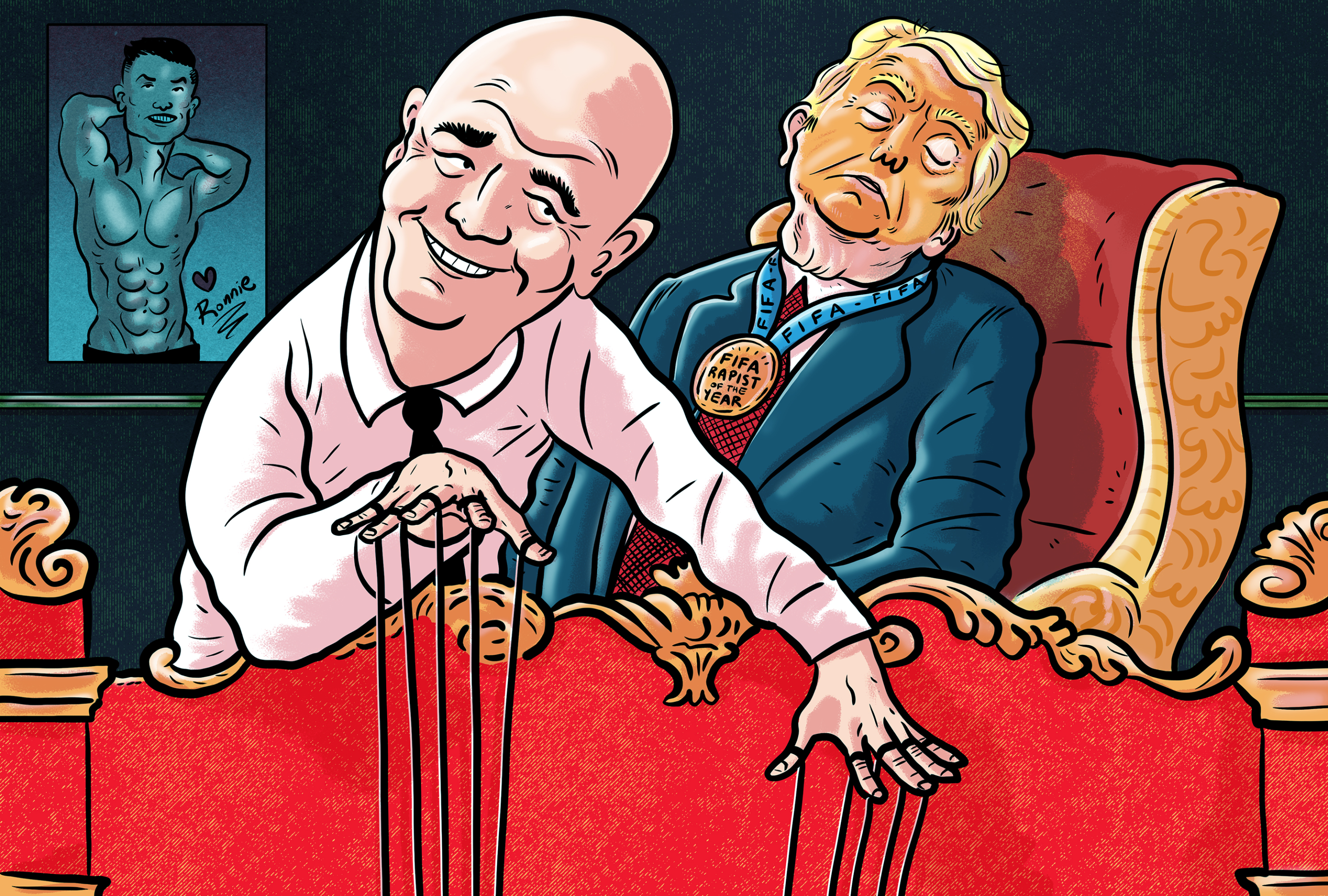
Femicide and sexual abuse are misogyny’s most extreme expressions, and FIFA puts sexual abuse perpetrators on pedestals, inventing awards to boost their insatiable egos.
Last year, FIFA President Gianni Infantino gave the inaugural FIFA Peace Prize to Trump, an adjudicated sexual abuse perpetrator. Three years ago, a federal jury found that the U.S. president deliberately and forcibly penetrated writer E. Jean Carroll with his fingers in a department store dressing room. The court also found the rapist liable for making defamatory remarks about her. Trump currently owes Carroll more than $83 million in damages.
Since the 1970s, 28 women have accused Trump of sexual assault. Most women never speak out, so this group likely represents a small sampling of his much larger survivor population. By awarding Trump the inaugural FIFA peace prize, one of the most influential and lucrative sports organizations in the world sent a message to girls and women: If a man sexually abuses you, it will advance his career.
World Cup players seem to have taken Infantino’s message to heart. The list of players accused of rape is long, and it includes team captains like Achraf Akimi of Morocco. He has been formally charged with rape by a French court and will stand trial in Paris. Ryan Mendes, the team captain for Cape Verde, is under police investigation in New Zealand for the alleged rape and strangulation of a team translator.
Argentina’s match against Cape Verde in the round of 3-2 was a near disaster for Argentina, and it was accompanied by complaints that the refereeing was biased in favor of Messi, a cash cow. Argentina needed overtime to score and while I wanted to cheer for Cape Verde, I couldn’t. I don’t respect athletes who appear happy receiving instructions from a rapist.
The most famous among the accused is Portugal’s Cristiano Ronaldo, a middle-aged striker and center forward who has bragged about being the greatest athlete of all time. The forty-one-year-old exists in a unique category; he’s the only player in this World Cup who has confessed to sexual assault.
The history of accusations against Ronaldo begins in 2005, when English police arrested him on suspicion of rape. The accuser withdrew her complaint under what I imagine was crushing and terrifying social pressure.
Ronaldo’s star was rising. Rape survivors are often told to shut up. That a man’s promising future matters more than her well-being.
The next accusation came in 2009, when model Kathryn Mayorga reported to police that Ronaldo had violently raped her in a Las Vegas hotel room. When lawyers questioned Ronaldo about the incident, he gave a detailed description of the assault:
“She said it was not proper to have sex . . . I entered her from behind. It was rough . . . five to seven minutes. She said that she didn’t want to . . . Maybe she got some bruises when I grabbed her.”
Despite Ronaldo’s horrible performance during Portugal’s yawn-inducing match with Spain, Coach Roberto Martinez kept him on the field. While I can’t say for sure why Martinez did this, I can speculate. When an abusive man is in denial about his physical decline, his coddlers indulge him, fawning to make him feel big, strong, and powerful. We see this behavior with Trump, a man who insists that he’s in tip-top physical shape despite clear evidence that he’s not.
Pandering to Rolando’s fragility likely prevented Martinez from substituting the ego-maniacal rapist with someone fresh, someone capable of helping his team to win. Martinez’s decision to play Ronaldo cost Portugal the World Cup. It also cost Martinez his job.
Selfishness drives this type of behavior. Rapists and their admirers would rather destroy what they or others have built instead of stepping aside when they’re no longer useful. They are allergic to humility.
Enthusiasm for the World Cup cooled among my friends and family when Egypt lost to Argentina, the Germany of Latin America. A white Argentine once taught me that this is how her countrymen see themselves when she said, “Argentina is like Mexico but better because it’s more European.”
Talk like hers is why so many Latinos boo Argentina. It’s also the reason why many white supremacists flock to the country. Fans have been left wondering if white supremacy handed the match to Argentina.
The game went like this: Egypt took an early lead, then scored again on a fast break. The referee then reached back to a questionable foul at the other end of the field, one that had no meaningful connection to the goal, and reversed himself, erasing the goal. Egypt scored again anyway.
With 10 minutes left, Argentina faced elimination, while Egypt—whose coach condemned the genocide in Gaza before and after every match—stood on the verge of its first World Cup quarter-final. Projected ticket prices plunged.
Then, Argentina scored twice and took the lead. The referee ignored fouls that should have given Mo Salah a penalty—and likely Egypt the match—before showering Egypt with yellow and red cards like glitter. Many melanated fans have suggested that a lot of racists probably wouldn’t want to pay Messi prices to watch a team of brown Muslims.
Salah is a star, but Messi is a global industry, and it looks a hell of a lot like the World Cup is rigged to favor financial investment in white teams.
You might be wondering what this has to do with rape. The answer is that racism always goes hand in hand with misogyny. You can’t have one without the other, and an organization’s levels of corruption can be measured by the intensity of its misogyny.
When Infantino hung a medal around a rapist’s neck last year, FIFA showed the world that the association is rotten to its core.
Another moment that tempered enthusiasm happened when Trump called Infantino to discuss the suspension of U.S. striker Folarin Balogun. After the call, Balogun was reinstated. By pulling strings to reinstate a player, Trump brought rape culture into the game itself by inserting himself where he didn’t belong. The president used his position as head of state to influence the outcome of a sporting event, degrading and spoiling any future team achievements.
Just to be clear, my condemnation of FIFA isn’t an indictment of soccer—it’s an indictment of the wealthy men who set the professional standards of the game, the smug puppet masters who treat FIFA like their frat house.
I don’t begrudge anyone their World Cup fun. If you want to cheer for rapists, go ahead, but I’d rather seek my joy elsewhere.


