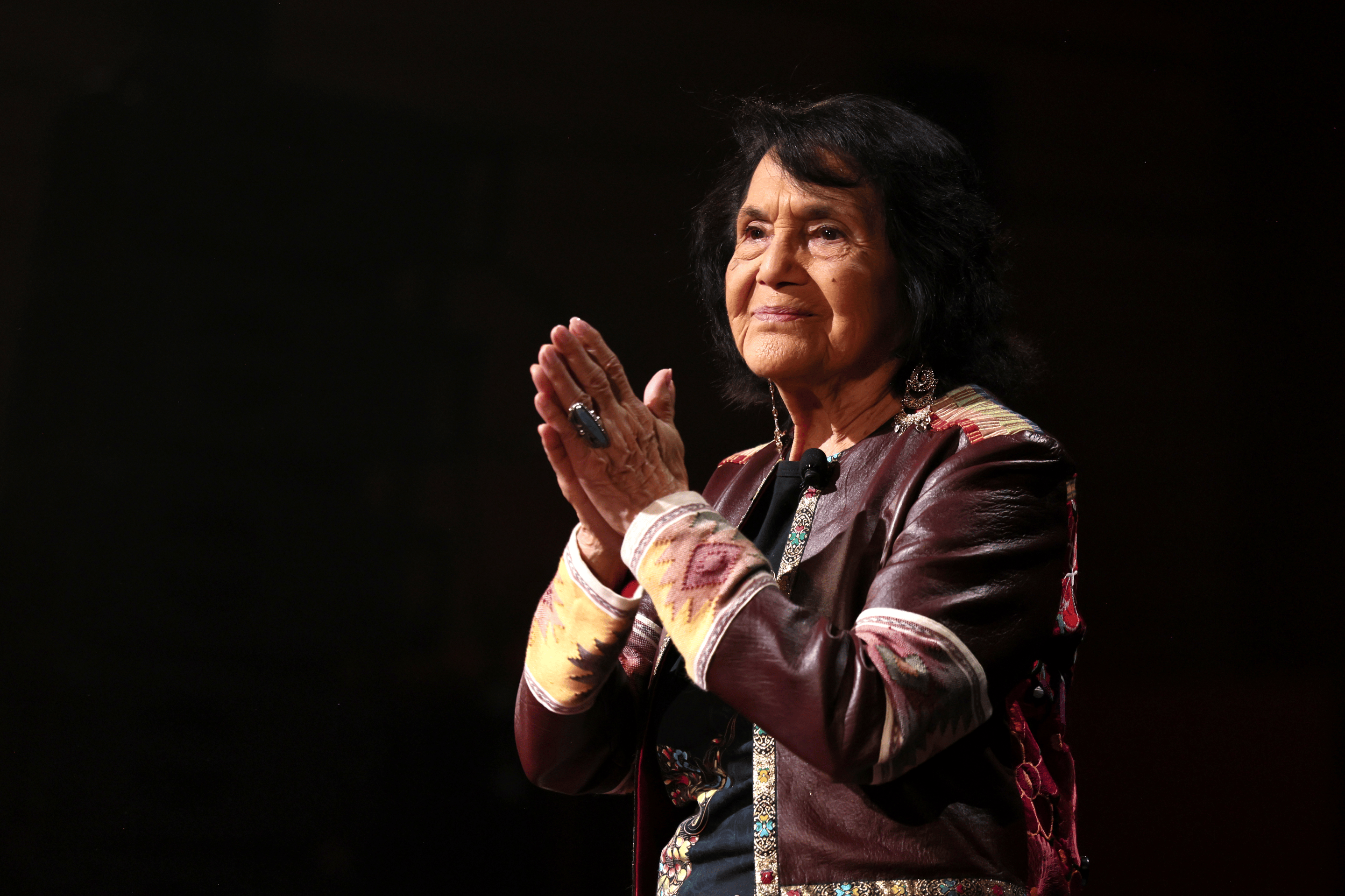
The last time that I saw Dolores Huerta, I struggled to hear her.
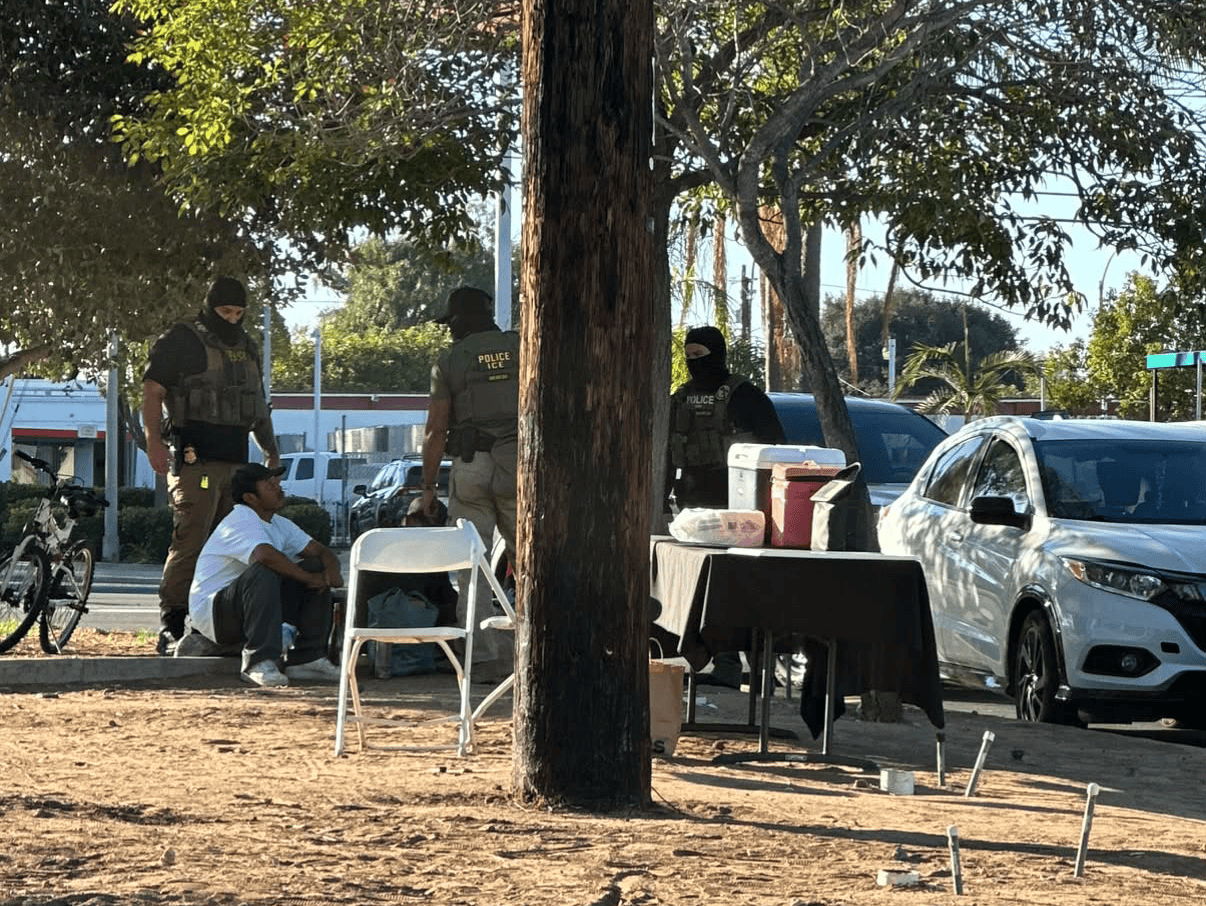
It was the morning of June 8, 2025, back when ICE had just started its masked siege of Los Angeles. I’d heard about an anti-ICE march that would begin at Mariachi Plaza, so I headed to Boyle Heights, where I joined a crowd of protestors gathered in front of the stage. We listened to the rallying cries of several local labor leaders, clapping and whistling when one called for a strike to shut down the city.
Then we watched Huerta, the most seasoned labor leader present, carefully ascend the stairs to the stage, walk to the microphone, and reach for it with her left hand.
The 95-year-old civil rights leader wore a Panama hat, a pair of beaded necklaces, and a bright cobalt suit. Police helicopters hovered close by, and with the din of their whirring rotors, they tried drowning Huerta’s most iconic weapon, her voice.
If a government sends choppers to silence a five-foot-tall woman, whatever she has to say must be dangerously important.
If a government sends choppers to silence a five-foot-tall woman, whatever she has to say must be dangerously important.
Everyone leaned closer. Though I could barely hear her, it didn’t matter; Huerta’s presence validated ours. Feeling energized, we marched to the Edward R. Roybal Federal Building where the police launched tear gas canisters at us. The next day, some of us returned armed with leaf blowers.
Huerta stepped into the afterlife this past Wednesday, and she was undoubtedly honored on many of this year’s Día de Muertos altars. I can envision her framed portrait propped on candlelit wooden tables draped with white linen. Around her smiling face rest warm pastries, red grapes, dewy strawberries, succulent guavas, and golden bananas. Bouquets of wild orchids, pink roses, chamomile, and eucalyptus fill simple vases.
We meditate on our dead for a critical reason—they teach us how to live, and Huerta created a new Latina template, one that contradicts a musty patriarchal saying that’s still used to smother and declaw Latinas: Calladita te ves mas bonita. (You look prettier when you’re quiet.)
When historian Studs Terkel asked Huerta to comment on machismo, she slyly redefined the term, answering, “Machismo is guts . . . women can have machismo.”
Huerta was a nerdy, civic-minded, and extroverted kid who grew up in Stockton, California. In college, she spent more time going to protests than she did attending class. After earning her teaching credential, she worked as an elementary school teacher in the San Joaquin Valley, an area that produces more than half of California’s agricultural output.
The wealth generated by agribusiness didn’t reach the primarily Mexican labor force harvesting the nation’s food, and Huerta witnessed the effects of poverty on her students. The children of farm workers often came to school hungry and barefoot, and Huerta resolved to improve their parents’ lives by becoming their advocate.
The children of farm workers often came to school hungry and barefoot, and Huerta resolved to improve their parents’ lives by becoming their advocate.
Though she was told that farm labor organizing was no place for a woman, she famously co-founded the United Farm Workers in Delano in 1962. She helped to organize the nationwide grape boycott that led to the first farm workers' union contracts, and as Vice President of the UFW, she secured the passage of the California Agricultural Labor Relations Act, landmark legislation that established farm workers' right to collective bargaining.
Agriculture remains one of this country’s most dangerous job sectors, and Huerta knew its perils intimately. After her father, Juan, lost his job as a coal miner, he became a migrant farm worker. Traveling in search of ripening crops, Juan took his wife Alicia and Huerta with him. She probably learned to walk in one of the tar paper shacks that her family lived in while her dad harvested sugar beets during the Great Depression.
As an adult, Huerta recognized the “tremendous stigma” attached to farm work and identified it as a strain on her parents’ marriage, causing them to divorce when she was three. While Alicia did occasional farm work in the Central Valley, she prohibited her young daughter from entering the fields. Alicia warned Huerta that “women in the fields are treated pretty badly,” that they sometimes become “prey.”
During her final chapter as an activist, Huerta spoke, not about the exploitation of others, but about the exploitation of herself by Cesar Chavez, the labor leader with whom she co-founded the UFW. She spoke with journalist Maria Hinojosa about being raped by someone widely hailed as a folk hero and, in some circles, a folk saint, describing that she felt “trapped,” “alone,” and “isolated.”
She added, “It never would have happened in the first place if I had not had this great admiration for him. And he was my employer. He was my boss, you know?”
Like many rapists, Chavez used his charisma and reputation for doing good to access victims. Rather than reckon with Chavez’s unmasking, many misogynists attacked the messenger, condemning Huerta and validating the fears that had kept her silent for decades. There were also many women and femmes who rose to the occasion by uplifting Huerta’s voice, offering public statements of condolence and solidarity, and announcing, “Me, too.”
Few people understood the power of social movements better than Dolores Huerta, and the social infrastructure that was put in place for the disclosure of her survivor story was built by several waves of feminist activism.
In the 1980s, activists organized “Take Back the Night” programming that involved rallies, vigils, and street protests. Open mic spaces were curated at many of these rallies, providing a stage where survivors could speak their stories to an empathetic audience.
In 2006, activist and survivor Tarana Burke founded the “Me Too” movement, ensuring that survivors have tools to craft healing journeys and that communities are empowered to interrupt sexual violence. In 2017, the #metoo hashtag went viral and social media sites filled with stories of survivorship.
Huerta’s revelation belongs to this lineage, and I imagine that, as an ancestor bound to collectivity, she’d want for her voice to be embedded within a historical chorus.
What Dolores Huerta models for survivors isn’t that we must tell. Instead, she models one of Tarana Burke’s adages: that it is our responsibility to survive. By setting free the secret that she carried for so long, Huerta has invited us to help her carry her burden.
Lighting a candle for her is one way to ease her pain.
Meditating on how to live a life like hers is another.