



A federal judge ordered immigration officials to release a man who suffered “severe leg injuries” when they were arrested during an immigration raid in Carson in August, and had been in police custody at a hospital for 37 days without facing charges.
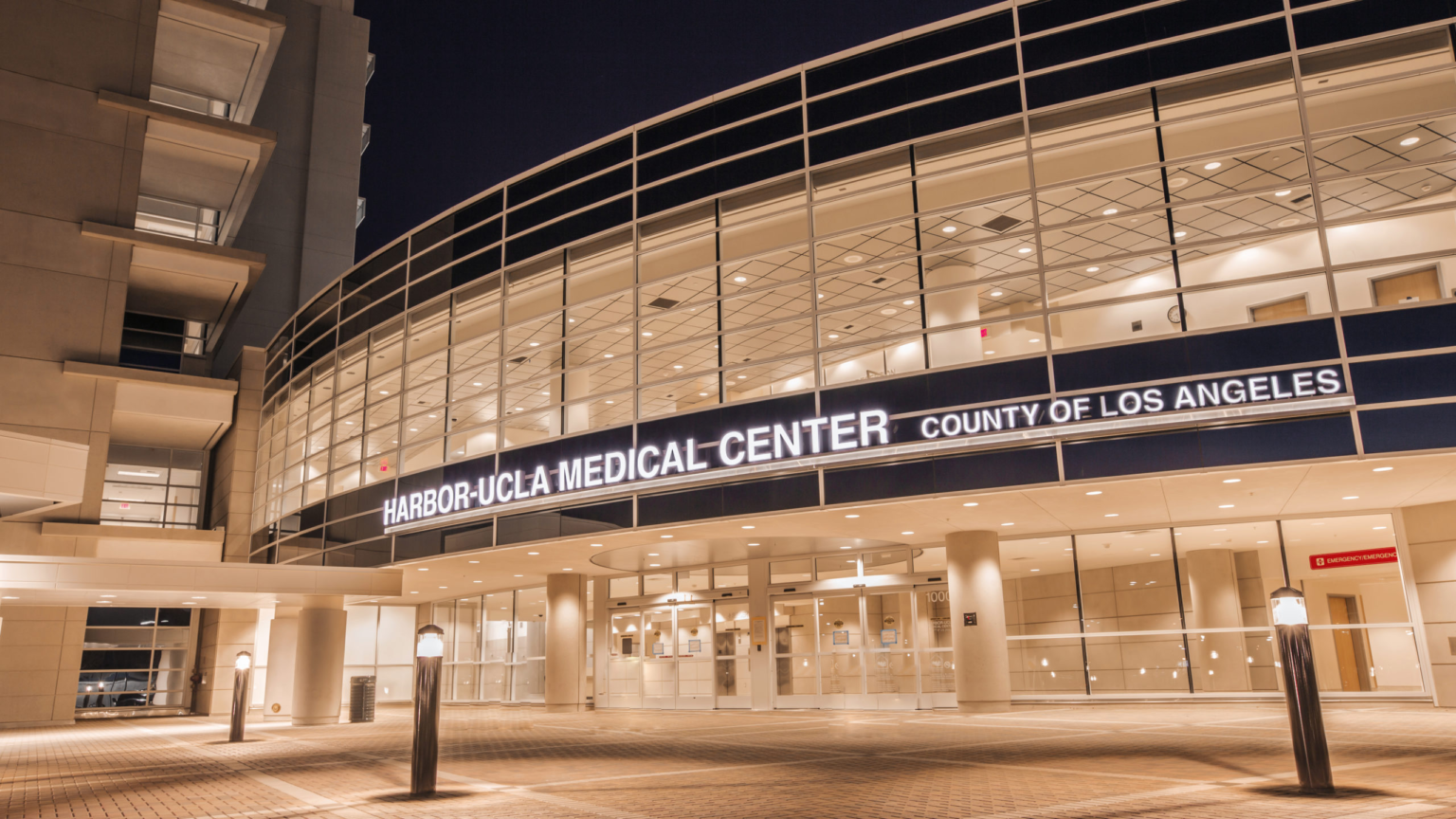
Bayron Rovidio Marin was arrested by Border Patrol agents and unidentified federal agents in plainclothes at the Carson Car Wash in Carson, California, on August 27, according to court documents reviewed by L.A. TACO. After sustaining “severe leg injuries” while being taken into custody, Marin was transported to the emergency room at Harbor-UCLA Medical Center in neighboring Torrance.
At the hospital, Marin was registered under a pseudonym and was monitored by federal agents at all hours of the day and night, according to an October 4 court order.
For over a month, two to four uniformed guards—either ICE agents or private security guards contracted by ICE—watched over Marin while he slept, ate, used the bathroom, and received medical attention.
"ICE agents listened to every conversation between him and his doctors,” Cynthia Santiago, attorney for CLEAN Carwash Worker Center, and Nicolas Thompson-Lleras, attorney for The Coalition For Humane Immigrant Rights (CHIRLA), said in a joint statement to L.A. TACO. “They interrogated him while he was in pain and under the influence of medication."
"At this time, we request that he and his family be given the privacy needed for a proper recovery,” the attorneys continued. “Our client and his family are grateful to the many people who have taken an interest in his case and advocated for his release."
Nearly a month after being arrested, Marin had yet to be processed or assigned an “A number,” a unique number assigned to ICE detainees, according to the court record. And as of October 3, ICE had not placed Marin in removal proceedings, charged him with violating immigration law, set bond, or otherwise processed him.
L.A. TACO first learned of Marin’s case through POLITICO legal affairs reporter, Kyle Cheney.
In a court filing, federal immigration officials stated that they intend to “to take further action” against Marin once he’s released for medical care. But they have yet to provide “any factual basis” for his arrest.
Under federal law, authorities have 48 hours to decide if someone will remain in custody following a warrantless arrest, or if they should be released on bond. Only in the event of an “emergency or other extraordinary circumstances” may someone be held for “an additional reasonable period of time.”
In the case of Marin, federal authorities have cited his medical condition as an “emergency circumstance” and claimed they have been “unable to examine” him.
What constitutes a “reasonable period of time” and “emergency circumstances” is somewhat subjective.
People who were arrested after the terrorist attacks of September 11, who were accused of being in the country illegally, were legally held for over a week in some cases.
But the circumstances in the case of Marin “are materially different,” United States District Judge Cynthia Valenzuela concluded.
Marin was held for 37 days, “substantially” longer than several defendants who were held for five to 16 days after September 11. In those cases a court found that the September 11 attacks qualified as an "extraordinary circumstance."
“Even assuming Petitioner’s medical condition qualifies as an ‘extraordinary circumstance,’ however, respondents do not explain how this emergency has prevented them from making a Section 287.3 determination,” the court found, referring to the law that dictates how long immigration authorities have to determine if someone should be held in custody after a warrantless arrest.
The federal government assertion that they’ve been “unable to examine” Marin “is contradicted by unrebutted sworn testimony that deportation officers questioned him about his place of birth, family immigration status, and other sensitive matters during his hospitalization,” the court concluded.
And holding him for 37 days without formally explaining why he’s being held is likely a violation of Marin’s “due process rights.”`
The court stated that the federal government provided no evidence that Byron is a noncitizen.
The court added that rulings in the ninth circuit have previously recognized that there is “no public interest” in agencies acting unlawfully. However, there is “substantial public interest” in governmental agencies following federal laws.
In a written statement to L.A. TACO, Jean Elizabeth Reisz, an attorney representing Marin, who is also a law professor at the University of Southern California (USC), said that being held in custody for over a month without being charged with violating immigration laws interfered with Marin’s access to family, attorneys, “and complicated communications with his medical team.”
“The law does not permit this kind of prolonged deprivation of an individual’s liberty without any allegations or charges of violating the law. It is fundamental to the right to due process in the Constitution, and is also part of our immigration statutes and regulations,” Reisz said.
When reached for comment, Christina Alejandra Marquez, an attorney representing the federal government said she was not allowed to comment on the case and referred us to Ciaran McEvoy, the public information officer for the U.S. Attorney’s Office for the Central District, who told L.A. TACO they have no comment.
Customs and Border Protection (CBP) did not respond to requests for documentation of a judicial warrant or questions regarding the decision to hold Marin in custody for over a month, nor did Immigration and Customs Enforcement (ICE) or Department of Homeland Security (DHS). But we will update this story if we hear back from any of them.
On October 4, Judge Valenzuela issued a temporary restraining order that requires immigration authorities to withdraw guards from Marin’s room, remove any physical restraints on him, such as handcuffs, and lift restrictions on his ability to make calls to family, friends, and his attorneys.
The order makes it clear that immigration agents should not move Marin from the hospital before he is medically discharged.
It’s unclear if immigration authorities have complied with the court’s order.
“I can say that the guards left his room,” Reisz told L.A. TACO.
Federal authorities have until October 16 to show cause why a preliminary injunction should not be issued.


