

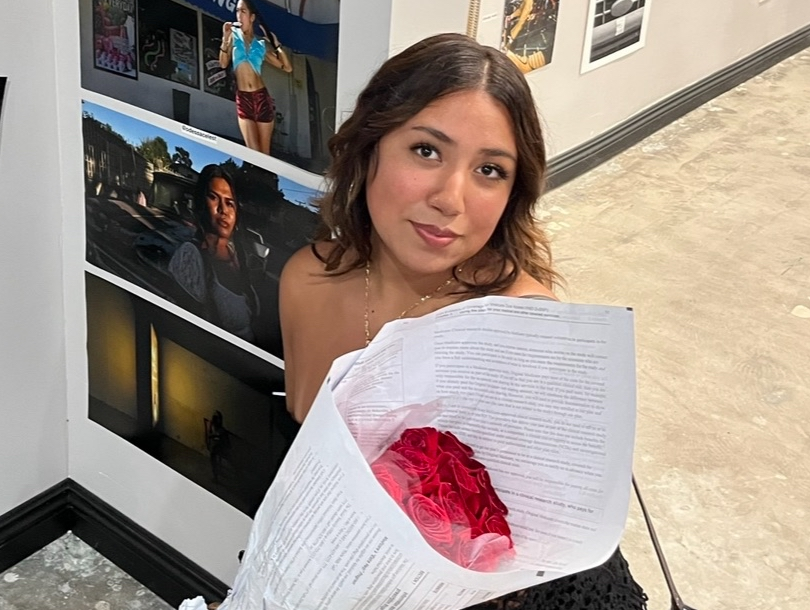
Isaura, a recent college graduate whose younger self would dress as an artist for career day and who today aspires to teach printmaking at a community college, believed that showing her work at the week-long show, alongside bigger names, was a dream come true. Over 150 days since the short-lived exhibit concluded, she sits disappointed, betrayed, and $1,248 short of sold artwork.
Deeply researched and vulnerable pieces got lost in this temporary Los Angeles exhibit that featured over 100 artists. Whether sold to a collector, stolen, or abandoned, various artists who featured work in the show are left with questions about where it now resides, along with unanswered emails from the show’s curators while they’re still yet to see a cent from their sold pieces, they say.
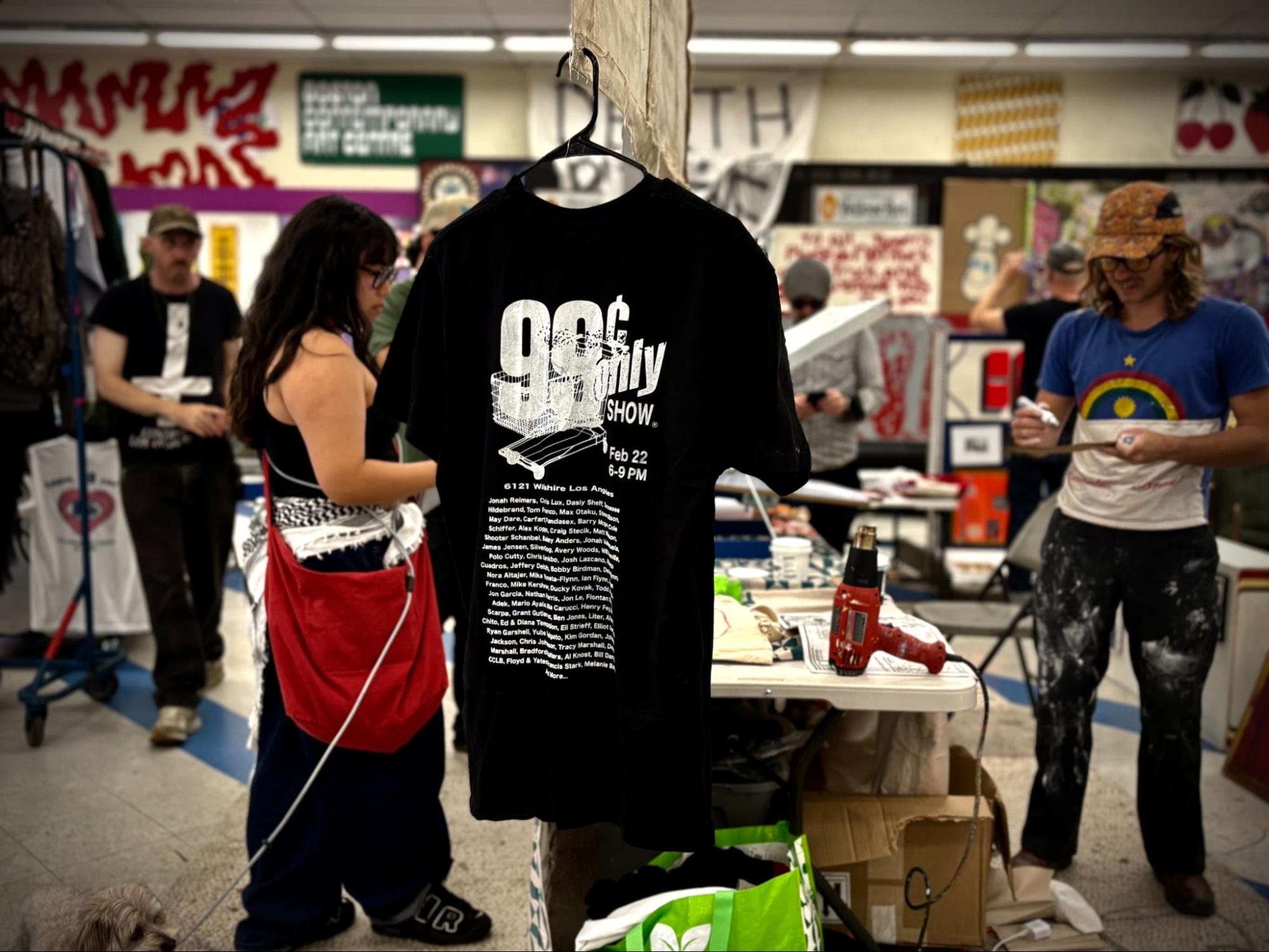
In collaboration with U.S. artist Barry McGee, “The Hole” presented an artistic hysteria inside a former 99 Cents Only Store from February 22 to March 1, for the making of "99CENT." Artists north and south of greater Los Angeles found themselves squeezing their original pieces into the show—whether they were personally invited from the curating crew, or tagging along with a friend who was.
“I thought it was fucking dope because it was the most anti-gallery show,” airbrush painter and Channel 5 News reporter Polo Cutty tells L.A. TACO. “It felt super chaotic, do-it-yourself. ”
Cutty, an L.A.-based artist who airbrushes mockingly educational artwork—like his piece called "Corruption" and another inspired by a Nigerian billboard ad—knew what he signed up for, but didn’t expect to be five months without pay from his sold work through the gallery. Invited to feature art in the show by a friend himself, and seeing as different artists flew in and out of the store to set up their work before opening day, Cutty gained the impression that the show would resemble more of a “graff party” for artists and their friends rather than a gallery with art sales.
Artwork began to multiply in the days leading up to the show’s kickoff, and continued whilst it ran for a week, completely transforming the unit. The chaotic yet artsy jungle, with foam sculptures for trees and spray painted banners for leaves, was bound by a sole Google Form.
While the application form was created and first sent out to different artists by The Hole, there were no parameters of who could, or could not, access it and participate in the show. There were no implications of a max capacity. No rejected applications. The sign-up link had been passed from one artist to another—making “word of mouth” the name of the game.
Cutty, like many others, was given the link to the Google Form by a fellow participating artist, not through members from The Hole as he says that “they were struggling . . . just dealing with the amount of people coming in.”
“There wasn’t no process,” Cutty says. “Anybody can walk in with a canvas.”
The Google Form required that all participating artists enter identifying information such as their first and last name, their email and cell phone number, and artist name if they had one.
Cutty listed three pieces for sale that were displayed among other unpriced paintings. With the mass of artwork and heads at the show, he was aware of the possibility of his art getting stolen, but was unaware that he wouldn’t be paid for his original airbrushed t-shirt that sold for $250.
If an artist wished to market their displayed piece, or pieces, they were required to check a box acknowledging that The Hole would take 20% profit from each of their sales. The artist would then list each of their selling pieces in a drop-down menu with a photo of their work, its title, the year it was made, and its price.
Having graduated from California State University Long Beach last year, Isaura relished 99CENT as an opportunity for the pieces she made throughout art school to meet a larger audience. With photographic printmaking as her bread and butter, she was excited to share pieces that reflected her memories with others, such as a warm landscape film photo from her trip to Joshua Tree, edited within what appears to be a saloon door’s silhouette, with framing flower and butterfly graphics, printed on a velvety-textured surface.
Isaura exhibited 15 original pieces at the show, listed all but two for sale, sold five pieces—with one being unaccounted for by show curators—and says she has yet to be paid.
Cutty listed three pieces for sale that were displayed among other unpriced paintings. With the mass of artwork and heads at the show, he was aware of the possibility of his art getting stolen, but was unaware that he wouldn’t be paid for his original airbrushed t-shirt that sold for $250.
Not long after the show’s close on March 1, artists who submitted the Google Form received an email from the former art director at the Hole, Charlotte Grüssing, inferring that the staff would shortly be going through the sales and that it would take several weeks to pay those artists who sold work. In the coming weeks, show curators sent "inventory lists” to selling artists that presented which of their pieces were sold and what the total pay would have come out to.
Isaura noted that one of her pieces was not included in the inventory list, yet wasn’t among her other displayed pieces when she had gone to visit the show, and sent an email to Grüssing. No more than 20 minutes later, Grüssing responded with an answer about her artwork’s location to be provided for the next week. After follow-up and follow-up from Isaura, about both her missing piece and payment for her five sold pieces, those 20 minutes turned into hours, then days, and now months.
“I kept everything friendly for so long,” Isaura says. “But you can only do that for so long until you get fed up.”
Cutty has also been following up with the gallery about his sold piece throughout the months and, unlike Isaura, saw responses, but with no definite answer.
Around three weeks ago, The Hole emailed him stating that they’re still catching up on all the sales, coordinating artists’ pay, and will get back to him by the end of the week, but didn’t. This past Thursday, The Hole emailed Cutty asking for his payment information, to which he provided them with for the second time. Today, he still has not been paid nor replied to.
“I kept everything friendly for so long,” Isaura says. “But you can only do that for so long until you get fed up.”
Throughout these months of silence, Grüssing had been sending messages to those added to The Hole’s email list about upcoming events, while Isaura has spent time endlessly searching for answers.
“It would always kind of excite me when I would get her email because I’d be like ‘Oh, finally a response,’ but nope, it’s just an ad,” Isaura says.
Fueled by her own indignation and social media literacy, Isaura was able to connect with other unpaid artists from the 99CENT show. It took analyzing Instagram captions for "I’m so excited"’s and "I’m happy to announce that"’s, and messaging participating artists to find that many artists didn’t sell, to finally be connected with friends of a friend who are on the same boat.
She, too, still awaits $1,400 from a sold painting—frustrated that the piece alone was “enough to be able to pay some of my rent,” she tells L.A. TACO.
Renee, an oil painter from up north who studied art at UCLA, felt less alone after seeing Isaura’s message about not getting paid. She, too, was invited to display her pieces at 99CENT by a friend who was directly “invited by that crew,” as Renee says.
She, too, still awaits $1,400 from a sold painting—frustrated that the piece alone was “enough to be able to pay some of my rent,” she tells L.A. TACO.
Renee featured an original series of four Los Angeles cityscape oil paintings in the show; each vibrantly highlighting an L.A. staple, like a liquor store that never goes out of style, with hours of research embedded in the paint.
Like Isaura, Renee had a piece go “missing” from the show and was never paid for her oil painting that sold. And, like Isaura, she says she has sent several emails and made phone calls to The Hole within these past months but never heard back. She also reached out to show participants, but was turned down due to their fear of speaking out and seeing their careers spoiled, as artists early into their careers.
“I understand it’s exhausting, but as a smaller, new emerging artist that’s kind of what we need to get our footing somewhere,” says Renee.
Just this last week, The Hole was reportedly sued by two contemporary artists who have not been paid a combined $50,000 from their sold artworks at the gallery. While Isaura and Renee now find themselves in the same position, they found hope after seeing that other hurt artists are taking a stand.
“This is important because other people shouldn’t work for The Hole,” says Isaura.
“As an artist, I support other artists, and I want to warn people,” Renee says.
The 99CENT show was both Isaura and Renee’s first time exhibiting art with a big gallery. Since graduating with a BFA in printmaking the year prior, Isaura took 99CENT to be a safe haven for newer artists, compared to the bigger galleries that she finds unwelcoming and intimidating.
“It was kind of for everyone, and students, and people who might not have that opportunity right away,” Isaura says. “I never worked for a large gallery, this was my first time. That’s why I was excited.”
That excitement had grown into skepticism as the days continued to pass without payment or a response.
In early April of this year, ARTnews reported that The Hole was being sued by the property owner of one of its two New York galleries for owing over thousands of dollars in rent. With that knowledge, unpaid artists from the 99CENT show believe that what came as a big achievement to them was only a matter of making money for the New York-based gallery.
“I do feel like, since they have this lawsuit of not paying their rent, I feel like that’s kind of what they’re using these proceeds from the show for,” says Renee.
Though frustrated with The Hole’s lack of transparency, Cutty chooses to give the gallery the benefit of the doubt as he figures they bit off more than they could chew with 99CENT.
“It’s just so difficult, especially when they have no clue who’s all involved . . . it’s just overwhelming,” Cutty says. “If it was a little bit more organized I think it would have been easier to handle the situation.”
Though more experienced within the art scene, Cutty has noticed a rise of sponsored art shows that push its artists to the side.
While Isaura and Renee’s first big gallery experience will be remembered differently from how they expected, they remain hopeful of their future endeavors with other big art galleries.
“I think there’s a lot of secrecy and a lot of opaque kind of contracts where artists . . . treat it like a job and then people just piggyback off it,” Renee says. “But I know there are a lot of good galleries out there that take care of their artists.”
In late August, Isaura will be off at an art residency that she was accepted into. With the help of the art residency covering half of the cost, and support from others buying her prints via social media listings, she was able to afford the acceptance offer but expressed that her earned money from the show “definitely would have been helpful.”
“It makes you feel really good when there’s opportunities like that, and there’s people who want to help artists that don’t have the means to do certain things like that,” Isaura says.
Though more experienced within the art scene, Cutty has noticed a rise of sponsored art shows that push its artists to the side. A painter himself, he deems artists to be the backbone that “make the show exist,” and deserve to see a cut from the money that sponsorships reel in. He condemns the exploitation of today’s emerging artists looking for opportunities as he understands the struggle of making a living from art.
“Artists need to show work,” he says.
These three artists believe that, instead of leaving them in the dark, making a statement of accountability and further action would be The Hole’s next best move.
The Hole has not responded to L.A. TACO's requests for a comment.


