This story and all of L.A. TACO's Arts coverage is sponsored by Nikos Constant.
When Los Angeles has run itself dry of fresh creative spaces, what more can it do but find a temporary home within the city’s forgotten landmarks? After the loss of 99 Cents Only stores in different communities in 2024, many of the locations were turned over to become different businesses, including Dollar Tree.
Driving down Wilshire, what appears to be an abandoned, graffitied store with foggy windows is lost amid the shadows of the nearby Academy and Petersen Automotive Museums surrounding it. But just behind the store is a rear entrance leading to a nostalgic, feverish experience.
In the aisles where 99 Cents Only products once stood were now disfigured sculptures and portraits, their overwhelming color schemes balanced with the overhead tunes, bouncing from soft-indie music to a whimsical, lyricless jingle.
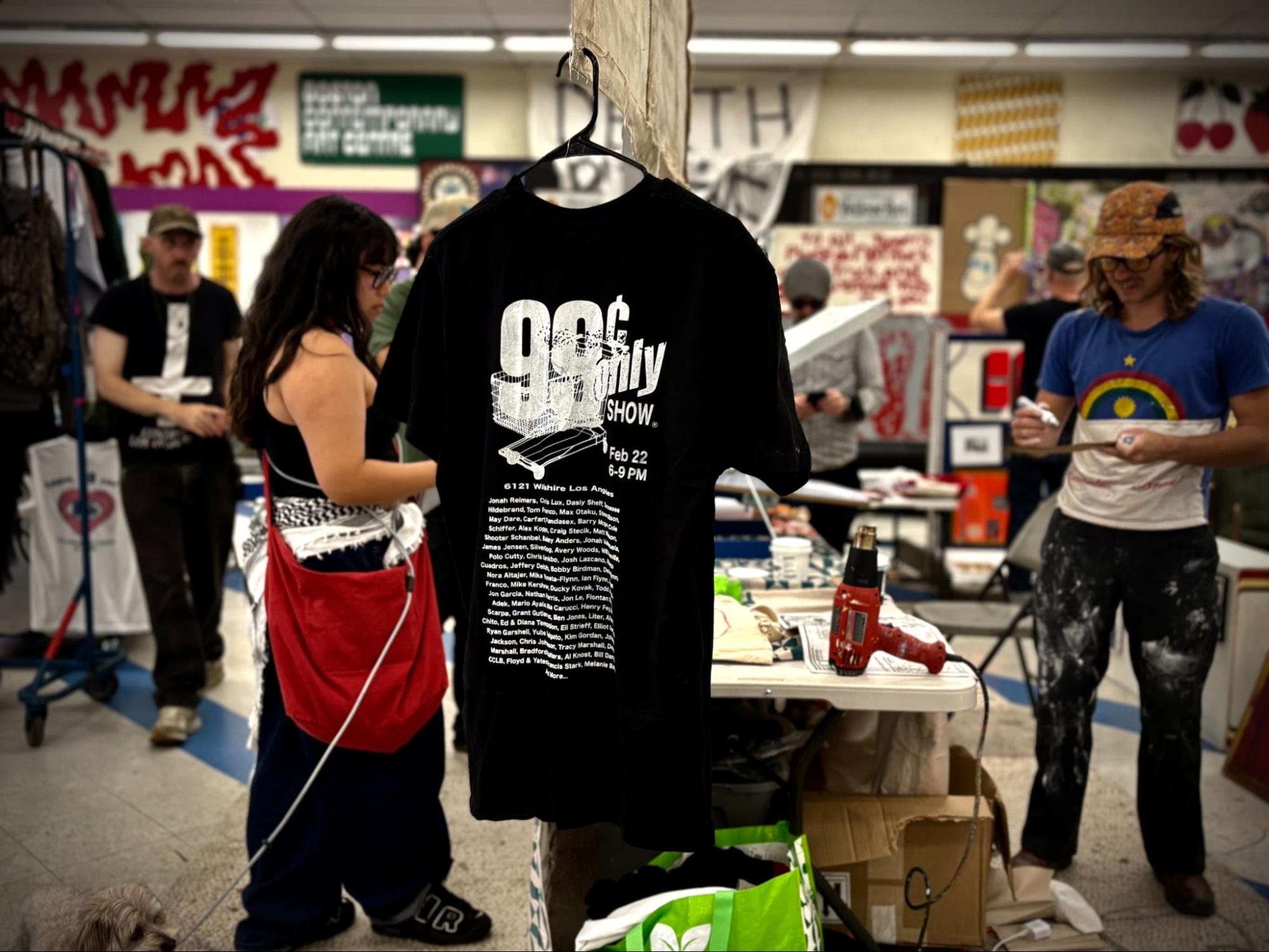
Without deconstructing the bones of 99 Cents Only–leaving its original blue and white tile floors, numbered purple signs that hang above each aisle, long white shelves, and checkout lanes in the front and back of the store–The Hole, a contemporary art gallery run by Kathy Grayson and American artist Barry McGee, took form from their partnership. Together they’re helping to reimagine a tribute to art and nostalgia with their “99CENT” exhibit.
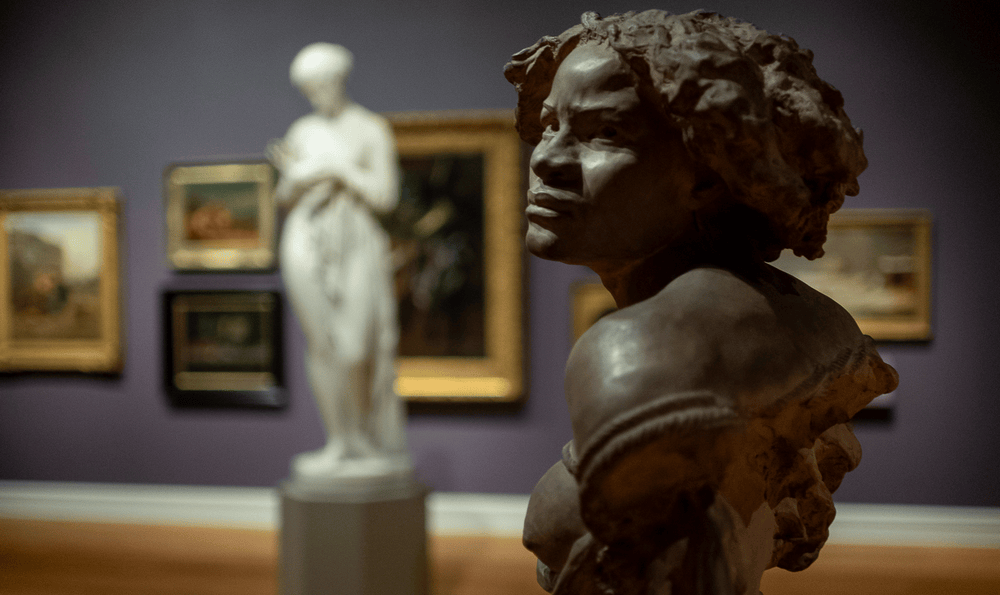
Inside the abstract haze are aisles cramped with different mediums of creativity– from foam sculptures made to replicate the human body, black-and-white film prints, childhood toys thrown together to tell the story of youth, and toilet paper with previous presidents drawn on each cut to numerous anti-ICE markings on posters, and a bridal gown tagged with spray paint.
“The scale of this [exhibit] and amount of artists contributing is really quite exceptional and really something only Barry could pull off,” Charlotte Grüssing, an art director at The Hole tells L.A. TACO. “Artists were showing up by the hundreds up until the opening."
While the exhibit provided a venue for underground artists to show their work, it also served as a creative playground for McGee and his artist friends.
“The word-of-mouth really spread,” says Grüssing. “A lot of old friends and mutual artists from the graffiti scene, or artists he’s [McGee] worked with over the years, as well as some really emerging people who, through friends of friends, got the word . . . this is long-term relationships and friends making this happen.”
Trailing from ceiling to floor are displays that pay homage to the different cultures of L.A.: skate, surf, and street, among others, often with the artists’ names in front. Congested with the varied installations, one or two walks through an aisle does not guarantee seeing all the projects nor understanding each of their messages.
As a competitive field with limited opportunities at success, 99CENT provides an ego-free outlet for all kinds of artists to get exposure for their work, even if it’s just for a split second of time, since the exhibit is only open for a week as of their February 22 opening.
“There’s some stuff that literally looks like the stuff [you see] walking around an art college at the end of the semester that just gets left behind because they were assignments,” says exhibit-goer Bryan Rosser, recalling his time at an art school.
The visitors, too, reflected 99CENT’s embrace of L.A.'s diversity, as guests from different generations, skin colors, sub-cultures, and media algorithms each analyzed the artwork with the same forward lean and furrowed brow.
Although some objects around the store may seem out of place—like the emptied sardine tins and egg cartons—they all seemingly fall under the exhibit’s central theme: no theme at all. With the deranged atmosphere that makes use of any memorabilia, a crushed can of Modelo left behind is easily mistaken as an artist’s symbol for a deeper message.
“I love how everything’s so abstract and that there’s some [displays] that definitely have message and some that you have no idea—maybe it was just an expression of self in some kind of way,” says Ginger Sorrah, who found the exhibit from an online recommendation.
“I don’t really know what I’m looking at but it’s visually very appealing to see something that’s bizarre and different,” says Jenni Ricci, Sorrah’s friend and a photographer from L.A., telling us she can spend hours in the exhibit observing each piece. (Editor's Note: Jenni Ricci's last name was corrected on February 26 after originally being spelled "Richie.")
As 99CENT is both by and for the community, free of contribution and visitation fees despite the spreading buzz for the show, participating artists profit only from the luck of one of their pieces being sold, though most are content in their sole love for creating.
“They [artists] have free space to show their work—it’s very much for the artist and they’re benefiting from showing amongst some of their idols and friends,” Grüssing says. “They’re able to sell work and come together as a community.”
Sitting just across the street from some of L.A.’s big-hit museums, 99CENT offers a more community-oriented zone that lets the weird roam free, where artists are given the liberty to just do—whether taken seriously or not.
“It definitely has this feeling of going into a thrift store,” says Tula Jeng, an art enthusiast from L.A. “Everything tells this very specific story and although there’s so many artists that I don’t know—that I’m going to discover today, you get a really strong feeling for all of their voices and point of view.”
“This is also just a nice juxtaposition from LACMA [museum], it’s great art but from seeing [Claude] Monet . . . to see this in a different way, in a different light,” adds Steve Motola, from under an L.A. TACO hat. “It’s just more peoples’ art and it doesn’t have to be funded by tens and millions of dollars . . . it’s refreshing to see this space provided for so many folks.”
Before the art exhibit, the space was occupied by The Really Really Free 99, a totally free store run by the Community Solidarity Project, a non-profit who had been donated the empty space on a handshake agreement with its landlord until a lease was processed. The organization utilized the space by providing free essentials like non-perishable food and baby supplies for those impacted by the 2025 fires and recent ICE raids.
The organization operated out of the store up until February 12, when the landlord notified them of the art exhibit taking place.
“We always knew that it was going to come to an end and we’re extremely grateful that we were able to get a full year [began in January 2025] out of that,” says Roz Jones, a founding member of the organization.
Though aware of their borrowed time at the space, organization members were still saddened by the lack of proper notice.
“I personally wish that we had more time to give the Free 99 a proper goodbye and create a healthy, smooth transition for the projects we were working on and the families we were supporting,” Jones says.
“The issue is really [that] we wish we would’ve had more time to be in community with our coalitions and with the people we were serving so that we could process things together and really be able to communicate what was going to come next for us,” said Community Solidarity Project director Michelle Manos.
With time playing a vulnerable role in this situation, the organization believes that the harm of closing the Free 99 could have been avoided through extra consideration.
“What we could have done was be more collaborative together so that we could have reduced the harm of losing the donation center,” says Manos.
“We just really want to stress that we have an enormous amount of gratitude for the donation of the space to do our work,” she says later.
6121 Wilshire Blvd. Los Angeles, CA 90048 ~ 12 p.m. to 6 p.m. until Sunday, March 1
Updated on February 26, 2026: The original version of this story misstated the name of the Community Solidarity Project. Comments from the organization’s director and one of its founding members have also been added after they responded to L.A. TACO’s request for comment post story publishing.