

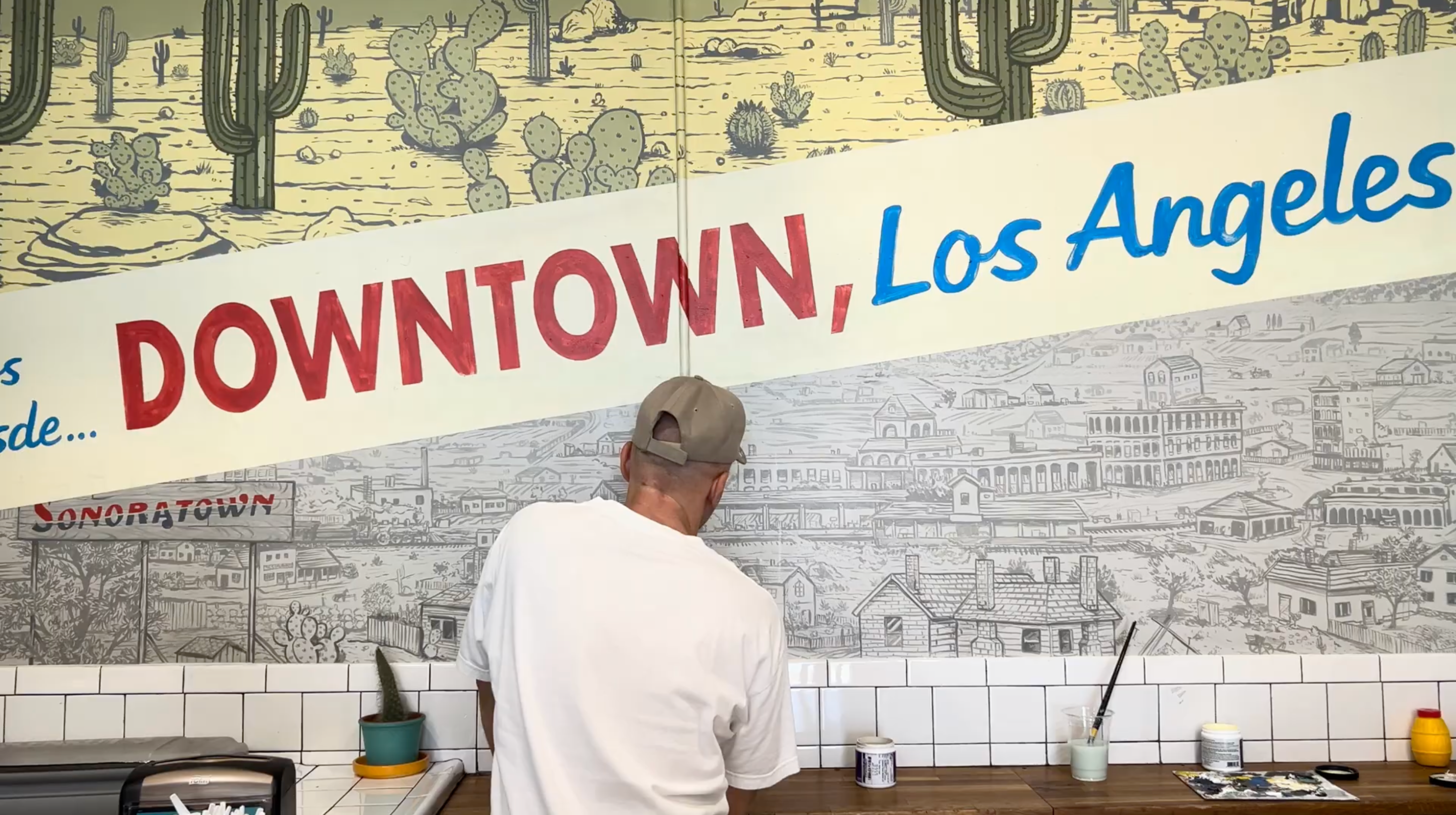
The artist makes slow, deliberate strokes after loading a brush with just enough paint to lay down a clean line without a drip. They use no stencil, relying on decades of muscle memory from performing the same motions throughout the city.
Most people walk past the signs and murals adorning some of L.A’.s most esteemed taco shops and don’t think twice about who made them. But behind the colors and letters are respected artists like Mikołaj Wyszynski.
This includes the art inside Sonoratown, one of L.A.’s best taquerías. Its now iconic mural (a collage of imagery tracing the wheat that makes the tortillas here so distinct, sourced from the Rio Grande basin near San Luis Río Colorado), along with its menus, signage, and designs across all three locations, was created by Wyszynski, under the direction of owners Jennifer “Jen” Feltham and Teodoro "Teo" Diaz-Rodriguez, Jr.
Ten years ago, before it was Sonoratown, the space was Toto's, a small Mexican restaurant serving garment workers in the Fashion District, back when you could still hear the pneumatics and the sewing machines running nearby. Wyszynski was a regular. When the new owners quietly started looking for a sign painter, his existing murals in the neighborhood did the talking for him.
"It is elusive," he says. "You just see our work, but we don't really put our number on there.”
He'd already painted a rooftop mural visible to the owners of Sonoratown's loft, along with signage and apparel for Down and Out and other small businesses in Downtown. That was enough for Wyszynski to land on their radars.
"I'm just the tool between the owners and their vision, bringing my experience and my hand style to their establishment,” he says. “It's been 10 years; it's been really good."
Wyszynski has lived in the L.A. area since the '90s, when his family settled in the Inland Empire after moving from Poland. He went to Norco High School, "east of L.A., where it's hot in the summer and cold in the winter, and it's just kind of hills and desert and suburbs," he tells L.A. TACO.
That's where he first picked up acrylics.
Looking for work as a young artist, he started painting kids’ rooms in suburbia. Soon after that, it was painting tract homes, and then restaurant signs. The restaurant work is what stuck. He took a brief, six-month job at a sign shop doing channel lettering and neon setup; there, he learned to bend sheet metal into letterforms by hand.
"Just manufacturing in the warehouse," Wyszynski says. "You just get a roll of metal, and then at the end of the day it's just a bunch of K's, L's, and S's. That was really cool."
The artist’s fingerprints are figuratively and literally all over some of Downtown's most storied buildings.
He left to finish school and earned an associate’s degree in art from Riverside Community College. By then, sign painting and restaurant murals had become his main hustle, and the early 2000s had a very specific look: beach scenes, Corona bottles, and mission arches. Lots and lots of mission arches.
"Missions were everything," he laughs. "I actually painted a bunch of missions."
His first commercial mural was a beach scene between arches at Casa Mota, a small Mexican restaurant located in a shopping center in Riverside. From there came work at several Mariscolandia locations across the Inland Empire, which he painted with cartoonish fish and squid floating across the walls.
One location that stands out from the rest is El Acapulco in Corona, where the new owner "fed me and gave me work," Wyszynski notes. "I'm really thankful for that relationship."
A move to Long Beach opened up more work: vintage-style lettering on 4th Street’s Vintage Row, a run of chalkboard murals that includes farm animals, butcher knives and wording all rendered in white pencil on black chalkboard for Bo-beau, a gastropub with a rooftop patio on Pine Avenue.
Recently, Wyszynski painted the decor on the 5th Street location. You can see it placed all over the counters, the menu hanging above the registers, and the teal wall with "SONORATOWN" hand-painted in white, orange, and red letters, continuing his long-standing relationship with them.
His resume stretches well beyond Sonoratown. The artist’s fingerprints are figuratively and literally all over some of Downtown's most storied buildings. He brought the original signage back to life at both The King Edward Hotel and the Baltimore Hotel, which carries its own bit of movie magic, once serving as a filming location for John Carpenter’s “They Live,” one of Wyszynski's favorite films carrying a deeper meaning for him.
Then you have the Hands mural in the Arts District that had its viral moment, and it's been up since 2014, tagged only once in over a decade, which he considers a small miracle. Elsewhere, he painted a mural of a cyclist racing through the leaves outside Spoke Bicycle Cafe in Frogtown.
"You could go hire some artist who got paid tens of thousands with a whole group of promoters, and they're probably going to get tagged on the next day, just like they did at the Alloy in the Arts District," Wyszynski says. "My work is affordable, and it's still running. The taggers don't hate on it."
He has also built a body of paintings documenting Downtown L.A.—particularly Oceanwide Plaza, better known around the neighborhood as "the graffiti towers”—and a burned-out paper warehouse locals have nicknamed “Trash Island.” His paintings of the towers themselves capture the graffiti, which is expected to be cleaned up as the towers shift to a new owner. The paintings themselves are textured, highlighting the graffiti tags across the glass windows in his photorealistic style. He even makes the frames by hand.
"It's just people that live in that neighborhood," he says. "I painted one or two of those paintings, and the people who live in the area started buying them." He's sold nearly 30 pieces from the series so far.
"It's kind of crazy," Wyszynski points out. "They're paying top market rate for lofts, and the view outside is either the graffiti towers or a hollowed-out building. But it grew on them."
Despite two decades of his paintings being scattered across the city, Wyszynski doesn't get much recognition for his work, something he's made peace with.
"I would like to get some more notoriety for it, but it just gets omitted," he says. "Subconsciously, if the sign is really well done, people like it. They might not say something about it, but they like it. And that's the important part of running a business: You're branding an image, and it needs to be good."
He candidly mentions AI's growing presence in restaurant branding.
"It's super mid, mediocre. There's no personality," he says. "If that pizza doesn't look like the AI picture, I'm not buying it. You can sell tacos and food in L.A. without ChatGPT."
His advice for young artists follows the same logic: Don't overthink it, don't chase trends, and don't turn down the small jobs. He cites advice from artist David Choe, who used to sell paintings out of a yogurt shop.
"Just go do it all," Wyszynski says. "Do the yogurt place. Put your paintings there. Do the local coffee shop. Don't be afraid of rejection."
"The creative process is going to come from the canvas, not in your head all the time," he adds. "Don't be afraid of taking something that's not top dollar. You might meet somebody in your local neighborhood that leads to a bigger job."
Find Wyszynski's work at Virtue Coffee Shop near the graffiti towers and at a curated show by Albert Reyes at Eastern Projects in Chinatown this October. Wyszynski's handiwork has a way of sneaking up on you, from the merch to the small details above the counter. So, try to keep your eyes peeled next time you're posted up waiting on your order.


