[dropcap size=big]F[/dropcap]or generations, El Salvador has been producing some of the most premium coffee in the world, an often overlooked fact in the constant hubbub over Guatemalan, Brazilian, Colombian-origin coffee. When Americans do see Salvadoran beans, it’s usually through blends with other coffee powerhouses.
However, two Salvadoran coffee businesses in Los Angeles, Don Leo’s Coffee and Cafe Juayua, aim to change that with single-origin coffees from Salvadoran coffee farms. Together they are filling a void most of Los Angeles probably didn’t know it had: coffee direct from El Salvador.
“El Salvador doesn’t get the credit it deserves for the quality of coffee it produces,” says Cristian Quintanilla, owner of Don Leo’s, which is based in Marina del Rey.
Don Leo’s Coffee came about after Quintanilla labored in search of a true cup of Salvadoran coffee. Like many migrants, he went searching for a taste of home. In 2010, his search took him to coffee shops, regular and high-end grocery stores, scouring the coffee shelves for anything that had a label that read, “Coffee from El Salvador.”
His search became even more obscure when he searched for an actual Salvadoran coffee brand. “'Wait a minute that’s not right.' That thought and that experience just stayed in my head,” he said.
Why El Salvador isn’t at the tip of the tongue when it comes to coffee production is in part due to the crop’s tumultuous history in the country. Coffee became an agricultural powerhouse in the 19th century, however this led to it being at the center of issues like corruption, gang fees, exploitation of indigenous people, land rights. Then there was the civil war of the 1980s and even El Salvador’s largest massacre called La Matanza. The barrage of issues made it a challenging industry to get back on its feet sustainably.
Despite El Salvador’s excellent conditions to produce specialty coffee across the country (due to its volcanic material and forest shade), it still only produces a small fraction of what other coffee giants produce in a year. For instance, according to Reuters, in 2018 El Salvador produced 740,000 bags of coffee. Each bag weighs approximately 152 lbs, which only amounts to 1 percent of what Brazil produces. This makes it difficult for farmers to get a healthy payout for their harvest.
An added layer of difficulty is the specialty trees that make the best coffee in the country also happen to be the most challenging when it comes to disease resistance.
With a dissatisfaction over his options, Quintanilla became obsessed with research in the coffee industry of El Salvador. Years went by. While in corporate finance for a Fortune 500 company, Quintanilla began his plans, traveling extensively to El Salvador and diving deep into research. He later used his grad school degree to do more research on coffee in the States.
Everything came together in late 2017, when Quintanilla met up with a high school friend in Los Angeles. His friend heard about his research and asked him for a business plan. Quintanilla, ecstatic about the opportunity, composed the plan, and by the end of the meeting had secured the financial investment to make a go of his business.
He quit his finance job in February 2018, and in June of last year, received his first coffee shipment. And like that Don Leo’s Coffee – named in honor of Quintanilla’s grandfather – was in business.
Don Leo’s Coffee is smooth, with floral and citrus notes and it is sourced from Apaneca, Ahuachapán, at 3,900 feet. It is sold in specialty stores, Salvadoran restaurants, and can be purchased online.
RELATED: Hot and Cool Cafe ~ In Leimert Park, A Coffee Shop Builds Community Bonds
[dropcap size=big]J[/dropcap]uayua is a mountain town in the department of Sonsonate, where the Gonzalez family has deep coffee roots. Cafe Juayua was founded in 2016 when Linda Gonzalez, realized that her father, would get an enormous amount of stress from sending money to keep the family coffee farms afloat.
“He would be stressed around this coffee conversation – it was financial stress. The farms had to be supported [and] somebody had to be financing them year after year,” said Gonzalez. It was then that she and her husband Juan, along with her brother, decided to take over leadership of the business. They did so with hopes of lightening the load on her father and simultaneously creating sustainable solutions for the farmers back in El Salvador, many of which are her family members.
“It was a very naive idea,” Gonzalez recalled. “We didn't understand how deep the coffee industry was. ‘Let's just sell coffee, how hard can that be?’”
When it came to the name, Gonzalez knew she wanted to keep her family’s indigenous connection at the forefront of their business. They are third generation coffee growers from Sonsonate, so they went with Juayua, not just for its location, but also because it is a Náhuat word – the native language of the Pipils, the indigenous people of the land. Juyua means land of the purple flower or orchid.
Being intentional about the indigenous heritage was something important to the family, according to Gonzalez. “It's such a peculiar world, maybe it's a little difficult but I've heard it all my life [and] I think it's very significant if you allow people to speak a different language for a moment,” she said.
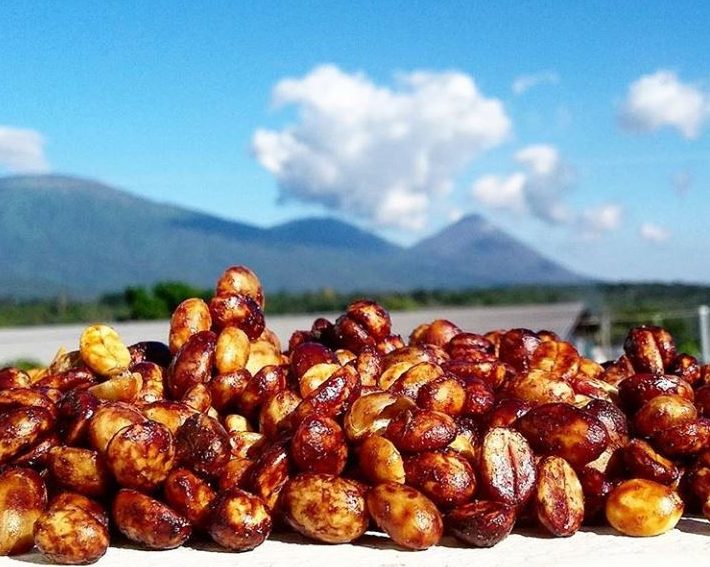
They offer three single-origin coffees from heirloom coffee varieties – Bourbon, Pacas, and Catimor – at the altitude of more than 3,000 ft. They offer a Traditional Wash coffee, a Honey coffee (referring to the sticky appearance of the beans while drying), and Natural Process coffee. All the coffee ranges in flavors like chocolate, caramel, and ripe blueberry notes.
“El Salvador coffee in Los Angeles is already special because there’s not much Salvadoran coffee in L.A.,” Juan Gonzalez told L.A. Taco.
Most often Salvadoran coffee is found in blends. Cafe Juayua’s coffee, on the other hand, wants to offer coffee from a single farm, and a single variety. “It's something that the industry is starting to appreciate more and more. The family blessed with having coffee farms, historically has produced very good coffee,” said Juan Gonzalez.
Cafe Juayua can be purchased at cafes like El Cielito Cafe, and Ground Up Coffee shop and through their online store.
Competing with the established system in El Salvador has been the biggest test for both sets of owners from Cafe Juayua, and Don Leo’s Coffee.
“We're going through it,” explained Juan Gonzalez. “The system there has a very clear path and it's established. The coffee is routed from the farm straight to the beneficios and exporters. They have their exporters and importers, so breaking away from that, having the courage and walking away from that specific framework is what is challenging.”
For both coffee brands, they are among the first in attempting this model. Bringing single-origin Salvadoran coffee to the United States is difficult at times. They are breaking ground as 100% Salvadoran coffee brands.
But Juan Gonzalez is undeterred from the complex circumstances of the coffee. “I love coffee, but I love people more. The risk that I take here, is nothing compared to the risk that our people have to live through in El Salvador, so that's why I do it.”
RELATED: Feminist Food and the 'Queerest Coffee' in Long Beach ~ Wide Eyes Open Palms