


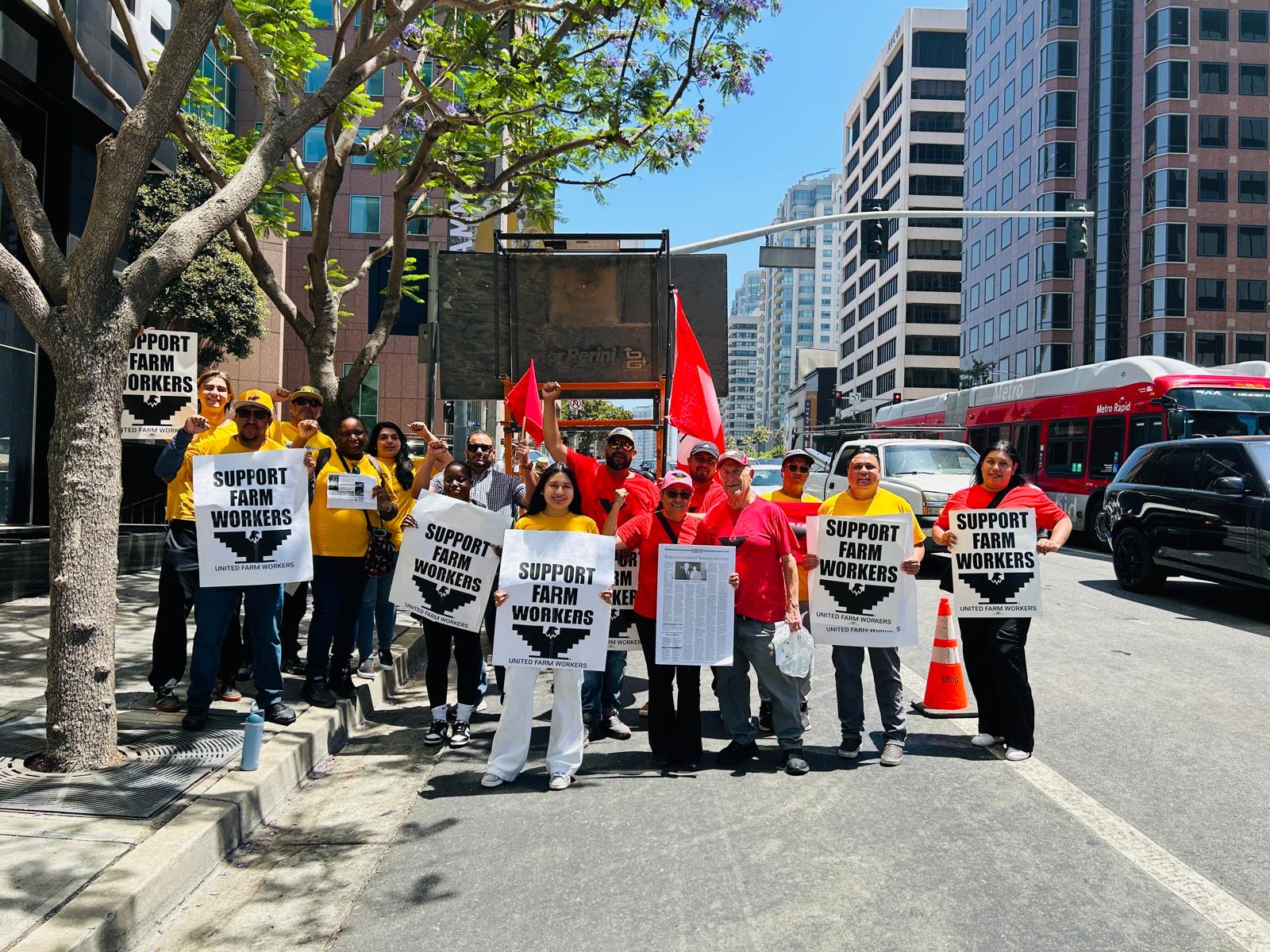
On Wednesday afternoon, farm workers and supporters organized by the United Farm Workers union protested outside of the UCLA Hammer Museum, which received a $30 million dollar donation from the Resnick family of the Wonderful Company.
“They gave $30 million dollars to support this museum. Meanwhile, many of their workers don’t have health insurance. We don’t have fair wages,” said Rosa, a farm worker working at Wonderful Nurseries for the past six years. “This is what their empire is based on. This is where they get their money, which they then donate to museums like this.”
The Resnicks made the donation in 2018. The funds were used for the construction of the Lynda and Stewart Resnick Cultural Center, which opened in 2023.
Around 90 people protested in front of the Hammer Museum– representing eleven organizations including UFCW 770, California Nurses Association, AFCSME 3299, UAW 4811, American Federation of Teachers, Clergy and Laity United for Economic Justice, UPTE, Unite Here Local 11, and International Brotherhood of Electrical Workers.
The UFW has been engaged in a Wonderful worker unionization effort for two years and a majority of the workers decided to join the union, according to UFW spokesman Antonio De Loera-Brust. Instead of recognizing the farm workers union and negotiating a union contract, Wonderful engaged in a union busting effort, said De Loera-Brust.

“They pressured and persuaded many workers who had signed of their own free will to say they had changed their minds,” said Rosa. "And now they are even threatening to shut down the entire nursery where I work — firing hundreds of workers rather than recognize the union.
“This is my message to the Resnicks: if you can give millions to this art museum, which a majority of your workers will never visit, why can’t you also pay your workers something fair?!”
Rosa and many of the protestors came down from the Central Valley for this action and to visit the museum, according to De Loera-Brust. The farm workers felt proud that their labor is part of what made the donation to the Hammer Museum possible.
Following the rally, Rosa and other UFW supporters wanted to enter the museum. De Loera-Brust said that they were initially denied entry. After negotiating with museum staff, Rosa and one translator were allowed into the museum.
“Since when is exercising free speech cause for not being admitted to a museum?” said De Loera-Brust. “That’s [in their] mission statement. The first thing it talks about is using art to create a more just world. I don’t know what they mean that they won’t let workers look at the art."
"The Hammer Museum at UCLA believes in the promise of art and ideas to illuminate our lives and build a more just world,” reads the Hammer Museum’s About Us page.
L.A. Taco reached out to the Hammer Museum for comment but did not receive a response.

Wonderful is often cited as one of the largest agricultural companies in California – a six billion dollar company best known for their pistachios, almonds, Fiji water, POM juice, and Halo tangerines, according to the Wonderful website. The company was founded by Lynda and Stewart Resnick in 1979.
The couple and their company have faced many critiques over the past couple of decades, especially over their use of one of California's most scarce resources, water, and the conditions of the places where their workers reside.
Mother Jones investigated their water use in 2016. During the California drought in that same year, the Resnicks, like many farmers at the time, began to drill for groundwater on their properties. Despite the drought, the use of groundwater allowed for almond and pistachio acreage to increase.
The conditions of the communities in the Central Valley where many of their farm workers reside, like Lost Hills, have also drawn criticism.
It’s not just UCLA’s Hammer Museum that has accepted donations from the Resnicks. The Los Angeles County Museum of Art received $45 million dollars for the construction of the Lynda and Stewart Resnick Exhibition Pavilion. They have also made charitable contributions to academic institutions and invested $580 million dollars in community programs in the Central Valley, according to the New York Times.


