


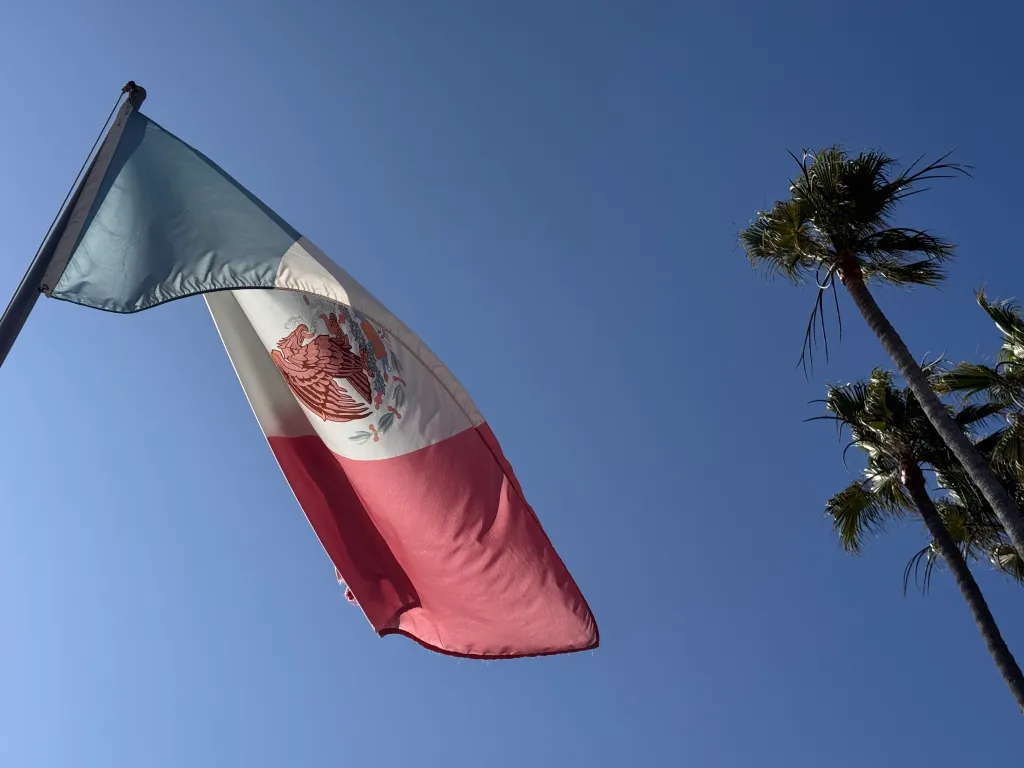
The United States is gearing up for something reckless: a war on Mexico, packaged by Trump and MAGA as a crusade against fentanyl and the so-called “terrorist” cartels.
No one here is defending drug trafficking or organized crime—but that’s not what this is really about.
So why is the United States really preparing to attack Mexico and stop any reforms? Two words: power and labor.
Washington is feeling its global influence slipping—its “soft power” questioned abroad, its military power stretched thin. Mexico, meanwhile, is not sending migrants north in the same numbers it once did. Enforcement plays a role, sure, but the deeper truth is that Mexico is finally beginning to emerge from its historical malaise. Mexico has moved toward a new and different path, but the U.S. does not want the abusive historical cyclical relationship to end.
Mexico today is not as beholden to U.S. economic power as it once was. In fact, it could be argued that it is the United States that depends far more on Mexico than it admits.
Mexican labor has been vital to many economic sectors that would otherwise struggle to survive without it—agriculture, hospitality, manufacturing, food processing, construction, kitchens, and nurseries, to name a few. Without this low wage Mexican labor subsidy, the broader U.S. economy would be challenged.
The irony is that Mexico has been trying to reduce its dependency on the U.S, while the United States is addicted to its perception of cheap Mexican labor. This American refusal to acknowledge that Mexico and other countries are moving on from U.S. hegemony is the essence of this ongoing and historical tug of war—ensuring a clash of some sort.
The consequences of this clash will be felt for generations. Whether these consequences turn out positive or negative and for whom depends on choices yet to be made on both sides.
For his part, former Mexican President Andres Manuel Lopez Obrador or (“AMLO”) laid the foundation for current U.S. anxiety with anti-corruption initiatives, sweeping constitutional reforms, and massive infrastructure projects during his 2018 through 2024 administration. The most audacious part of AMLO and his strategies is that he made reforms without permission from the U.S.
At the heart of AMLO’s agenda was judicial reform—a direct strike against what many Mexicans have long viewed as a corrupt, foreign-influenced judiciary. However, the reform did not get passed until the end of his Presidency, leaving implementation to current Mexican President Claudia Sheinbaum.
Sheinbaum, sworn into office in late 2024, has taken up the mantle of judicial reform with determination. This September, she is poised to launch the most ambitious phase yet: full implementation.
The objective is clear—severing the historic strings of U.S. influence that have long reached into Mexican institutions. While judicial reform is not a panacea for all of Mexico’s challenges, its enactment will be the foundation to curtailing the ability of foreign powers to manipulate the country through the corruption of judges and politicians.
Thus, Trump’s attacks on Mexico are not truly about fentanyl or migration—they are about blocking reform and Mexican independence.
A clean, independent judiciary would transform Mexico’s future, anchoring economic and social stability for generations. With real accountability, corporations would finally have to pay their taxes, and the rule of law would carry real weight. Such justice would open doors to more opportunity at home, reducing the need for Mexicans to migrate north. And less migration means the U.S. economy would have to stand on its own—without the hidden subsidy of waves of workers driven out by corruption and leaders long protected by U.S. intelligence.
Whether you love or hate current President Claudia Sheinbaum—or her predecessor, AMLO—both are rooted in the political project known as the Cuarta Transformación (“Fourth Transformation”).
For context: the first transformation was independence from Spain, the second the struggles against the Catholic Church, the third the Mexican Revolution. The fourth, launched by AMLO and now Sheinbaum, seeks nothing less than to make Mexico self-sufficient and truly independent. Both view a future Mexico as developing as a regional and world leader.
AMLO and now Sheinbaum see Mexico as a future global player, not a side character. New airports and railroads have been built, including an interoceanic train designed to rival the Panama Canal. Mexico is investing in new ports, natural gas terminals, and semiconductor manufacturing, along with Mexican-driven research and development—while also developing its own auto industry. All of this is happening under the stability of the peso.
Far from a “failed state,” Mexico is stepping onto the world stage with a vision of independence. For many in Mexico’s opposition and the American government, having Mexico succeed was simply not part of their narrative. Even if they know it’s the correct path, they will be against Mexican success simply because of self-interest and ego.
For Trump and his allies, deciding how to respond to Mexico’s so-called disobedience is no simple matter. The good news in Washington, however, is that there are already voices inside Mexico working to discredit the reforms underway and undermine the country’s independence. These voices largely come from segments of the Mexican elite who control vast sectors of the economy—especially the media. And though they represent only a fraction of Mexican society, their influence is amplified far beyond their actual reach.
Take, for example, Senator Lily Téllez, who recently appeared on Fox News to deride Mexico’s reforms and its current government while openly inviting U.S. military intervention. The audacity of such a proposal shocked many Mexicans, for whom national sovereignty remains paramount. Yet this should come as no surprise. We’ve seen this play before.
Téllez and her allies are cut from the same cloth as the conservatives who, in 1861, invited Napoleon III to invade Mexico and impose a monarchy. Then, as now, democracy was never their concern. What mattered was raw power—and the determination of the conservative elite to maintain control and keep the wealth flowing their way.
Trump’s saber-rattling against Mexico is both irresponsible and arrogant, but it rests on a hard truth: U.S. military power is unrivaled. No other military force comes close. The U.S. military budget—approaching $895 billion per year—dwarfs that of every other nation.
So where does this talk of designating cartels as terrorist organizations actually lead? Is Trump imagining U.S. troops marching into Mexico to “save it from itself?” Or is a false-flag operation being prepared to justify intervention in the name of democracy and decency?
It’s telling that Senator Téllez chose Fox News as the stage to openly invite U.S. involvement. Meanwhile, the American embassy in Mexico City—already one of the largest in the world—houses vast intelligence and law enforcement assets, serving as the hub of U.S. coordination.
Controlling Mexico isn’t just Trump’s ambition; it reflects a broader historical U.S. establishment agenda. Recall how former U.S. ambassador Ken Salazar repeatedly pressured AMLO and later Sheinbaum to abandon judicial reform. And now, under Trump, the ambassador is no mere diplomat but a former CIA operative and Green Beret.
Here’s where Ken Klippenstein’s reporting becomes essential. In The Commandos Prepping Mexico Attacks, he reveals how U.S. Special Operations units are already gaming out military strikes inside Mexico under the guise of “cartel wars.” Just as with Iraq, the story being sold is terrorism and security, but the machinery being built points to something deeper: keeping Mexico in its place. Washington is not afraid of fentanyl. It is afraid of a Mexico that builds its own economy, reforms its own judiciary, and refuses to play second fiddle.
The cycle is repeating. MAGA politicians say they don’t want immigrants, don’t want to pay for schools or health care, and don't want anyone “invading” their communities. But the U.S. economy is addicted to the near-slave labor of Mexican and Latin American workers toiling in its low wage sectors. That’s the contradiction Trump won’t say out loud: America needs Mexican labor while pretending it doesn’t need Mexicans.
For Americans, the real question is not whether the U.S. military is the most powerful—it undeniably is. The question is whether sheer military dominance serves U.S. interests in this hemisphere, especially when confronting a neighbor of 130 million people whose perception of the United States matters.
America’s global standing has never rested on strength alone, but on the belief that it was the “good guy.” That credibility collapses when military force is turned against neighbors instead of being used to foster shared prosperity.
If Trump believes he can weaken or ultimately remove Sheinbaum and the MORENA party from power, he may be in for a harsh awakening. While Mexico may lack the military strength to repel a U.S. incursion outright, the collective will of the Mexican people—shaped by the memory of past U.S. invasions—would prove formidable.
Such resistance would make it nearly impossible for the United States to achieve its objectives. And if an intervention ends in failure, which it will, no military budget—even one exceeding a trillion dollars a year—will shield the U.S. from the lasting humiliation and consequences of that defeat.
Trump’s threats against Mexico are less about drugs or cartels than about preserving a broken status quo—one where the U.S. quietly relies on Mexican labor while denying Mexico its sovereignty.
But Mexico is no longer the dependent neighbor Washington imagines or has tried to mold for generations. It is building a modern economy, reforming its institutions, and asserting itself as a regional power.
If the United States chooses the path of aggression, it will not only face fierce resistance from a proud Mexican people, but risk accelerating the very future it fears: a Mexico that breaks free from U.S. dominance and reshapes the balance of power in the hemisphere and world.
The choice before America is stark—coexist with an independent Mexico as a partner, or attempt to crush it and face the humiliation, instability, and economic blowback that will inevitably follow.


