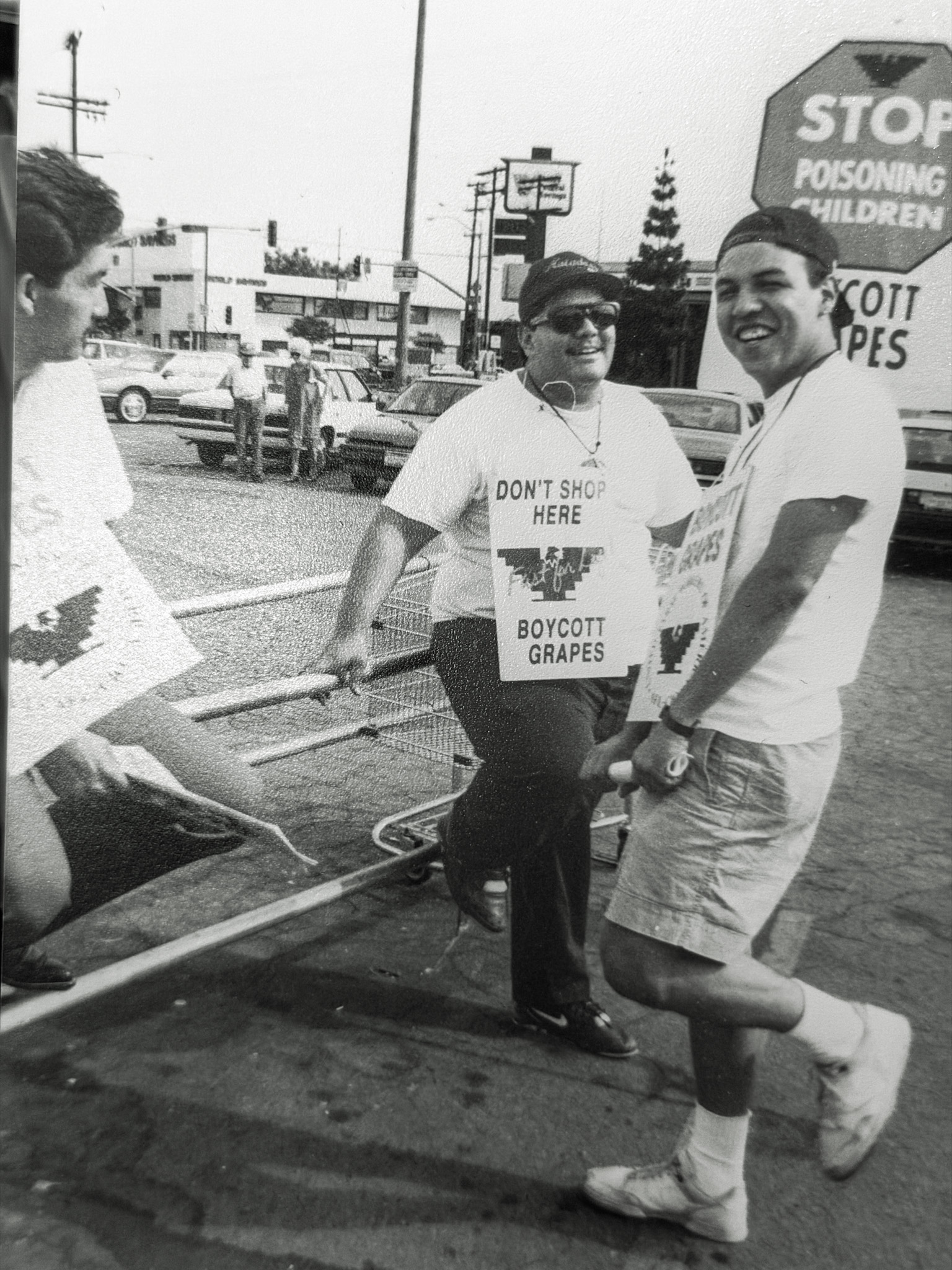
Growing up Chicanos in Los Angeles, Cesar Chavez and the United Farm Workers were symbols of hope and what was possible from our Chicano/Mexican and Latino communities. Chavez was proof that people who looked like us could effectively confront power, and win. For those without power, that kind of image matters. It shapes identity. It creates courage.
The farmworker movement understood what it was doing. Their actions were not random. The use of cultural and religious symbolism—La Virgen de Guadalupe, the UFW eagle, the Mexican flag—were key as a means to connect with those who felt marginalized. These symbols were carried from the fields and into the streets, the schools, our neighborhoods, and our homes. They became the symbols of protest, boycotts, and student organizing. The movement and its leaders showed up for us and we for them.
That energy, that fervor, that movement was real. Si Se Puede or Yes We Can was even taken up by President Barack Obama. The UFW trained generations of organizers. It built institutions—credit unions, housing, legal programs, media—and seeded leadership across industries. That legacy happened. It cannot be erased.
But today, we find ourselves at a major crossroads.
Chavez died in 1993. His death left a gaping hole in many of our communities who had seen in him an indelible leader. He had been our guiding light. Principled and unmovable. But when it was revealed that he had abused and raped girls and women for years, that news signaled his second death.
The revelations of this abuse not only sent shock waves; they brought deep disappointment and profound disorientation. Chavez had been elevated as a symbol of moral clarity. But now it has become clear that he carried a dark and destructive side, one that left many victims still suffering from those actions.
This second death may be the hardest to reckon with.
Some will say these well-documented claims of rape are “just allegations” and that Chavez never got his day in court. History is not only written in lawsuits and jury verdicts. It is also written in patterns, in testimony, in what institutions knew, chose not to confront or literally intentionally hid. The question is not only what Chavez did—it’s who knew what, who stayed silent, and what systems allowed that silence to hold for decades.
Just stating that these are “allegations” when clear evidence of witnesses’ statements over decades exists is foolish and insulting to our collective minds. Using these types of excuses means that you might be part of the problem.
These patterns are not unique.
The Catholic Church stands out most prominently, but the patterns are the same across public institutions—corporations, schools, community colleges, universities, local and state governments. And private businesses and institutions aren't immune, no matter their budgets. The playbook is the same no matter where you go: delay, deny, defend, and bury. Lawyers invoke privilege. Institutions close ranks. Settlements are paid. Careers survive. Victims carry the cost.
That is the deeper issue—and the one that matters going forward.
If there is any meaning to this moment, it should not be in focusing our ire on one man, but perhaps it ought to be in confronting the systems of power that continue to protect the abusers above the rights of victims. Beyond outrage, this requires shining the light on behaviors that too often are dismissed as a cost of doing business. Real inquiry ought to focus on actual subpoena power. A public accounting of who knew what and when. Transparency ought to be able to show how much is being spent defending misconduct instead of preventing it.
It also requires cultural honesty. Hero worship without accountability creates the conditions for abuse. Movements are not weakened by truth—they are weakened by denial.
Dolores Huerta once said, “When things get hard, you organize.” That still holds true, but organizing now means asking harder questions. Showing up to city councils, school boards, college districts, and demanding answers. Following the money. Refusing to let institutions hide behind process while harm continues.
If we care about victims—past and present—then the response cannot stop at grief or anger. Tearing down statues may satisfy some urges, but they are not enough. It must extend beyond support to include accountability and structural change, because behind every predator is not just an individual, but a network that enables them.
The second death of Cesar Chavez is a heavy loss for many. But if it forces us to confront how power protects itself—and to dismantle that protection—then there is, at least, the possibility of a different kind of legacy. Not one built on myth, but one built on truth.
The California Legislature and the Attorney General must immediately convene an independent blue-ribbon commission with full subpoena power, public hearings, full funding and a mandate to produce a transparent report that is made public with action items and new policy. We need facts, not institutional deflection. There must be a process for investigating sexual abuse and harassment that is independent of local institutions, which too often protect predators they know or feel indebted to rather than victims simply trying to live their lives.
Predators exploit fragmentation across school districts, colleges, cities, nonprofits, unions, and corporations, using public funds to defend misconduct and purchase silence. That must end. Any entity—and any individual—who enabled or benefited from that silence should be identified publicly. Accountability requires names, not anonymity.
At the end of the day, we can learn from Cesar Chavez. He chose not to be a leader at a time when his community needed it most. He failed! A real leader thinks in terms of generations. They understand that their actions will reverberate into the future. Chavez chose instead to be selfish and evil. He took advantage of those around him and those in his care. That is not leadership.
We need accountability over his failings. We need clarity, and we need to set the record straight.