“This land is your land, this land is my land.”
You know these immortal lines, written by folk music hero Woody Guthrie and sung by generations of Americans, encompassing words of promise, belonging, and shared hope for our nation’s 250-year-old experiment.
We also know that the land we inhabit, and our sense of who it belongs to, is vastly more complicated than the lyrics indicate.
Now The Huntington is inviting you to consider and question the meaning of this phrase through THIS LAND IS …, a sweeping, multidisciplinary initiative that brings together the disparate treasures of its vast library, art galleries, and botanical gardens, driven by the experts and curators who oversee all of these astounding collections.
At the heart of the initiative is “This Land Is ...,” a major exhibition that offers an open-ended exploration into what this land means to various people, past and present, using historical artifacts, manuscripts, and artworks.
The experience extends beyond the exhibition halls, with an amble through the beauty of The Huntington’s Oak Meadow, where native plants and oak trees connect visitors to the land itself. The nearby reimagined Virginia Steele Scott Galleries of American Art continue the conversation with contemporary works and new installations that invite guests to consider how promise, conflict, and belonging shape our sense of place.
Your journey begins with a stroll through The Huntington’s new Oak Meadow, named in honor of our national tree. Along its meandering pathways are 15 oak species, including Engelmann Oak, Coast Live Oak, and Valley Oak, and the little worlds they help sustain, as evidenced by passing monarch butterflies and diving hummingbirds.
Native Toyons, purple needle grass, and manzanita are among the more than 5,000 plants and 55 species completing this natural tapestry, as the San Gabriel Mountains frame the 43-foot-high glass dome of The Rose Hills Foundation Conservatory for Botanical Science.
Here you can contemplate nature in its finest form.
From Oak Meadow, you’ll find your way to the MaryLou and George Boone Gallery, where the central exhibition, “This Land Is ...,” invites a more critical, introspective, and appropriately complex look at our nation’s history.
A slice of an Engelmann oak tree greets you at the entrance. Estimated to be around 250 years old and bearing a burn scar and biological evidence of droughts and floods on its rings, this silent witness to the rise and fall of nations and caretakers–it was just a sapling during Spanish colonization–is a fitting symbol of the viewer themselves, as they go on to witness and observe two and a half centuries of history.
Behind this oak cross-section is a large-scale wall illustration created by Samantha M.J. Yang (Gabrielino/Tongva), a local Indigenous artist, resurrecting the whole tree as it may have looked in life.
“This Land Is ...” is rich with these kinds of contrasting artifacts across different mediums and centuries, including writings, maps, documents, and art that reveal both the glory and horrors of our country’s growth, while confronting the dispossession and oppression experienced by so many.
Central to the San Marino-based exhibit are two rare, annotated July 1776 printings of the Declaration of Independence, perfect points to ponder as you question and explore the promises, ambitions, successes, and failures of our country’s thesis.
In the same room as one of the Declaration of Independence copies–itself a document of rebellion and revolt–and a 1782 letter from King George III, Guthrie himself is given a spotlight.
You can view a 1936 guitar on loan from Seattle’s Museum of Pop Culture that Guthrie subtly inscribed on the back with his notorious tagline, “This Machine Kills Fascists,” as well as several journal entries and drawings on loan from the Woody Guthrie Center in Tulsa, Oklahoma, including his own portrait of George Washington.
These riveting objects are fleshed out by the writings of major authors who wrote vividly on the themes of land, including a manuscript page from Thomas Pynchon’s “Mason & Dixon” and books and excerpts from legends like Pasadena’s own Octavia E. Butler, plus “Roots” author Alex Haley, and poets Langston Hughes and Walt Whitman.
You’ll also see a document detailing the Walking Purchase, an 18th-century treaty that fraudulently claimed ownership of more than a million acres of land in present-day Pennsylvania that belonged to the Delaware/Lenape people. Close to the short-lived letter of protection from George Washington to Native Americans of the Eel Rivers Nation (in present-day Indiana) is a 1972 Mohawk-published activist newspaper shouting the headline, “A Trail of Broken Treaties.”
Side by side, these contrasting artifacts paint a more nuanced portrait of what this country and this land really are, calling up deep considerations as to whom they may belong.
Native American displacement. U.S.-Mexico border disputes. The 13th Amendment abolishing slavery. Haiti’s role in relation to U.S. history and the Louisiana Purchase. Japanese American incarceration. Our history is laid bare through photos, personal recollections, and artworks that detail historic and contemporary revolutions, displacements, disagreements, celebrations, resistance movements, disasters, and the strength of our communities.
There’s a panoramic photo by Cara Romero (Chemehuevi) showing her nephews in the desert environment of the Coachella Valley, wearing traditional regalia and sunglasses to highlight Indigenous presence in the region. A striking mural by L.A. artist Noni Olabisi depicts the history of enslavement, rebellion, and freedom in Haiti. And hanging nearby is a quilt by Rosie Lee Tompkins that presents an abstracted interpretation of the American flag, drawing upon her own African American textile traditions.
So, what is this land, and what do we want it to be? There is no single answer. Instead, the exhibition poses those questions to its visitors, inviting them to complete the phrase “This land is . . .” for themselves. The responses, written on cards, are posted for all to explore, revealing frustration, pride, and determination in equal measures.
The experience naturally extends to the Virginia Steele Scott Galleries of American Art, which have been thoughtfully reimagined to highlight treasures of The Huntington's art collection that continue and deepen the conversation.
Sandy Rodriguez opens the galleries with “Book 13,” a multifaceted installation that includes a 20-foot-wide representation of the continent made with natural, earth-borne paints and that graphically pinpoints the locations of boarding schools that Native American children were forced to attend, along with the contemporary sites of today’s immigrant detention centers. Grim and foreboding icons like skull-faced helicopters hover in the painting and from the ceiling, and ICE agents monitor routes and borders.
Among the many rooms, you’ll see vivid contrasts in pieces like Gilbert Stuart’s 1797 portrait of George Washington placed near Charles Bird King’s portrait of Moanahonga, an Ioway Chief, painted in 1824.
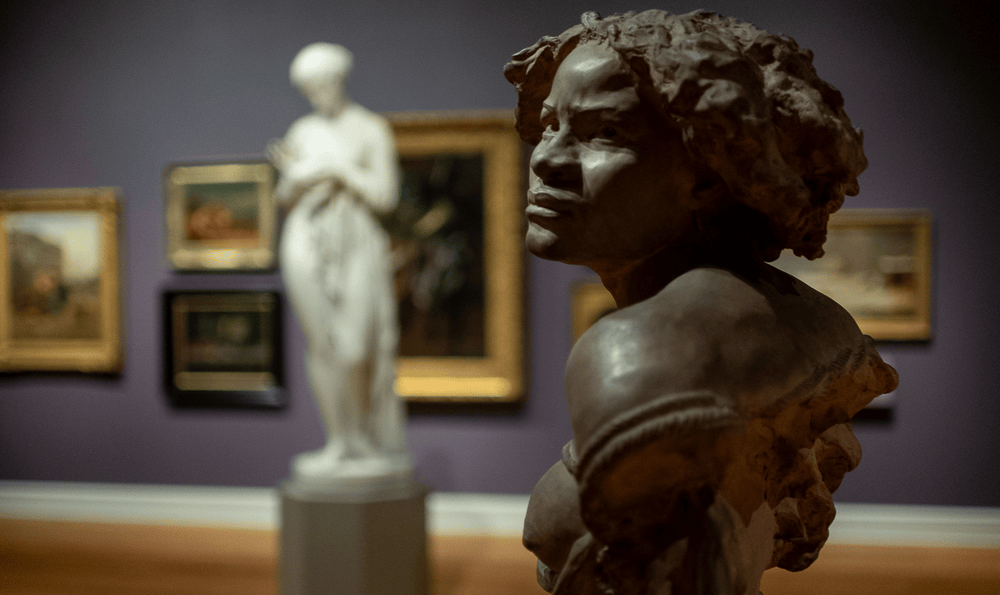
In the adjoining room, a neoclassical marble statue of Pandora is juxtaposed with Jean-Baptiste Carpeaux’s terracotta bust of an enslaved woman bound by ropes, created just a few years after the Emancipation Proclamation Act was passed in the U.S.
In the surrounding alcove, you can explore Tongva artist Mercedes Dorame’s layered visual and interactive art pieces charting the paths and harmonies of water in our natural environment and hear musical expressions in the Tongva language.
By the time you’ve made your way through the oaks of Oak Meadow, “This Land Is ...,” and the reimagined American Art galleries, Woody Guthrie’s familiar refrain has become something much bigger.
The Huntington’s THIS LAND IS … experience brings together so many varied facets and gems of its botanical gardens, library archives, and art collection, changing the way you view those famous words in all their complexity, history, and struggle.
“This Land Is ...” is open through January 11, 2027, at The Huntington, while the broader THIS LAND IS … initiative continues through 2027. You’ll definitely want to dedicate more than a few hours to taking in its titanic breadth and pondering just what this land means to you.
The Huntington ~ 1151 Oxford Rd. San Marino, CA 91108
This article is sponsored by The Huntington.