This article was supported by Viva La Book Review.
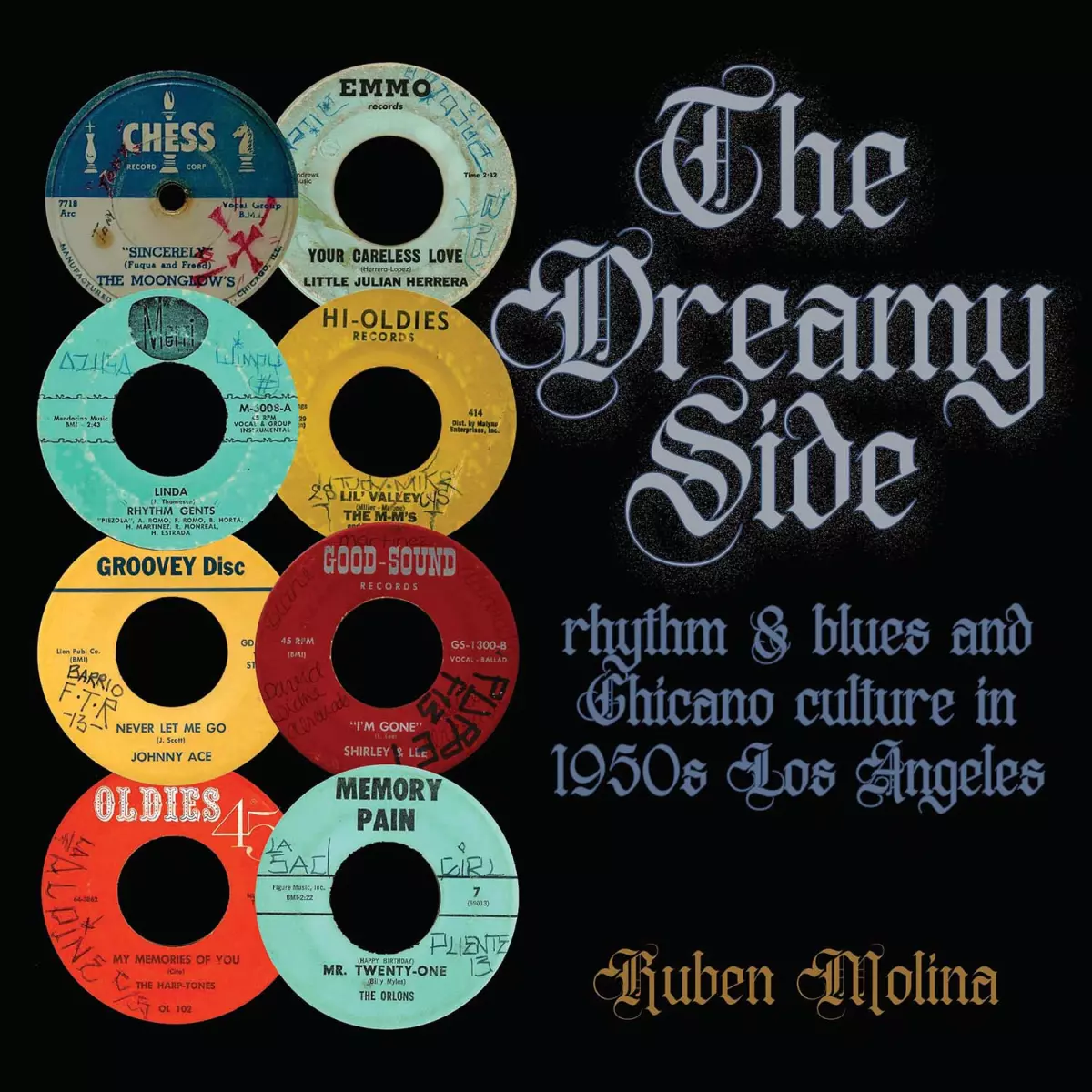
“Our personal histories are tightly interwoven with the music we collect. Each record serves as a vessel for memories, emotions, and experiences—preserving stories that might otherwise fade with time,” writes Ruben Molina in his remarkable book, The Dreamy Side: Rhythm & Blues and Chicano Culture in 1950s Los Angeles.
The Dreamy Side is an alternative map of 1950s Los Angeles, revealing a city that had little of Hollywood’s glamour, but was every bit as magical as Tinseltown. Molina’s portraits of pivotal figures, such as the dynamic saxophonist Big Jay McNeely and record-store owner John Dolphin, along with deep dives into venues like the El Monte Legion Stadium, prove that diversity, despite what the 1950s LAPD or the entertainment industry has propagandized, has always been a bedrock of Los Angeles. Molina pays ample honor to the generation of musicians, vocalists, DJs, and record buyers who defined this landscape.
While many of the musicians discussed in the book are well known, including Etta James, Fats Domino, Johnny Otis, Johnny “Guitar” Watson, Ritchie Valens, and the Isley Brothers, Molina also highlights more than 150 artists, among them lesser-known local legends like Little Julian Herrera and the Clovers, whose music remains relevant in 2026.
Between the book’s curated song lists and its striking homage to an aesthetic, The Dreamy Side offers an excellent roadmap for anyone interested in the Chicano soul scene, including the R&B music that not only united Black and Brown communities but foreshadowed the founding of labels like Stax and Motown.
The book’s pages are filled with vintage photographs, including images of dozens of rare retro record sleeves, and cutting-edge graphic design. Its beautiful design bears comparison with the print magazine Wax Poetics. Like that publication, the book caters to vinyl archaeologists, DJs, crate diggers, and connoisseurs of musical history. Molina also charts a vivid history of record stores like Dolphin’s of Hollywood and of key neighborhoods where the music was made and played, including Central Avenue, El Monte, La Puente, Lincoln Heights, and Boyle Heights.
Molina grew up in Frogtown, just north of Dodger Stadium, and he has mastered the milieu the book spotlights. An independent scholar, soul music collector, and DJ, he has earned the authority needed to tell this crucial history in musical terms. He has written three previous books, including his first, The Old Barrio Guide to Lowrider Music, published in 2000. What distinguishes his latest is the depth and breadth of stories he tells about the records he has selected.
Molina’s dedication, which opens the book, expresses his authorial intent: “This book is dedicated to the generation that gave us so much of who we are. Their values, experiences, and sacrifices have shaped our identities and laid the foundation for the lives we lead today.”
Molina honors the backstories of lesser-known, but should-be-remembered artists, such as Little Julian Herrera, Johnny Ace, and Jesse Belvin. He reminds readers throughout the book that sometimes the deep cuts, or what are now called “rare grooves,” are some of the era’s most powerful songs. He makes his revisionist argument with gusto: “It was the blues—not the blues of Muddy Waters or Elmore James, but the blues of teenagers.”
“The songs performed by teenagers reflected their own lived experiences, often more innocent than those recounted by seasoned blues artists. Singers like Johnny Ace and Jesse Belvin sang about love in ways that resonated with young listeners tuning in to late-night radio in 1951 and 1952,” Molina observes.
By the end of the 1950s, radio DJs like Art Laboe and Dick Hugg, aka “Huggy Boy,” were releasing compilation albums -- Oldies But Goodies in HiFi, Volume 1 and Huggy Boy’s RARE R&B Oldies -- that collected these lesser-known songs. These recordings helped cement the significance of the emerging movement.
Molina traces the evolution of songs such as “The Honey Dripper” and “Pachuko Hop,” along with other kindred tracks, notes their rise in popularity, and explains how these cuts captured the zeitgeist for, not only Chicano teenagers, but legions of Black, White, and Asian youth across Southern California who tuned into the radio shows of DJs like the aforementioned Art Laboe and Huggy Boy, as well as as Hunter Hancock and Wolfman Jack. For readers who want to listen to more tunes, over 200 songs are listed in the book’s index.
Molina has written a deeply personal book that will delight the many fans of the music he covers. Beyond that, he invites us all to think about the songs that make up the soundtrack of our lives.
“The grooves of every record echo with laughter, love, loss, and sadness, serving as reminders of who we were and what we felt at different moments in our lives,” he testifies.