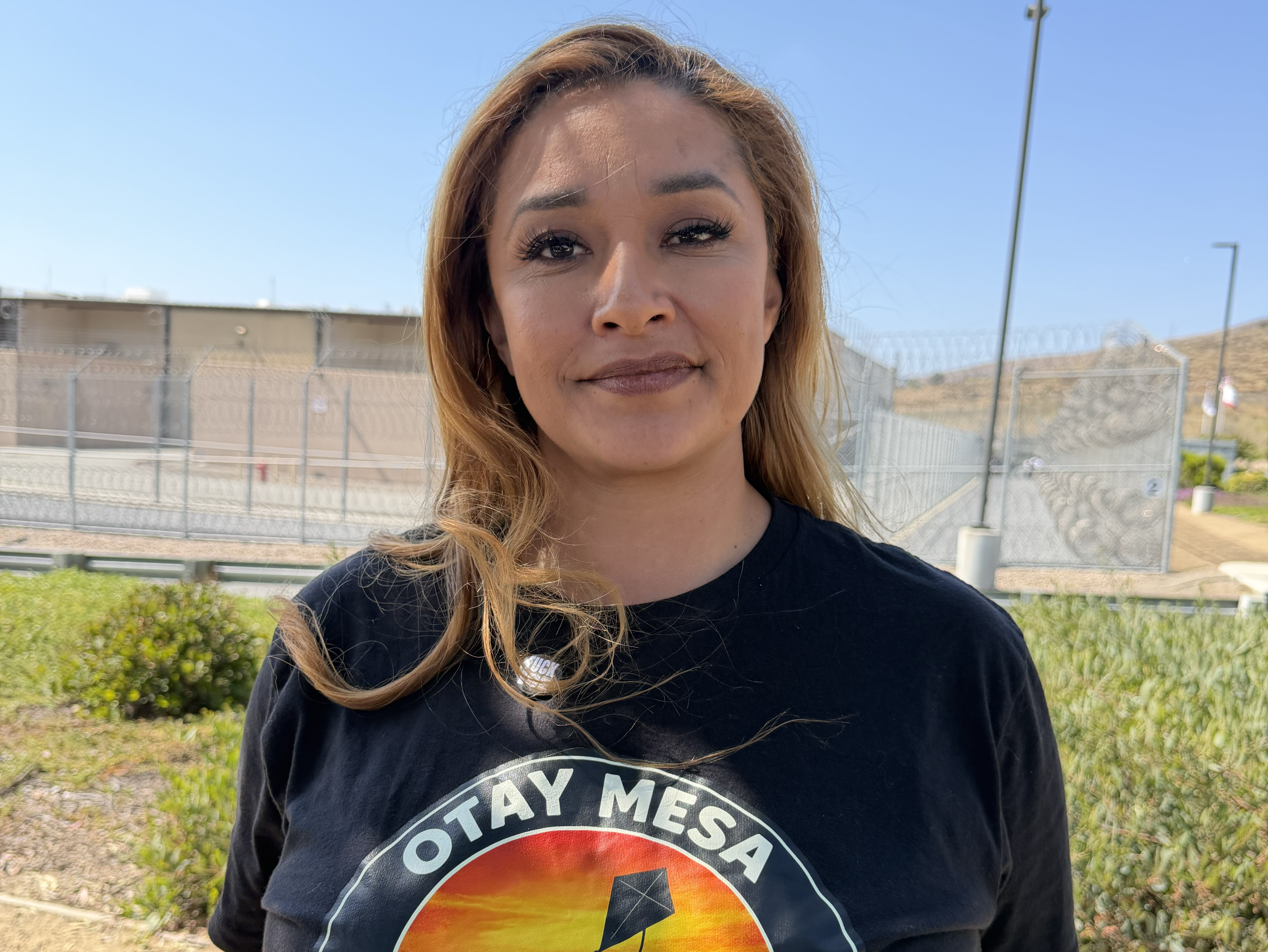
Diana Sanchez Ledezma arrived at the Otay Mesa Detention Center on December 18, 2025.
Throughout her long first day there, Diana was taken in and out of the holding cell for processing, growing irritated and frustrated. She had tried to call her family using the phone in the cell, but they were unable to hear her.
In a statement to L.A. TACO, CoreCivic said that there are multiple phones available in intake and in their housing units in the Otay Mesa facility.
Diana tried to refuse the medical screening process and initially, a pregnancy test, as well.
She thought about the horror stories she had heard, gossip from other detainees, about women being forced into abortions or having their uteruses taken out while in immigration detention, and she was scared to take the test.
She had also seen news reports about pregnant women in immigration detention being sent to a separate facility in Texas.
Confined without a sweater in a cold holding cell in the middle of winter, she later felt she was being punished for refusing the test. When she couldn’t take the cold anymore, she reluctantly took the test.
Ledezma looks back on these harrowing experiences in stark contrast to the life she once led as a DJ. A life she hopes to return to now that she’s been released.
In the Stockton music scene, she’s known as DJ Reina Azteca. She is starting to get gigs again, but has to borrow her friends’ music because her DJ account was deactivated during the almost four months she spent in detention, making her lose all her music.
An activity that normally brought her joy had now become arduous. To get her music back, she needed a bank account; she would not be able to open one until she got her IDs back from the federal government. She was uncertain when or if she would ever get them back. Like so much of her time in detention, she was unsure of what lay ahead.
Ledesma came to the U.S. for the first time as a child, then self-deported back to Mexico in 2020. She tells L.A. TACO that she re-entered the U.S. in August of 2021.
At the time of her detention in December 2025, she was enrolled in the Intensive Supervision Appearance Program (ISAP), one of several programs that are part of the Alternatives to Detention Program. These federal programs allow non-citizens with active immigration cases to be released from detention centers, to be monitored for their compliance through electronic monitoring and other methods of verifying compliance, as reported by L.A. Public Press.
She was detained during an immigration check-in. Ledesma asked the agents to deport her. But due to her pending U-Visa and open asylum case, agents said she had to be detained. She was taken to three holding cells before arriving at the Otay Mesa Detention Center in San Diego, which changed the course of her life
L.A. TACO spoke with several medical experts for this story. In a statement to L.A. TACO, CoreCivic said to their knowledge, none of the physicians quoted have visited or treated patients at this particular facility. Dr. Weber told L.A. TACO that in the past, he has reviewed medical cases of detainees held at the Otay Mesa Detention Center as part of his work with the Medical Justice Alliance. L.A. TACO asked about their general expertise on detention centers and commented on information provided to them through our reporting based on their experience.
Dr. William Weber is part of the Medical Justice Alliance, a national nonprofit group of physicians who review medical care for people in different carceral settings, including ICE detention centers. He tells L.A. TACO that he sees common gaps in care across detention centers nationally, like poor medical care. In many instances, detention centers fall short of meeting their own standards, keeping patients guessing about their care.
“We’ve seen a lot of patients whose concerns are brushed aside. Medical staff will dismiss their chest pain or shortness of breath as stress or dehydration and send them back to their cell without actually evaluating them,” he tells L.A. TACO.
Weber says he’s seen patients struggle to get medications and experience drop-offs in care due to transfers to different detention centers.
Dr. Amy Zeidan is an emergency physician and professor at Emory University School of Medicine in Atlanta who has studied detention centers across the country. She tells L.A. TACO that there is now less accountability in immigration detention centers across the U.S. than there was before 2025.
“Now, you know, there's no civil rights and civil liberties opportunity to report injustices about something, so there's no investigation, no trigger kind of for that,” she says. “You can't do anything about things you don't know about.”
Zeidan claims that, for years, generally speaking there have been violations of immigration detention centers' own standards of medical care discovered during routine and unannounced investigations across different facilities around the nation.
“It's a model that's kind of primary care, kind of preventative care, kind of emergency care, but actually doesn't really do all of those things very well,” she says. “So they say that they can do chronic disease management, but, you know, haven't really seen recent examples of that, that they've been able to adequately monitor people who are coming in with chronic conditions.”
In medical charts that she has reviewed from different immigration detention centers, medical visits are often triggered by detainees’ own sick call requests, and there’s not a lot of routine care. In some of the deaths she’s reviewed, detainees had seen a registered nurse but not someone with the credentials to appropriately treat the condition they were experiencing.
She has even seen referrals for care get denied by a detention center’s medical director and thinks the screening for communicable disease and emergency care in general are insufficient, as well.
“ Being unable to call 911 or go to the emergency department when you think you need help is very problematic,” she says.
In one such incident, Ismael Ayala-Uribe died in ICE custody in September 2025 after being detained at the Adelanto ICE Processing Center after developing an abscess in his left buttock, according to L.A. TACO’s Federal Immigration Agency Fatal Incident Tracker. Medical experts who examined his case for the San Francisco Chronicle said he could have survived if he had been examined by medical professionals earlier, and that in his case, treatment was delayed in being provided or was not administered.
Inside the Otay Mesa Detention Center, Ledesma saw similar conditions. She tried her best to advocate for herself and her fellow detainees by filing internal grievances about conditions she considered inadequate.
She spoke with her fellow detainees and learned as much as she could about their individual and collective experiences, documenting what she saw by texting with community activists on the outside.
Ledesma alleges that she witnessed threatening behavior from staff, a forced pregnancy test, detainees having to drink water from a supply closet, a potential infectious disease outbreak, inadequate food, and individual-sized cages.
“There's a long history of coercion with regards to reproductive rights [in immigration detention],” says Dr. Joseph Nwadiuko, a physician and assistant professor of medicine at the University of Pennsylvania who has researched immigration detention for the past seven years.
“ When you're in any facility that is a prison or a jail, the best tool that anyone has at their hands
is confinement, right?” he says. “Further confinement.”
He likens requiring people to receive medical care, including tests, to forcing detainees to give over biological samples. He stresses the importance of patient autonomy, and says that coercion of biodata is blatantly wrong from a morality standpoint.
In a comment to L.A. TACO, the public affairs team for CoreCivic, the largest private prison operator in the nation, said the company follows all federal detention standards, procedures, and health screenings as part of the intake process. The private prison contractor said pregnancy tests are performed as part of the intake process. Detainees receive medical, dental, and mental health intake screenings within 12 hours of arriving, a full health assessment within 14 days, and have access to 24-hour emergency care, according to a statement from a Department of Homeland Security Spokesperson.
“Those who refuse the screenings are returned to the area where detainees begin the entry process,” the statement claims.
L.A. TACO requested the current Intake Screening guidelines and has not received them from CoreCivic or DHS as of this publication.
“The treatment we received was inhumane, dehumanizing, and degrading,” she wrote in the document.
During her first lunch at the facility, Ledesma heard a guard yelling at a detainee.
“‘I'm gonna go to your house and rob all your fucking shit,’” Ledesma told L.A. TACO she heard the guard say.
Despite having been in an immigration detention center before, she had never heard a guard speak to anyone that way. She wondered why the guard seemed so comfortable saying that, and was worried about what lay ahead.
In a statement, CoreCivic claims that it has a zero-tolerance policy for staff misconduct and that all allegations are investigated. L.A. TACO could not independently verify Ledesma’s claim.
According to Ledesma, during her first days in detention, she was taken to a small holding cell on the day of her court hearing. When she asked the staff for water, she was told she needed to eat first. After about 20 minutes, she told the staff that withholding water from her was a civil rights violation.
Then the staff took her and other detainees to a utility closet with dirty mops and buckets. They were given cups and told to drink water out of the faucet inside. She described the water as tasting “metallic.” She wrote about this experience in an internal grievance submitted from inside the detention facility that L.A. TACO reviewed.
“The treatment we received was inhumane, dehumanizing, and degrading,” she wrote in the document.
The staff response within the document says that they confirmed the water fountain in the detainee restroom was not working on that day, that the kitchen did not deliver the requested juice and cups, and that the staff would take corrective actions, including a work order to repair the fountain and train staff.
“Under no circumstances will water be provided from the utility closet sink as an alternative source,” reads the staff response.
In a statement to L.A. TACO, CoreCivic said that the water detainees drink comes from the same municipal source as the surrounding San Diego community and that it is subject to the same standards. They said that their staff drinks the same water as detainees.
“It is not our policy to provide drinking water from a utility sink. This one-off matter was addressed with the staff involved, who sought to provide water while a repair was being made to the water fountain contained within the housing unit,” said Ryan Gustin, Senior Director of Public affairs at CoreCivic.
“Sending someone to a utility closet for water . . . it's clearly something that's gone deeply wrong with the way that you've thought about how your facility works, right?” Dr. Nwadiuko says.
An anonymous former detainee who spoke with L.A. TACO says the water he drank at the facility had a fishy smell, and he tried not to drink it.
Ledesma did not want to drink the facility's water, but felt she had no choice–buying water from the commissary cost money, and sometimes she didn’t have enough on her account. In a pod referred to as “Golf” by her and other detainees, she drank water from a water fountain attached to a toilet.
Dr. Nwadiuko says that access to hygienic water has been a recurring issue in his experience while looking into detention centers. Depending on how it’s maintained, a one-unit system- toilet and fountain next to each other can be high-risk and set up many potential problems.
“Additionally, the cells within our housing units are equipped with industry-standard combination units that include a toilet, sink, and water fountain. The sink and fountain water supply lines are plumbed separately from the toilet,” Gustin said in a statement.
In a statement to L.A. TACO, a DHS spokesperson said the agency provides detainees with clean water and that water bottles are available for purchase at a cost of $1.21. Detainees inside immigration detention centers in California are only paid $1 a day when they work inside the facilities.
Ledesma was stunned when, less than a week into her time there, she saw individual-sized cages in a big pod area. Cages, the size of a five-foot table– small enough to stand, sit, or walk around a chair–only big enough to hold one person.
“They were just metal cages all the way to the roof,” Ledesma says.
“You're dreaming and then all of a sudden, you open your eyes and you're like, ‘Fuck, I'm in detention,’" she says.
She heard they were used for punishment when detainees broke the rules. Sometimes, she said she would see men inside, and felt anxious that she could end up there one day.
In a statement to L.A. TACO, CoreCivic denies Ledesma’s allegations about these cages.
Ledesma did not expect her time in detention to be long; it felt like she was in jail. As days turned into months, she felt helpless.
“You're dreaming and then all of a sudden, you open your eyes and you're like, ‘Fuck, I'm in detention,’" she says.
Every time she stepped out of her cell, it seemed like something happened; she says medical emergencies happened constantly. Dealing with the guards' moods also affected her; she knew she was in for a rough day when certain guards were on duty.
"What the fuck am I gonna deal with today?’ That [was a] constant thought of mine,” she says.
Around her third month in detention, she felt something on her lip. She panicked; it was a sore.
“‘What is this?’ And I just looked around. Every, like, a lot of girls..had . . . them too, and I'm like, ‘Oh, my God,’ like, ‘This is bad,’” she says.
She felt frustrated that the sores seemed to be normalized in the facility; she felt like nobody cared. Everyone was so exhausted that it seemed like a small issue to bring up, given how much was going on. The sores were itchy and made her lips feel like they were on fire.
“You got rid of one, and another would pop up,” Ledesma tells L.A. TACO.
She didn’t seek medical attention because she was scared, and figured if other people had them, she probably shouldn’t worry. She said the last time she remembers having a sore was as a teen.
Another former detainee tells us he had a similar experience.
Speaking on the condition of anonymity due to fear of retaliation, he shares that almost everyone in his pod had sores on their mouths, including himself. He says he never had sores like this prior to being detained. He mentions that he had previously had a sore when he had bitten himself on one occasion, but that it was different from the ones he suffered inside detention.
He describes the sores he experienced in detention as being on his tongue and inside his cheek. Sometimes, he says, they bled.
Medical experts who spoke with L.A. TACO said sores could be caused by many things, but that it is difficult to determine the cause without seeing the patients.
Sores can be caused by dry conditions, poor sanitation, bacterial infections, or viral infections such as herpes or measles, according to Dr. Weber. He has not seen sores come up in the cases he has worked on. He says infectious diseases are common in cramped detention centers, and that he has seen multiple outbreaks at these facilities.
“As a doctor, if you start seeing patterns of symptoms in different patients, that suggests it could be an infectious disease, especially in a communal living area,” he says.
He added that it is important to know whether an infectious disease is affecting the facility so that people inside are aware of how to protect themselves and others.
Dr. Nwadiuko reviewed a photo of Ledesma's sores, taken by L.A. TACO the day after her release.
He tells L.A. TACO the sores look similar to cold sores or Herpes Simplex Virus (HSV) but could also be a result of other viruses. He says he has not heard about any wide-spread herpes outbreaks at detention facilities before.
But if it were to be HSV, one or more people whose HSV was reactivated, potentially due to stress when they entered detention, could spread easily through the facility, potentially by the sharing of faucets or cups. If the outbreak is widespread, the facility should be taking action, because HSV has the potential to cause brain and spinal infections.
“Unfortunately, you know, correctional settings do not raise concern above anything but, short of, life and injury loss, life and limb loss,” he says
A Department of Homeland Security spokesperson tells L.A. TACO, in a statement, that when a detainee has an infection, ICE Health Service Corps and medical staff take action to quarantine and control the further spread of the virus.
Ledesma grew increasingly worried when other detainees began talking about their gums bleeding. She initially brushed it off, but when a third person complained, she felt it was not normal. She saw two women with similar symptoms, one in her 50s and the other in her 20s, complaining, within days of each other, about bleeding gums and joint pain.
One of the women began to vomit blood, she alleges, and the other collapsed at dinner—both were taken to the medical unit and only given Ibuprofen.
“ It always crossed my mind every day like, ‘What am I gonna get?’ Like, ‘When is it my turn?’” she says.
Inside the facility, Ledesma says detainees were provided three meals a day, though she often went to sleep hungry. She’d usually skip breakfast, because it was served too early. She says detainees received “real chicken” only once a month, and ate meals that tasted canned. She recalls the detainees never receiving fresh fruit.
He reports that the detainees began chanting “Hungry” to get the staff's attention. The staff apologized for forgetting to feed them lunch, he alleges. He says they “made up for it” by giving the detainees an extra sandwich in the evening.
A different detainee who spoke to L.A. TACO on the condition of anonymity alleges how the facility staff forgot to feed his pod lunch on February 14. They requested anonymity because they fear that speaking out would affect their case.
He reports that the detainees began chanting “Hungry” to get the staff's attention. The staff apologized for forgetting to feed them lunch, he alleges. He says they “made up for it” by giving the detainees an extra sandwich in the evening.
In a statement to L.A. TACO, the CoreCivic Public Affairs Team calls the allegations defamatory and says that the evidentiary record at the detention center contradicts these claims.
When asked about the evidentiary record, CoreCivic alleges that it received a score of 100 on the San Diego County Department of Environmental Health's most recent food inspection, was reaccredited by the National Commission on Correctional Health Care in February 2026, and received a 100% score from the American Correctional Association on standards. L.A. TACO was unable to independently verify these claims. We requested these documents from CoreCivic and DHS and will update this story if we hear back.
The company says it provides three meals a day and offers specialized, therapeutic, religious, and cultural diets. They say fruits and vegetables are a regular component of meals.
A DHS spokesperson tells L.A. TACO that detainees were provided with three meals a day.
We requested health inspection documents from the San Diego County Department of Environmental Health.
Dr. Nwadiuko tells L.A. TACO, though he was hesitant to invoke it, that if a person is experiencing a lack of Vitamin C, which is found in the highest levels in fresh fruits and some vegetables, scurvy could potentially develop. Symptoms of the illness include bleeding gums and joint pain.
In a statement to L.A. TACO Gustin said that CoreCivic has not documented cases of scurvy in the facility and called the claim “outlandish.”
A woman in her 40s or 50s began complaining of a headache, then went limp. As the woman cried, detainees helped the woman and called staff. When a guard arrived, she decided to finish her rounds before attending to the woman, Ledesma alleged to L.A. TACO.
Eventually the guard called medical. Ledesma says the woman was gone for about a week before she returned. Ledesma says she heard from other detainees that the woman had a stroke that day.
In another incident, Ledesma managed to catch a detainee before she fell after the woman complained of heart pain. An officer ran into the cell, gave her an inhaler, and immediately called in a medical code. When the woman returned to the cell around two hours later, she said she came back because they did not have the machine to check her heart.
In a comment to L.A. TACO, CoreCivic said they cannot speak to secondhand accounts, but that all of their facilities have EKG machines, and 24/7 emergency medical care, and they coordinate with outside facilities when necessary.
“Oftentimes women suffer from bias when they describe symptoms related to heart attacks,” Dr. Nwadiuko says.
He tells us that women often don’t present with typical symptoms, and even when they do, sometimes their symptoms are not taken seriously. He says any facility should have at least an EKG.
CoreCivic tells L.A. TACO in a statement that detainees have access to emergency care 24 hours a day, seven days a week.
During her time in detention, Ledesma submitted internal grievances, reviewed by L.A. TACO, regarding the conditions she faced inside. She submitted internal grievances regarding receiving at least two Notices to Appear more than 10 days apart.
She also wrote about how there was only one working computer in the multipurpose room of G Pod, which did not have access to the ICE self-help library or any other legal forms. In the library, she said she checked all the computers and found that six were not working, two lacked ICE self-help files, and another did not work properly.
She alleged that on one computer, the files she had spent hours typing were deleted. She also claimed the 30 minutes detainees were given at the library was not enough time to work on cases. In another grievance, she wrote about Habeas Corpus materials having been removed from the law library.
“They reminded me that I'm in ‘jail’ and I am welcome to submit ‘my little grievance,’" she wrote in one text message that she shared with an immigration advocate outside.
In a comment to L.A. TACO, CoreCivic says that they have no role in determining an individual's time in detention or the outcome of immigration proceedings.
Gustin told L.A. TACO in a statement that CoreCivic is committed to providing detainees with access to legal counsel and access to immigration court, which includes functioning library resources and adequate time to prepare legal materials. Gustin said law library software is provided by LexisNexis, and that detainees can make requests for missing or outdated documents. They added that their grievance process for detainees has multiple avenues, that detainees have access to management staff, and that complaints are processed through ICE ERO.
On April 7, Ledesma took a nap and then was awoken by the facility guards, who told her that she was leaving. They did not specify where she was leaving to; for all she knew, she was going to be deported.
“I stand before you today not as a victim but as a survivor . . . a reminder that the Constitution still exists . . . I stand here in solidarity with my brothers and sisters behind these walls, many of whom feel forgotten, silenced, unseen, and alone,” she said.
She had heard nothing about her Habeas Corpus petition, which she had filed and argued herself without legal representation. Then, she was loaded into a van with a few other detainees. When the van came to a stop, the staff opened the vehicle doors.
She stepped out into the night at the San Ysidro Transit Center, where members of the immigrant support organization Detention Resistance greeted her. They set her up with a hotel for the evening and fresh clothes. Waking up in the hotel, outside of detention, felt surreal; she was free.
On May 24, Ledesma returned to the Otay Mesa Detention Center for the first time since her release. This time, of her own accord—to play a DJ set for the detainees still inside, her friends, whom she still tries to keep in touch with every day.
She arranged her DJ equipment and a booklet, made inside of the detention center, on a table. The booklet contained phone numbers from other detainees, shared with the hope of being able to find each other if they made it out—a way for her to preserve the memory of being inside, together.
With the help of Google Translate, Ledesma read notes addressed to her in different languages, with the detainees’ favorite songs. Those are the songs she played that day.
“Hola amigas, estoy de regreso,” she said through a megaphone as she faced the detention center. (“Hi friends, I am back.”)
“I stand before you today not as a victim but as a survivor . . . a reminder that the Constitution still exists . . . I stand here in solidarity with my brothers and sisters behind these walls, many of whom feel forgotten, silenced, unseen, and alone,” she said.
“Today we are here to remind them that they are not alone,” DJ Reina Azteca said. “History remembers the people who stayed silent, but it also remembers the people who showed up . . . today all of you showed up.”
Izzy Ramirez contributed to this report.
L.A. TACO reached out for further comment regarding specific allegations, and we have not received additional comment at the time of this publication. L.A. TACO reached out to the San Diego County Department of Environmental Health and Quality to request the documentation referenced by CoreCivic.
We are awaiting the documents and will update the story when we receive them. In a statement to L.A. TACO, Tim McClain, Group Communication Manager at the County of San Diego Health and Human Services Agency, said an environmental inspection was conducted on June 12, 2026, and that a report on the inspection is expected to be released soon.