


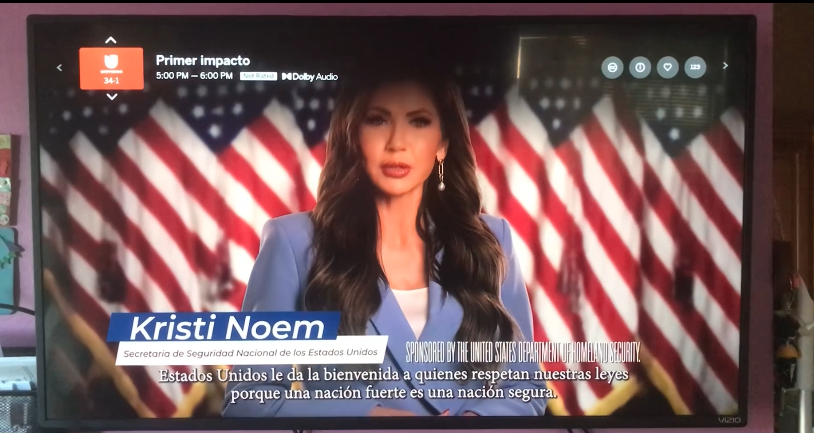
Univision 34 and Telemundo 52 are local Los Angeles Spanish-language channels that offer news and entertainment. The channels serve the region’s Spanish-speaking populations, many of whom belong to Latino and immigrant communities. Since March, both Univision 34 and Telemundo 52 have been airing the Department of Homeland Security’s ads wherein Secretary Kristi Noem “warns” “illegal aliens” not to arrive in the United States and to deport themselves.
On March 15, the Department of Homeland Security (DHS) launched an “international, multimillion-dollar ad campaign” that has been running on radio, broadcast, and digital. According to the DHS, the ad warns “illegal aliens to not come to America and break its laws or they will be hunted down and deported.”
The campaign has been running for five months. The two most popular ads are the videos “WARNING-Domestic” and “WARNING-International,” wherein Secretary Noem stands in front of United States flags as she provides her “warnings.”
Her speech is intercut with visuals of ICE agents—many of them fair-skinned—detaining Black and Brown men. One intercut video shows darker-skinned individuals running in what appears to be a desert.
Univision
Univision 34 functions under the larger TelevisaUnivision network as of 2022 when Televisa and Univision merged under a $4.8 billion agreement. Prior to this merger, Univision 34 was owned by Univision, a network whose roots can be traced to Spanish-language television executive Emilio Nicolás Sr., who was born and raised in Frontera, a town in the state of Coahuila in Mexico. He later migrated to the United States to attend high school and college.
Relied on by Los Angeles Latinos, Spanish speakers, and immigrants from Latin America, Univision often reports on issues relevant to these communities, including immigration. Univision 34 veteran reporter Norma Roque, an immigrant from El Salvador, recently reported on resources that can be used by those who fear stepping outside their homes due to ongoing ICE raids.
Despite the network’s initial goals to inform and serve Spanish-speaking and Latine communities, along with the fact that many of Univision 34’s journalists are immigrants from Latin America themselves (Norma Roque, Oswaldo Borraez, and Gabriela Teissier, for example), the local channel continues to air the controversial DHS ad.
Paola, who lives in a predominantly Latino suburb in Southeast Los Angeles County, said she felt betrayed by Univision running the DHS’s deportation ads.
“It is so sinister that the channel for Latinos in the U.S. would agree to have these ads run,” she wrote in an email. Paola mentioned she grew up watching Univision and continues to watch it with her mother.
“I can’t imagine the fear a lot of their viewers must feel as they are being told they will literally be hunted down. It feels so dystopian watching montages of our community get arrested on the very channel that made news in this country accessible to us,” she wrote.
L.A. TACO reached out to TelevisaUnivision to inquire about the decision to air these ads, the cost of airing such an ad, and if the ads are specifically aired in certain Los Angeles area zip codes.
“The ad is in line with the company’s standards and guidelines,” Alyssa Bernstein, Senior Vice President of Corporate Communications at TelevisaUnivision, wrote to L.A. TACO.
TelevisaUnivision’s most recent and available U.S. Advertising Standards and Guidelines for all media are those from 2023. One of these guidelines includes “Community Sensibilities,” which states:
Advertising must be free of presentations that stereotype or demean persons on the basis of their sex or sexual orientation, culture, ethnic origin, color, creed, religion, culture, or impairments. TU will not accept any advertising that it believes, in its sole discretion, may misrepresent, ridicule, discriminate against, or attack an individual or group of individuals on the basis of race, sex, sexual orientation, religion, creed, age, national origin, ethnic derivation, physical mental handicaps, or any other reason to avoid damaging or demeaning stereotypes.
In the DHS’s “WARNING - International” video, various clips show Black and Brown men being detained, primarily by white and fair-skinned officials.
In both the national and international versions of the ad, an intercut video shows darker-skinned individuals running in what appears to be a desert.
Berstein stated that the ad meets the company’s standards and guidelines, guidelines which state that advertising on the network must be free of “presentations that stereotype” or not “demean persons” based on their “culture, ethnic origin, [or] color.” However, the DHS ads present and perpetuate narratives that Black and Brown persons are dangerous and criminals.
Further, the ad also flashes a video of the border fence separating two bodies of land.
While it’s unclear which lands this fence separates, the image is emblematic of the varied wood fencing that separates the United States and Mexico border, insinuating that persons whose national origins are countries south of the border like Mexico and Latin American nations are “criminals.”
Telemundo has also been airing the DHS’s ads targeting the Latine immigrant community. The ad has even aired on Telemundo Entertainment’s YouTube Channel.
Paola says the ad “gives off very anti-Latino sentiment,” even to her family members who are documented. “They [the DHS ad] show a shot of people crossing the river that my own father, and I am sure many of our community members, crossed and call us criminals.”
Telemundo
Like Univision 34, local station Telemundo 52 is also composed of journalists who migrated to the United States from Latin America, including Enrique Chiabra from Peru and Alejandra Ortiz from Colombia.
L.A. TACO reached out to NBCUniversal, Telemundo’s parent company, for comment, but never received a response.
Comcast, the larger parent company of both NBC and Telemundo, has an advertising department website which claims to conduct multiscreen advertising—advertising that delivers ads across multiple digital devices and screens that consumers use simultaneously (i.e. watching Netflix while browsing through social media on your phone)—by “data targeting based on IP addresses for a 95% initial match rate.”
IP addresses can reveal the geographic location of any device with an internet connection. By consequence, this address can help an advertising agency determine the location of a device’s user.
To clarify, Comcast can direct ads to specific audiences based on the IP address of their devices, and therefore their physical location. NBCUniversal did not respond to L.A. Taco’s inquiry about whether certain zip codes in Los Angeles were targeted with the DHS ads.
The DHS stated on March 15 that “Ads will be hyper-targeted, including through social media, text message and digital to reach international audiences.”
How are these ads being financed?
The ad campaign is estimated to have cost $200 million, according to a press release by the Democratic House Committee on Oversight and Government Reform. In a statement to the Associated Press, the DHS followed a “competitive process” to find a company that could produce a campaign for the best price for “American taxpayers.”
Undocumented immigrants in the United States pay local, state, and federal taxes. In 2022 alone, undocumented persons paid $96.7 billion in local, state, and federal taxes, $59.4 billion of which were paid to the federal government according to the Institute on Taxation and Economic Policy.
The DHS has not specified which tax pools were utilized to finance these ads.
How are these ads being financed?
Both TelevisaUnivision and Telemundo do not make the cost of their ad slots public. Adriana Gomez Licon with The Associated Press reported back in March that it cost the DHS $360,000 to air the ad on Spanish-language stations.
Simulmedia, a cross-channel television advertising company, estimates that airing 60-second ads like the DHS “WARNING” ones on local television stations during prime time can cost between $3,000 and $100,000. The advertising platform also approximates that it costs $20-25 for every thousand impressions an ad makes on YouTube TV.
The DHS recently released new ads that will join the “WARNING” ads first aired in March. These new videos encourage self-deportation via the DHS’s CBP application. Both the 30-second and 60-second versions of the new video ad begin with an image of a Brown man in a white T-shirt with tattoos on his face.


