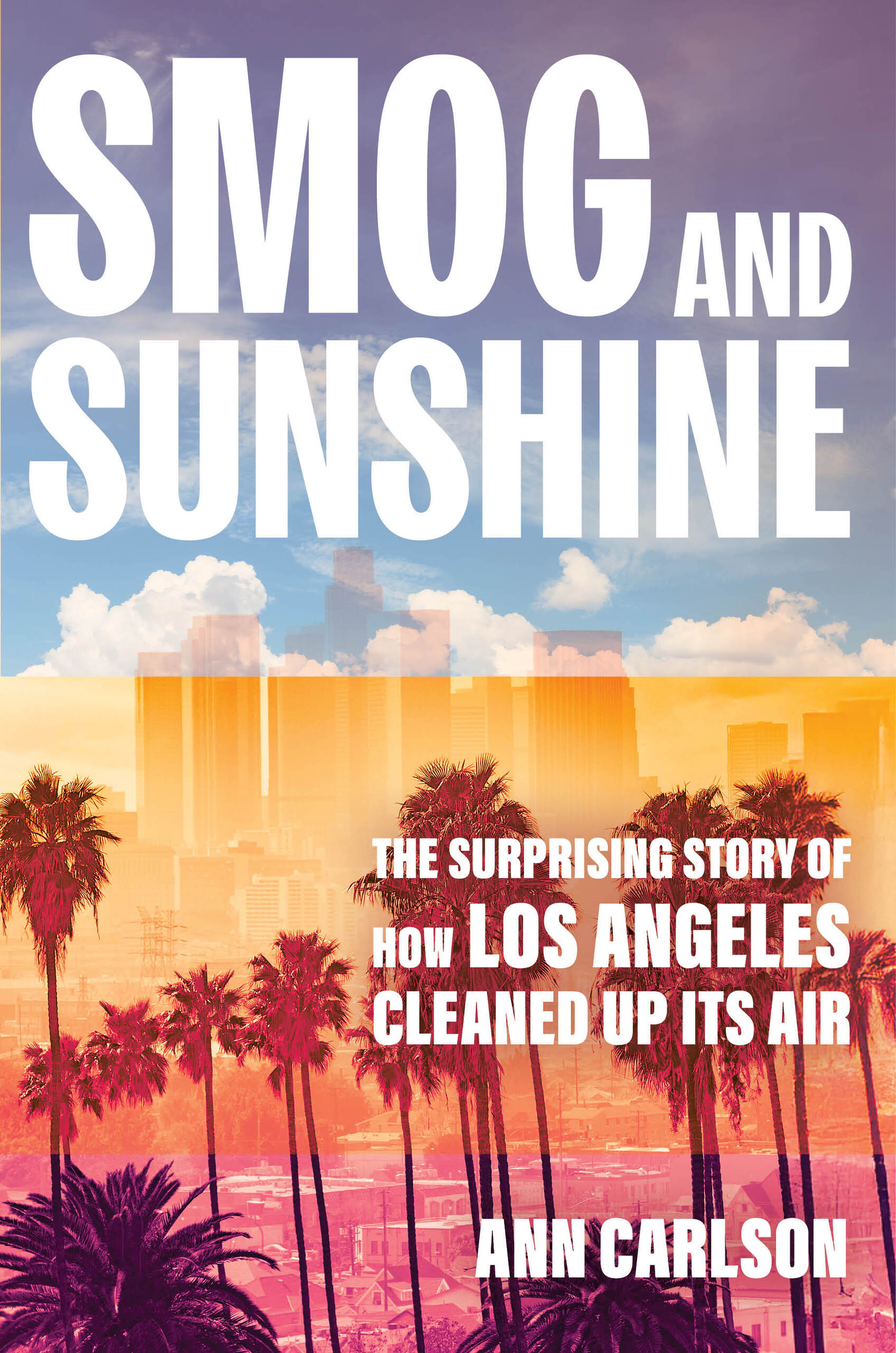
Professor Ann Carlson’s new book, “Smog and Sunshine: The Surprising Story of How Los Angeles Cleaned Up Its Air,” is for anyone who’s ever given a damn about the air we breathe in this city ... and for anyone with a tendency to fall into Wikipedia rabbit holes, hungry to learn about information you’d never thought could be connected.
As the founding director of UCLA Law’s Emmett Institute on Climate Change & the Environment, Carlson specializes in environmental law and has taught at UCLA since 1994.
Since her book uses a scientific, non-fictional foundation, some people may hesitate to pick it up, but Carlson maintains clear readability throughout the novel. She doesn’t hold the reader’s hand, but instead gives them a reliable peek into the insider baseball that exists within the world of L.A. smog prevention.
While growing up in Fullerton, California, Carlson grew deeply familiar with Southern California’s smog, the thing that “made her lungs burn and eyes sting” when playing outside. Visceral memories like hers are strung throughout the book, allowing readers, especially those who did not live through some of the worst decades of air pollution, to envision how gnarly the environment used to be.
Carlson grew up at a time in L.A. when children, seniors, and immunocompromised individuals were frequently discouraged from going outside due to the poor air quality (though that never stopped kids who were itching to play with their buddies after school).
These warnings were in place for good reason. During the mid-20th century, Angelenos were poisoned by the lead, carbon monoxide, and other toxins in the air, too many dying from heart attacks, cancer, and respiratory diseases.
Some years contained daily smog alerts more often than not ... and the smog test wasn’t even that rigorous compared to today’s standards. It also didn’t help that the geography of the SoCal basin practically traps smog, and a lack of wind prevents it from dispersing.
After finishing undergrad at UCSB, Carlson attended Harvard Law School, which did not offer any environmental law classes at the time. Her relationship with environmental law was jumpstarted at a “little public interest law firm that did some environmental work.”
“We worked for the Southern California Air Quality Management District, and we did some other environmental work, and I got really interested in it, and then UCLA was starting an environmental law clinic, and so they hired me to start that,” Carlson tells L.A. TACO. “I didn't even imagine in law school that I would be an environmental lawyer, let alone running a federal agency and being the head of an institute at one of the great law schools.”
Carlson took a three-year hiatus from writing “Smog and Sunshine” when she began her term as Chief Counsel and Acting Administrator of the National Highway Traffic Safety Administration (NHTSA) under the Biden administration.
“I was nominated to lead the agency by President Biden, and I ended up withdrawing my nomination because I was attacked pretty ruthlessly by Senator Ted Cruz, who was the ranking member on the committee that my nomination was supposed to go through,” Carlson says. “And I've never experienced anything like it. It was just bizarre and really, really tough.”
Carlson and her peers were not the first environmental professionals to be demonized for trying to better the air which we breathe. In “Smog and Sunshine,” Carlson breaks down the polarizing tug-of-war that occurred in the early days of smog research.
Smog research started with Arie Haagen-Smit, a scientist from the Netherlands who was deeply passionate about analyzing the flavor compounds inside pineapples–and concerned about the harmful impact smog had on plants.
After recreating smog in a lab and discovering that petroleum played a key role in its formation, Haagen-Smit faced scrutiny in the late 1940s when outsiders tried to wreck his credibility–since his findings had the potential to change how the oil and car industries operated.
Carlson’s writing confirms a bleak sentiment: Conservative capital and political power has always been at the forefront of arguments against environmental activism.
In tandem with environmental groups and scientists, mothers who reared their families in Los Angeles were driving forces in preventing the worsening of air pollution.
During the 1950s and 1960s, many Hollywood-affiliated mothers attended local council meetings sporting gas masks, alongside their children outfitted in the same masks. They called themselves Stamp Out Smog and were one of the first environmental groups in L.A.
After laws resulting from Haagen-Smit’s findings were finally enforced in the 1970s, the catalytic converter was created and federally required to be installed on every new car being produced. The air in L.A. improved exponentially, and 1970’s amendments to the Clean Air Act also diminished the air’s toxicity.
“Smog and Sunshine” draws a throughline showing how Black, Brown, and low-income communities have always been the most vulnerable to being exposed to breathing harmful air in SoCal. Frequent plans for new warehouses and factories consistently increased the amount of smog in areas like East L.A. and the Inland Empire.
Another activist group, “Mothers of East Los Angeles,” was led in part by former assemblywoman Gloria Molina. If you’ve hung around DTLA, there’s a good chance you’ve passed her namesake, Grand Park, a grassy 12-acre park sandwiched between government buildings.
In the late 80s, Molina and other moms pushed baby strollers from Boyle Heights to DTLA almost every week to protest the building of a prison in their neighborhood.
The flurry of environmental wins achieved by community members and professionals feels triumphant, even as a reader. But Carlson emphasizes that the work isn’t done yet, and the fate of our air does not rely solely on more individuals opting for electric cars and solar energy–even though those strategies are useful and our state government can help subsidize the costs.
“The worst thing that's happening is, the Trump administration is attacking California's power to regulate—and not just California's power,” Carlson says. “It's cutting back air pollution protections and other environmental protections as fast as it can.”
These days, we’re pretty damn lucky to live in an L.A. where we can see the mountains on the horizon, taco in hand. (Two of Carlson’s own favorites come from Ditroit Taqueria and El Chato, a taco truck that sets up at a car wash on the corner of Olympic Boulevard and La Brea Avenue.)
Carlson, a current resident of Central L.A., dedicated “Smog and Sunshine” to her family.
“[This book] is especially for Cody, our first grandchild,” she writes. “May he breathe clean air and live in a world committed to tackling climate change.”