In Mid-City, at the intersection of Rimpau and Washington, sits Rick’s Fish Market, one of the last standing OG “You Buy, We Fry” establishments in the city. The yellow paint on the small single-story building has long faded, but the taste of flaky fried fish and the warm, dependable service that’s made Rick’s place a neighborhood institution hasn’t dulled one bit.
Rick’s has been a cornerstone of the community for over 35 years. Black, Latino, Asian, everyone in Mid-City went to Rick’s. Originally opened by a man actually named Rick, it has continued to thrive under the stewardship of the new Rick (real name, Kuktae Chon, who adopted the moniker “Rick” when he took over the business) and his wife, Sun Lee, for the last 25 years. Throughout the decades, the couple has remained devoted to a simple promise: You buy, we fry.
“The previous owner decided to sell the business after a worker was killed during a burglary,” Kuktae told me. “But the sign was still there, and ya know, I just kept the sign and the name. But it’s not my name. Nobody calls me Rick outside this place.”
The person who was killed was Koang‑Ho Song. He was shot that January in 1992—an early crack in the city’s fragile calm. This was months before the Rodney King police beating that would set parts of the city ablaze. Just months later, the tensions sparked by tragic losses like his and Latasha Harlins’ would ignite the streets. Not long after, the original owner sold the shop. But now, the fryer will soon be turned off for good. At the end of this September, or “as soon as we run out of fish,” as Chon tells L.A. TACO, Rick’s Fish Market will close its doors for good.
The announcement has hit the Mid-City community hard—not just because those of us who grew up in this part of town are losing a place to eat, but because we’re losing a part of our story.
“I moved into the neighborhood in 1978. Four generations of my family have eaten at Rick’s. Sad to see them go. It’s the end of an era,” says Carol C., an L.A. native that I spoke to whose family immigrated to Los Angeles from Panama in the early 1960s.
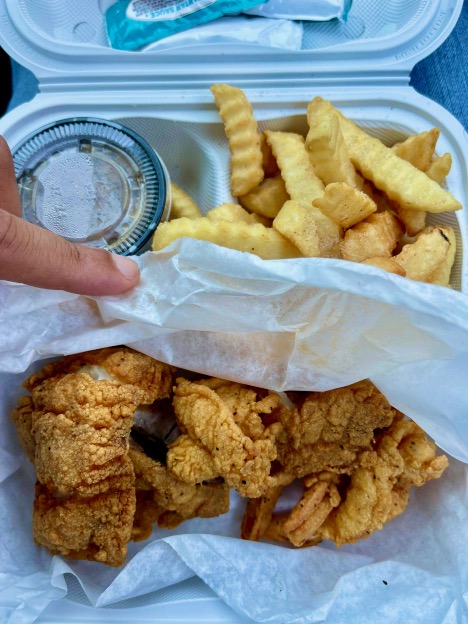
The menu is a celebration of Southern-style fried seafood. South Koreans learning to fry chicken from Black GIs during the Korean War comes to mind: catfish, red snapper, scallops, shrimp, sand dabs, oysters, hush puppies.
And for the “I don’t like seafood’ outliers, even chicken tenders. You could bring your own fish to be fried on the spot —a rare and exceptional service that made Rick’s feel more like family than just a business. And whether you came once a week or once a year, you left with a hot bag full of something golden and crisp, and your clothes smelling like heaven.
I ask him what drew him to fried seafood.
“I didn’t choose seafood, I chose fish and chips,” he says. “I chose it because I like it. It’s just my taste. If I like it, others will likely like it too. I used to eat lunch here every day back then.”
When I ask him if he ever changed his frying practices after he took over or because of clientele demand, he says, “When people get too specific about how they want their fish fried, I would say ‘sure’ and just do the regular fry. One hundred percent of the time, they were happy with it.”
When I think of Rick’s, I think of my late aunt, Beverly—the person who first introduced me to the place. She had a way of knowing where all the best food was, and she swore by Rick’s.
We’d pull up, place our order, and sit and wait while the grease popped behind the counter. Back then, there were two red plastic chairs near the window for customers waiting on their food—a small gesture that made the space feel more like someone’s kitchen than a commercial storefront.
Since the pandemic, the chairs have disappeared, but the feeling remains. I often came here with my cousin, Frances, who like my aunt, has also passed on. The memory of those visits sits heavy now. We wouldn't talk much while waiting—just watched the cooks work, nodded at other regulars, and maybe debated what kind of fish to get.
The walls inside are adorned with glossy photographs of Black celebrities—icons and entertainers who had stopped by or lent their shine to the spirit of the place. The pictures, proudly hung, gave Rick’s a quiet kind of grandeur. There was something special about biting into a hot hush puppy while being watched over by the likes of Mike Tyson, Jamie Foxx, or Muhammad Ali. That wall of fame was a reminder that greatness and community don’t live in separate worlds—they coexist, especially in places like this.
“Rick” and Sun Lee never made a big fuss about their food and that’s part of what made it so special. No Instagram marketing campaigns, no food trucks, or fusion menus—just honest, crispy fish, served in white paper bags, and smiles exchanged across the counter. It was food that brought people together, whether for a quick lunch, a Friday family dinner, or a stop after church.
“Food service is hard,” Rick said. “It feels like you’re making a lot of money, but not really. My body hurts. My wife would also like to retire.”
“We’ve been with this landlord for about 25 years,” he continues. “The price started at $600 and now it’s over $1,600. It’s still a good price—he’d be fine as long as I could pay—but we decided to close up shop.”
When I ask him about his relationship with customers, he says, “A lot of customers come up to me and know me, even if I don’t know who they are. I get recognized quite a bit. They know who I am when they see me.”
Now that it’s closing, the neighborhood is starting to feel a little dimmer. Rick’s is the kind of place you assume will always be there—until it isn’t. And while the fryer may cool, the memories will stay vivid in our minds. Those of us who grew up here, who stood outside under the fading paint waiting for our number to be called, will carry Rick’s with us long after the doors close.
Maybe the yellow building will be repainted. Something else may move in. But nothing will replace what Rick's meant. And for those of us who remember—who came with our aunties, our cousins, our friends, now gone—it will always be more than just fish. It was love, family, and flavor wrapped in butcher paper.
Thank you, Rick’s, for everything.
P.S. If you can make it before they close, please let them know Porter sent you.
4750 W Washington Blvd, Los Angeles, CA 90016