

The hype for the Rare Books L.A. book fair at Union Station felt bigger this year, thanks to the event’s partnership with Netflix to promote Guillermo Del Toro’s “Frankenstein” film.
Still, no amount of celebrity razzle-dazzle could distract from the annual stars of the show: cases and tables filled and stacked with antiquarian books, art, maps and other rare and curious items from dozens of book dealers.
Hundreds of people filled the hall at the main entrance of Union Station over the past weekend to peruse books older than their great-grandparents and trace their fingers over the signatures of their long-dead favorite authors; signatures that were safely stored within the covers of surviving first editions of their novels.
There were also plenty of rare items related to L.A. and L.A. authors, including sports memorabilia and booths featuring different first-edition books, some of which were signed by Octavia Butler. Best of all, yours truly got to sit next to Dr. Peter Weller for a brief moment while he awaited his turn to speak about his journey from working in Hollywood to writing his first book, “Leon Battista Alberti in Exile” (yep, Robocop has a PhD!).
Below, in no particular order, are photos of a few rare, interesting, and historical books and ephemera that we found at the book fair this year, along with the stories behind how they were found.
José Guadalupe Posada, Collection of 13 Chapbook Covers, and 25 Broadsheet Illustrations by Posada

Teri Osborn, of McBride Rare Books, tells L.A. TACO: “I believe we bought it from another book dealer who had assembled a group of different song sheets and broadsides and some of the chapbook covers. It’s a big group of them. Precisely 13 chapbook covers and 25 broadsheets all illustrated by Posada who is one of our favorites. We do a lot with his work. It’s a popular piece of ephemera.”
Signed Check by Orville Wright

Eric Patterson, of Bauman Rare Books, says: “It’s basically a used check. It was a check that transferred the funds it was supposed to and then they just kind of end up stacked somewhere. I would guess, because somebody got it down the road, it had Wright’s signature on it, [so] they probably saved it for that reason. Otherwise, it’s just kind of a valueless piece of paper. If you or I signed it, then we create the next big thing, then maybe they’ll save our checks."
“But it’s neat! These guys ... were geniuses. They had these huge projects and they also had lives, too.”
Atlas Ameriquian

Jim Owens, of Thorn Books, says: “The atlas was in a bookstore in Tucson. I don't know how long it had been there. I don't know how they got it, but it was in pieces and I was able to re-sew it and re-glue it as necessary. That binding has been through the American Revolution. That's why it looks the way it does. I decided not to try to restore the binding; just to preserve what we have."

“It was printed in France in 1778 for the French soldiers that came over to fight for us in the revolution. And it has huge maps in it of all of, basically, the east coast of what is now the United States, showing all of the cities, showing the Indian villages, the trails, the battles had that already had been done. It’s just truly a very important artifact.”
Alexandre Dumas' “Le Comte de Monte–Christo (The Count of Monte–Cristo),” First French edition 1845, 1846

Alex Hime of Biblioctopus says, “Most of the mid-century French and English stuff was printed first in periodicals for copyright [for] money. They get more money, immediate payout, so they’d be published in weekly or monthly installments over the course of months. With the case of the French books, like Dumas, they would be pirated by Belgian publishers, so the true first editions for Dumas are typically published in Brussels before the Paris edition was able to come out. So, this is the true first appearance, complete in book form of ‘The Count of Monte Cristo.’"
“These ones are from various European auctions, knowing what they might be and taking a gamble before we could actually get them in our hands. So, we didn't know [what] it was. It could have been, I mean, it wouldn't have been a waste of whatever we paid for them, but it could have been, right? So these were both gambles that we took on small European auction houses and then other things we get from other dealers. We buy collections from private customers. We’ll get stuff from mainstream auctions where they aren't missed, like these ones were. Then we’ll have to compete with other people.”
Unscratched California Lottery Scratchers

Alex Hime of Biblioctopus says, “We have the first 40 scratchers in the state of California, all unscratched. From 1985 to 1990, they did 40 of them. These are all 40 of them. They had a lot of winners out there in the beginning. They were really trying to encourage people to keep going with them, so there were quite a few winners in those early 40.”
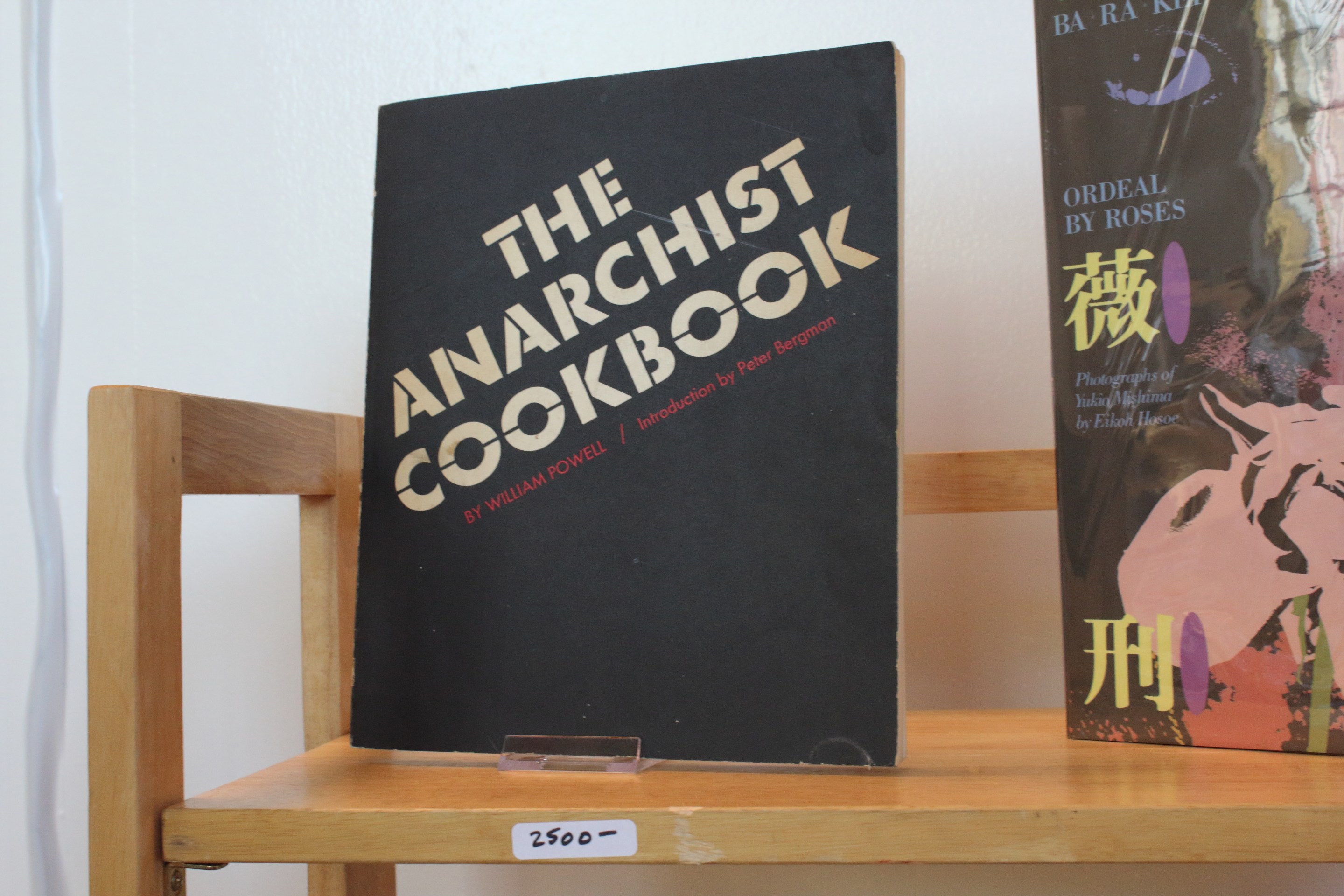
William Powell, “The Anarchist Cookbook”

Francisco Hernandez of Leaves Bookstore tells us, “I think it's the most expensive thing I have here. It came from an amazing collection from this gentleman named Richard Pearlbinder. Shout out to his niece Victoria Prober because he had a collection of about 25,000 books. This was the most valuable book he had, by far, and was the one he was, by far, the least interested in."
“He had it in the very back of his garage at the very bottom of the very last box and probably hadn't seen it in 25, 30 years ... a lot of his collection was very influenced by global religions and Buddhism, Taoism, Sufism. He was an Orthodox Jewish man, but had an esoteric practice for the I Ching. He had a Tarot practice in his life and was really dedicated to thinking about peace and like, global peace and the overlap between religious and ethnic communities, so it's interesting that he has this, incredibly, this book about violence. I find it really ironic, and it's like almost an inside joke to myself."
“It's, interestingly enough, not a very good manual. A lot of the bombs don't work that well and there are better ways to grow marijuana. I think some of the drugs don't exactly work how they're supposed to, but that's okay. It was about the sentiment, which is of anti-authority. This was during the height of the Vietnam War ... It's around this this time where anti-war and anti-authoritarian social movements were starting to become radicalized by the violence that was inflicted on them."
“Of course, the author disavowed it, and basically wanted it to be pulled because he was ashamed by it, which I understand because there was a lot of violence that came out of it. I believe like, the Oklahoma City bombings and things like that were were connected in some way, so we’re trying to discuss it in a way that contextualizes it as being more about thinking about counteracting things like police violence and police surveillance and authoritarianism.”
Salvador Dalí, “The Secret Life of Salvador Dalí”

Nathan Gabbard of Owl Creek Books says, “It’s signed by Dalí [and has] a little doodle by him also. It looks like a sunset or, well, there’s a moon and maybe a mom or a parent holding a child’s hand."
“[Reads inscription:] To Eileen Johnson. So Eileen Johnson was a children’s author and later became Eileen Bassing, and she and her husband were screenwriters in Los Angeles. So Dalí signed it to her and I got it from her family.”
Emma Goldman, “Anarchism and Other Essays”

Ken Sanders of Ken Sanders Rare Books, says, “Well, I've been in the rare book business for more than 50 years now and that's a long time. We're quite well-known throughout the world, in our country...I have a lot of notoriety in the trade. My short answer is that I tell people, 'books find me.' People, because they know me, they see me, they want to sell me when it's time—there are only three things you can do with your stuff. You're going to keep it [and] pass it down to your family. You're going to donate it. Or you’re going to sell it! That's it. There are no other choices."
“[The] Emma Goldman [book], it had been through this family, I guess at one time they knew her and nobody wanted it and that's worth money, so we agreed to purchase it from them. We just got another really cool one, a signed first edition over there of Sinclair Lewis’ ‘It Can’t Happen Here.’ Kind of timely, don't you think?"
"The answer really is: books find me! They seek me out. You'd think that it would be the other way. Naaah!”


The next edition of the Rare Books L.A. Fine Book Fair will be held in Pasadena on February 2026.


