[dropcap size=big]I[/dropcap]t was 'curtains up' for the spectacle of the 2020 presidential election on Wednesday night in Miami, as the first of two groups in the overcrowded Democratic primary fought for speaking time before the U.S. public. While pundits parsed the seconds, the semantic standout of the night undoubtedly was the candidates' use of halting, marbled American Spanish to somehow appeal to the English-dominant U.S. Latino electorate.
It is a political tactic well-known in the American Southwest but which works best in a very narrow linguistic window. On Wednesday night, Texas Rep. Beto O'Rourke tried it first. Unprompted, he launched into his high school El Paso Spanish, and it was ... fine?
"Necesitamos incluir a cada persona en el éxito de esta economía," Beto said. He continued: "Pero si queremos hacer eso, necesitamos incluir cada persona a nuestro [sic] democracia. Cada votar [sic], cada votante, necesitamos la representación [sic] y cada voz necesitamos escuchar."
Listen to Univison's live, extremely talented interpreters pause as O'Rourke launches into the lines: "We need to include everyone in the success of this economy. But if we want to do that, we need to include every person in our democracy. Every [voter] needs representation and every voice should be heard." (Give or take.)
Then Sen. Cory Booker moved to remind everyone that he reps a Spanish-speaking state, too: New Jersey. But Booker's pronunciation was terrible, and it was difficult to discern what regional vernacular of Spanish within the United States he was trying to imitate. It is difficult to literate.
He says: "La situación ahora es inaceptable. Este presidente ha atacado, ha demonizado [sic] los inmigrantes, es inaceptable, y voy a cambiar este [sic]." Watch:
Cory Booker also answers a question in Spanish while debating the issue of immigration during the #DemDebate https://t.co/ewYqXS8Vqc pic.twitter.com/swYH1Emddr
— Hollywood Reporter (@THR) June 27, 2019
Booker described himself in the post-debate period as "people who can speak Spanish." For Beto, the memes and cheap-shots ensued.
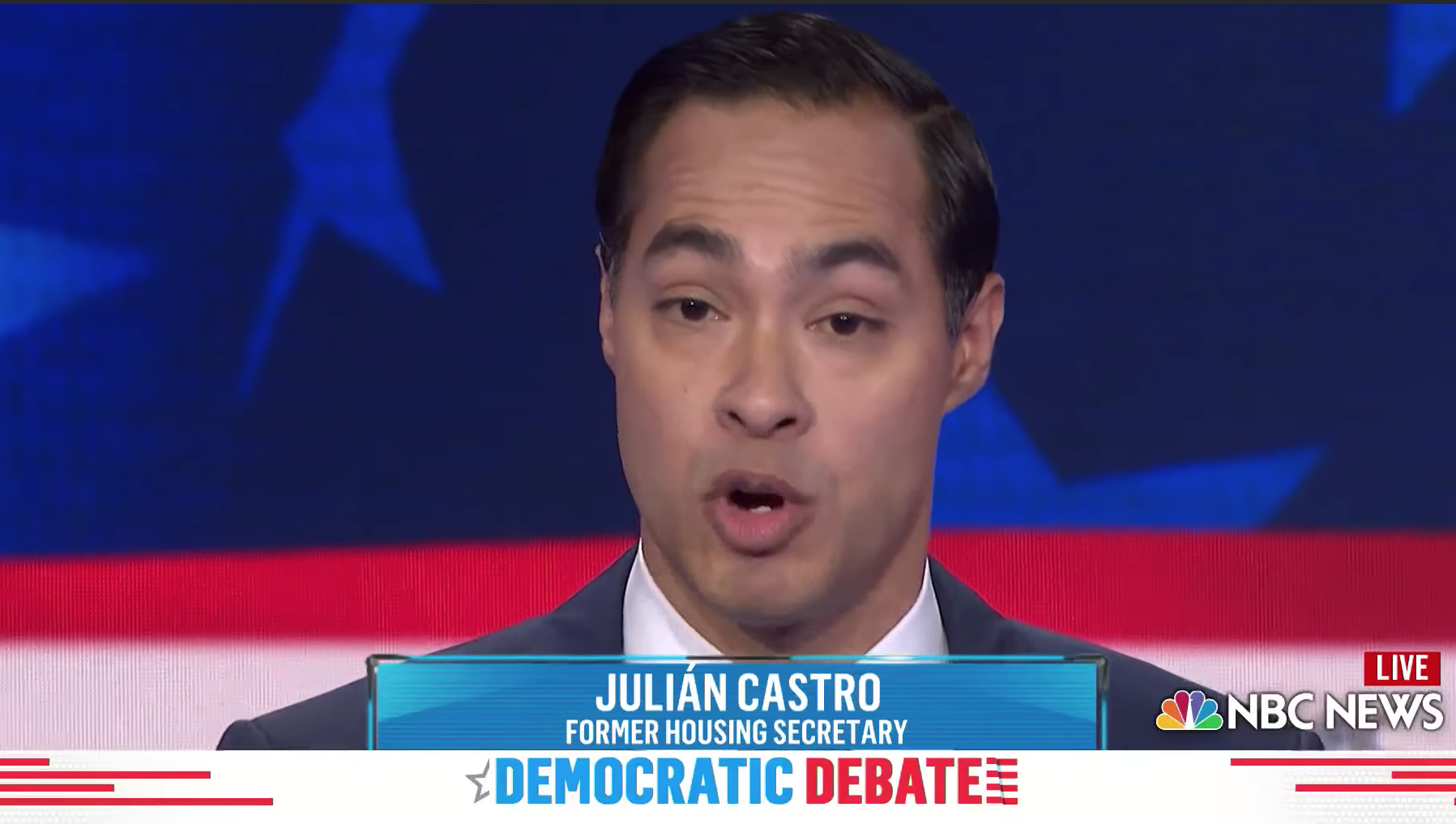
Finally it became the Chicano's turn. Julian Castro, the second-generation Mexican American wunderkind twin and former housing secretary under Barack Obama had to do some Spanish. Smartly, he kept it short: "Me llamo Julián Casto, y estoy postulando por presidente de los Estados Unidos."
The way he said it is wrong, unfortunately. It should be para not por — as OG blogger Laura Martinez always points out when she mocks the "Latinos Por Trump" people. In fact, the whole sentence, spoken fluently, should have been: Me llamo Julián Castro y estoy postulándome para presidente de los Estados Unidos. Or, it could be: Me llamo Julián Castro y hoy me postulo para ... etc.
Castro's incorrect Spanish should not be seen as a deficiency, however. Castro himself would be first to admit his Spanish is weak. On the contrary, the candidate's limited "pocho"-style Spanish is a well-known tool in SoCal, where we have the example of former L.A. Mayor Antonio Villaraigosa and his liberal use of pocho Spanglish-isms. For generations, casually poor Spanish has been the norm among Latino pols in Southern California.
In short, Castro's Spanish is authentic — one of the most important currencies in the 2020 race — because it is only so-so. Like most of ours is. Aware of this, Julián kept it short, and therefore, truly spoke to the awkward bilinguals among us. Language mangling aside, what was remarkable for me watching this first night of debate was how far the field has come as a robust flank of non-Republicans.
A la Izquierda
In late 2014 and early 2015 it was all but assured — like, more assured than it had ever been for an incumbent party in U.S. history — who, exactly, would be the Democratic nominee in 2016. Hillary Clinton, avowed centrist. We knew it was going to play out this way since 2008.
Then an angry viejito with a four-decade track record of being an indie activist filed papers to run as a Democratic rebel from the left, and most folks laughed. (We all remember Ralph Nader and his valid constituency in 2000, right?) But, in four short years since this time of year in 2015, the entire Democratic field has more or less embraced the ideas and platforms first championed by the independent/registered-Democrat named Sen. Bernie Sanders.
Remarkably, today, his most ardent base of support is literally teenagers. Meaning the enthusiasm for his candidacy is pushing downward, to the voters who will be most affected if climate change is not attacked head-on now.
Still, in 2016 pro-Hillary mode, most of the mainstream media doesn't take kind to Bernie, and more or less everyone knows it. But don't sleep on the old man tonight. His method of campaigning — with zero corporate dollars and armies of volunteers since Day 1 — has normalized. The magazine Jacobin, noting the special election win for district attorney of Queens, New York, for Sanders-endorsed Tiffany Cabán this week, just flat out said: "Socialists keep winning elections."
The movement's budding leader, Alexandria Ocasio-Cortez, appears well positioned to pick up the mantle no matter what happens in 2020. But Election Day is still far away, and until we get there, in 495 days, the spectacle must be endured. And the true foe — authoritarian federalism or ethnonationalist fascism if he can push it there — must be confronted.
The show began with Wednesday's debate, and continues tonight when polling frontrunner, the moderate former VP Joe Biden, faces off against Sanders, along with Kamala Harris, California's junior senator, punching not far behind.
RELATED: The L.A. Taco Voter Guide for the Midterm 2018 Election