

Originally from Napa, California, Jack Duffy attended his first protest at the age of 14 when he joined his mom at a march during President Trump’s first term.
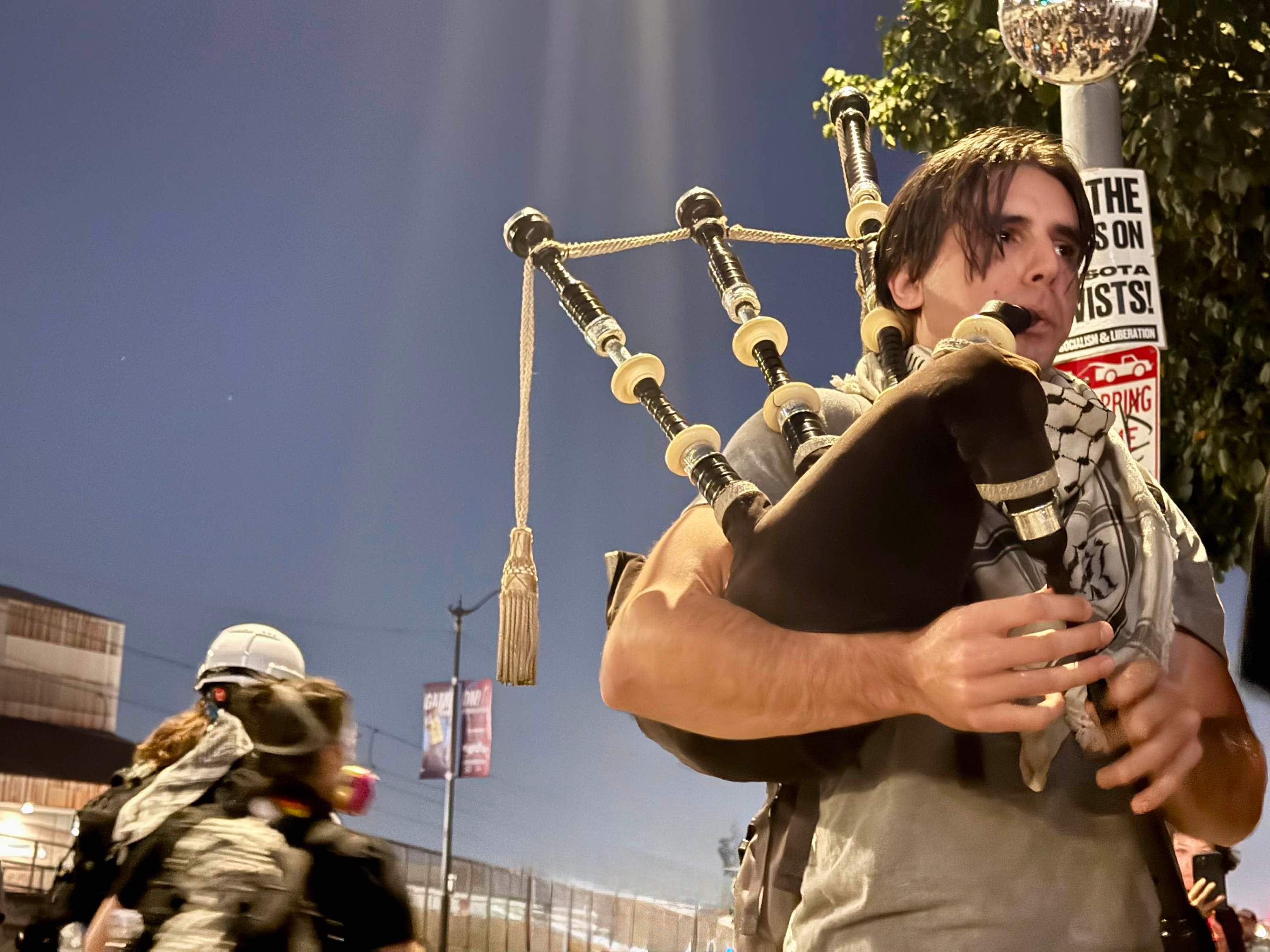
Now a computer science major at Chapman University, the 21-year-old has become known for playing the bagpipes at recent protests in Portland and Los Angeles.
“The first one I went to and played at was ‘No Kings Day’ in Portland,” Duffy says. “I was living in my car, and I went up there to see what it was like . . . that was my first real protest. We were getting tear-gassed and everything. I was playing, someone gave me goggles and a mask.”
Duffy says he started playing the bagpipes over three years ago when he “randomly got into Irish music in high school.”
“I learned [bagpipes] online which is not what you're supposed to do,” Duffy says. (He tends not to share that with any of the other members on the bagpiping Discord server he belongs to.)
Around this time he also learned the tin whistle, which he describes as an easier version of the flute. The banjo and the uilleann (or Irish) bagpipes are also part of his sonic arsenal.
“The one that everybody knows is the one that I play at the protest,” Duffy says. “It’s the Highland bagpipe. It's three drones, nine notes. It’s very narrow, what you can actually play on it. If someone asked me to play a metal song, you just can't. Then the other set that I play is the Irish Uilleann pipes, which you play sitting down. It's a lot quieter, but you have a lot more range.”
Historically, the sound of the Highland bagpipe–its booming vibrations that completely and aurally capture the attention of anyone within earshot–has represented Scotland during both wartime and peace, according to Historic UK.
Duffy tells L.A. TACO that bagpipes were played in Scottish rebellions, World War I, and World War II.

He describes the bagpipe as a “functional instrument,” its sounds punctuating the ears of modern sports viewers and funeral attendees alike.
“Most cultures have their own take on the bagpipe,” Duffy says. “Like, it's not just an Irish and Scottish thing, you know.”
Learning to play the bagpipes, memorizing the notes to historical marches, and moving your fingertips in the exact same rhythm that rebels did hundreds years ago presents pipers with a purpose that is more than just musicial.
“I thought, ‘I have [bagpipes], I might as well take them to the protest and try and use it to fire people up,” Duffy tells L.A. TACO.
Duffy utilizes a skillful musicality to not just empower demonstrators, playing marches like the 11-minute-long, 600-plus-years-old “Black Donald’s March,” but Duffy also communicates his sentiments towards the police and federal agents directly to their faces.
“I always play it whenever the police retreat because it's like, ‘You fucking ran while we stayed,’” he says. “There's a clip on Saturday when they shot that woman in the stomach. I was playing that while it was going on.”
Duffy is referring to an event that he witnessed outside of the Metropolitan Detention Center in Downtown Los Angeles on Saturday, January 31. He says he arrived around 7 p.m. and set up by the parking garage where he met another Irish American musician. They played a few Irish songs together before Border Patrol, DHS, and the National Guard began “to form a perimeter” at 7:38 p.m., according to his timeline.
That is when someone noticed a firework set off by an unknown source, he says, potentially a police agitator. Agents immediately began to release tear gas and shoot less lethal projectiles at demonstrators.
Duffy attached a respirator to his bagpipes to play through the tear gas, he says. While not completely efficient at blocking the gas from entering the blowstick, he still had the capacity to continue playing, an opportunity to maintain morale among the crowd.
“Probably the most important moment of the night for me was, I saw one of their guys: They had a sniper go to set up on top one of the staircases,” Duffy says. “That really pissed me off because he's pointing a gun at unarmed civilians. I thought he was really sloppy to get seen.”
Duffy says he asked others in the crowd if they had flashlights to bring attention to the sniper. He resorted to yelling to alert other protesters about the gunman on the staircase. Protesters then used their flashlights to strobe the sniper atop the building as Duffy started to play a song.
“Once that happened, they started firing on us, and there was a pregnant woman,” Duffy says. “She took a less-than-lethal [round] in the stomach, and she went down really close to their line . . . A bunch of people ran around her. I was trying to get people to line up in between her and the feds because I didn't want them to rush her. But eventually we got her moved. She was kind of blacking out from the pain, I guess, I saw her eyes going back and everything.”
Duffy says that while this occurred, LAPD had apparently declared the protest an “illegal assembly,” out of earshot.
“We had no idea they declared illegal assembly,” Duffy says. “We tried to leave, but they had us kettled, they wouldn’t let us go. I think they arrested about 50 or 60 of us.”
Since Duffy only had a passport onhand, he was categorized with a “non-ID group” before being handcuffed and detained.

In a clip recorded earlier in the night and posted by L.A. TACO editor-in-chief Javier Cabral (@theglutster) on Instagram, Duffy is seen playing the bagpipes while wearing a keffiyeh, a scarf associated with the empowerment of Palestinians. Wearing this keffiyeh is both a symbol of solidarity with Palestine and an homage to the San Franciscan protester who first owned the scarf.
“There's two sides of it for me,” Duffy says. “Obviously, I believe there's a genocide perpetrated by Israel and the United States against the Palestinians. That's currently going on, [I] think it's important to bring attention to that. I think it's particularly relevant for me because during the Irish rebellion, or the Irish Civil War in 1922, some of the same soldiers that the British deployed to put down the Irish in that rebellion–after that was over, they sent those soldiers over to Palestine.”
“Also, I wear it because one of my friends got it from a protester in San Francisco, and we were on Court Watch there. . . .,” Duffy notes. “He got bear-maced on Labor Day wearing that and then he gave it to me to wash. And he said I could just keep it, so I wear it for him.”
Between lacrosse matches, computer science classes, and honoring historic melodies, Duffy uses music to support the protesters willing to venture to the frontlines and the individuals patrolling local ICE activity every day. He says his arrest has not scared him away from demonstrating at future protests.
Duffy’s presence is an important reminder to onlookers that art is a powerful form of resistance–especially when the artist is willing to speak out against enablers of a violent regime by eclipsing the sound of police sirens with the blaring lament of a bagpipe.


