Imagine a Los Angeles ravaged by devastating wildfires, a worsening water crisis, and the rise of political authoritarianism.
A right-wing demagogue rises to power with the slogan: “Make America Great Again.”
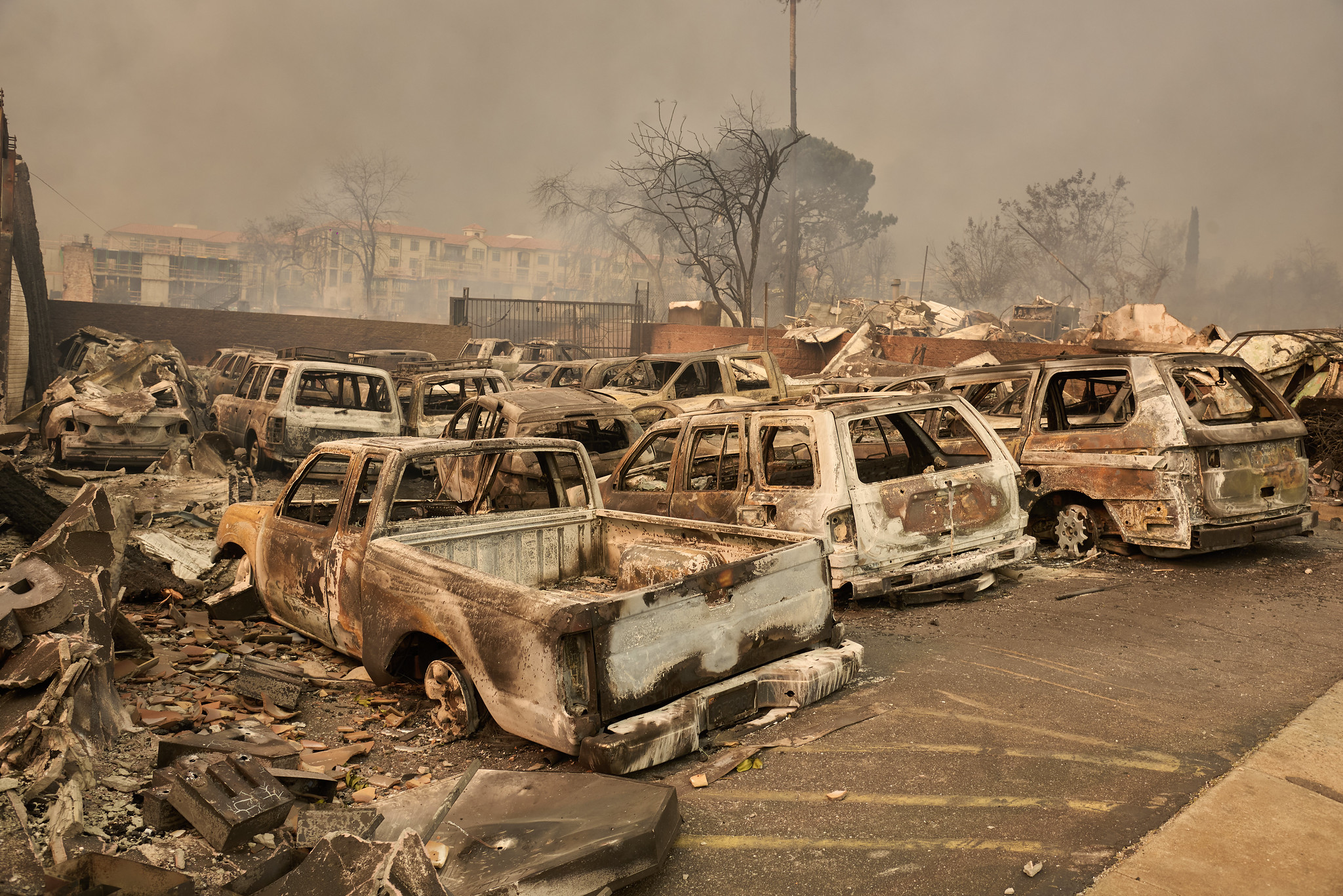
A catastrophic fire burns the community of Altadena to the ground.
If the plot of Octavia Butler’s 1993 novel “Parable of the Sower” rings true to our current L.A. landscape, it’s not because the award-winning science fiction author had any particular prophetic insight or knowledge.
Octavia E. Butler was simply paying attention.
The Pasadena-raised author was a meticulous researcher who spent hours each day pouring over scientific and historical texts during frequent trips to the Los Angeles Central Library.
“Some of the librarians still remember her,” Lauren Kratz, a librarian at Central Library, tells L.A. TACO.
Butler was able to read the warning signs of global warming trends because she was familiar with climate science before it was widely understood by the general public. Upon her death in 2006, she donated her extensive collection of research notes and journals to The Huntington Library in Pasadena.
In recent years, “Parable of the Sower” has grown even more relevant. During the first year of the COVID-19 pandemic, “Sower” ended up on The New York Times Best Seller list for the first time, nearly 30 years after it was originally published.
“Right now, Octavia Butler's works are being read more than ever,” says Kratz, who runs the Octavia Lab, a DIY maker space at Central Library named in Butler's honor.
“We have some high schools that will have field trips to the lab because they're reading ‘Parable of the Sower,’ they’re reading ‘Parable of the Talents,’ and I think because ‘Parable of the Sower’ [took] place in Los Angeles, that ties in a lot to the community.”
Notably, this October marks the 20th anniversary of the publication of Butler’s final piece of work, which was written in 2005.
“Fledgling,” the last novel she completed before her untimely death at the age of 58, is a story of a genetically-modified vampire named Shori Matthews, who wakes up with no memory of her past and journeys down the California coast to learn about her family history and identity.
In “Fledgling,” Butler’s characters mention familiar Los Angeles landmarks, such as Huntington Memorial Hospital in Pasadena, the 101 Freeway, and the dreaded L.A. heat.
Brook, a human follower of a vampire clan in the novel, says of the city, “I went down to Los Angeles a few years ago to visit my aunt—my mother’s sister. It’s too hot there.”
“Yeah,” Victor, a Los Angeles local, replies matter-of-factly. “It’s hot.”
Butler’s writing was no doubt influenced by her strong ties to the Los Angeles Public Library, as well as Pasadena Public Library. She wrote her debut novel “Patternmaster” at the Central Library branch and even worked there as an adult literacy volunteer.
According to Kratz, Butler also helped save some of the 350,000 library books damaged in the 1986 fire.
In her journal entry written on the day of the massive blaze, Butler blames politicians for budget cuts that robbed the building of critical maintenance that might have lessened the spread of the fire.
She describes her experience of being informed about the library fire by a Metro bus driver, writing, “He could have announced the death of one of my friends and not hit me as hard.”
Since Butler spent so much time walking and traveling by bus, she got to see a part of Los Angeles that residents who exclusively drive miss out on. Her journals document trips to Downtown on the Metro 18 bus line. Her Hugo Award-winning short story, “Speech Sounds,” opens with a reference to Culver CityBus Line 1.
According to L.A. journalist Lynell George, who authored “A Handful of Earth, A Handful of Sky: The World of Octavia E. Butler,” Butler once made the observation that, “Los Angeles is so spread out that almost any bus ride will be a long one. The time proved perfect for writing.”
In 1995, Octavia E. Butler was awarded a MacArthur Fellowship — colloquially referred to as the “Genius Grant” — and became the first science fiction writer to earn the distinction. She used her prize winnings to purchase a house in Altadena, where she resided for years.
During the Eaton Fire that people claim Butler predicted, much of the historically-Black neighborhood of Altadena was reduced to ash.
Miraculously, Mountain View, the Altadena cemetery where she was laid to rest, was mostly spared from major damage.
To say that California’s landscape, and Los Angeles in particular, were deeply embedded within the pages of Octavia Butler’s writing is an understatement: Los Angeles defines her body of work as much as her work continues to define L.A.
If her collection of notes and journal entries are any indication, it’s clear how much Butler cared about getting the details of Los Angeles exactly right.
She seamlessly wove together the topography of the places she lived with cautionary tales about climate disasters, far-right extremism, alienness, slavery, and colonization.
“I know it seems like she was telling the future and people get excited about that,” says Lauren Kratz. “But I think she was almost writing as a warning — a wake-up call to people — to pay attention.”
If anyone knew how to pay attention, it was Octavia E. Butler.
Now, we must try our best to do the same.