

Skip to Content
History

Native Community Bands Together In San Pedro, Fighting Trump’s ‘Columbus Day’ Reinstatement

"Traditionally, we do not recognize borders. We are all Indigenous people and seek to represent unity," George Funmaker, a Ho-Chunk/Dakota nations member and organizer of the nineteenth Many Winters Gathering of Elders event, says. Gabrielino-Shoshone artist Jamie Rocha designed this year's Turtle Island logo, an image of a single continent spanning from Alaska to South America.

Mary Lyons (Leech Lake Ojibwe) Great-Grandmother, Ojibwe Elder, spiritual advisor, storyteller and wisdom keeper.

Mary Lyons (Leech Lake Ojibwe) Great-Grandmother, Ojibwe Elder, spiritual advisor, storyteller and wisdom keeper. Photo courtesy of Many Winters Gathering of Elders.

This past weekend, San Pedro hosted Native tribes across North America at the nineteenth Many Winters Gathering of Elders. Launched in 1992, the initial purpose of the four-day event was to overturn the Columbus narrative and combat the 500-year celebration of the Spanish explorer’s so-called “discovery” of the Americas, despite First Nations having prehistoric roots on the continent.

“Here in San Pedro [in 1992], they were going to build replicas of La Niña, La Pinta, and La Santa María, the ships Columbus took on his first expedition across the Atlantic, “ begins George Funmaker, part of the gathering’s organizing committee and a Ho-Chunk/Dakota nations member. “Community members like my father and Tony Portillo (Chicano) asked, ‘How do we counter that false narrative?’ Instead of trying to disrupt, the plan was to hold a gathering to show the country that Native people are still here; that Columbus didn't discover anything … That we were thriving before 1492, and to provide a gateway to bridge culture, languages, mentalities, and truth.”

Taking place the weekend before ‘Columbus Day,’ October 12th was proclaimed as ‘Native American Truth Day’ by George’s father, John Funmaker, and the first MWGOE committee in 1994 to precede the colonial celebration on the 13th. 

Community members gather in a circle while sitting on white chairs.
Community members gather in a circle at the nineteenth Many Winters Gathering of Elders. Photo courtesy of Many Winters Gathering of Elders.

Uprooted to ‘Indigenous Peoples’ Day,’ thanks to the efforts of tribes across Turtle Island, Trump and others in the current U.S. administration are aiming to reverse those efforts, the orange man himself signing a proclamation last Thursday redeclaring today as ‘Columbus Day.’

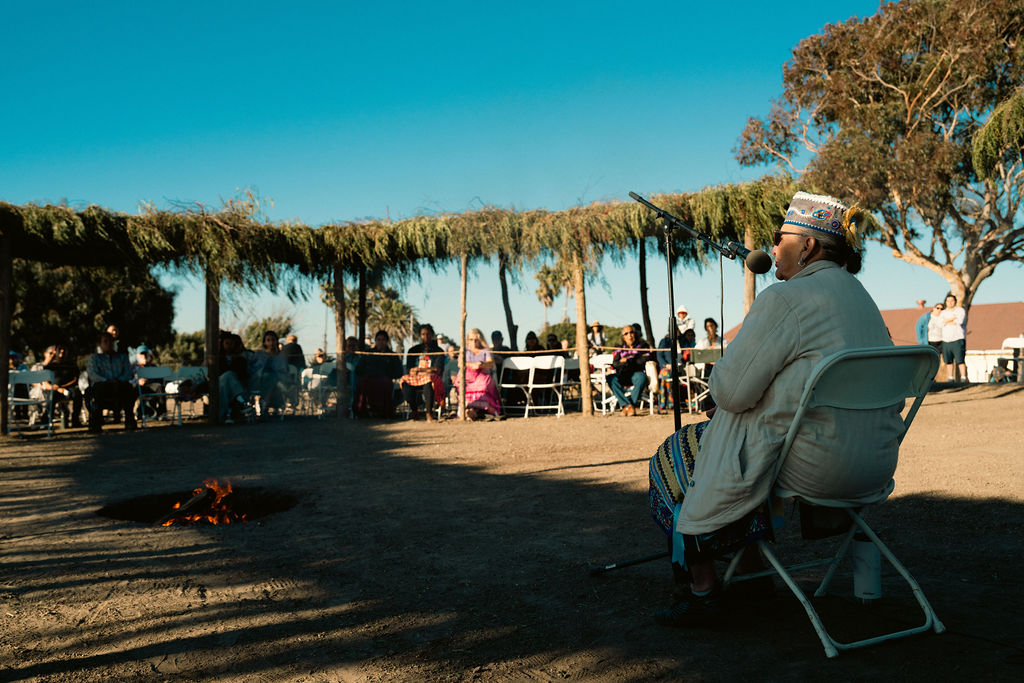
Stephanie Mushrush, the Washoe/Filipina organizing committee chair for the gathering, explains that Amy Eriksen, the executive director of Angel’s Gate Cultural Center, has incorporated the gathering’s efforts into the on-site programming, obtaining fire permits for ceremony, and clearing space for tribes to hold ritual even out of season. 

Photo courtesy of Many Winters Gathering of Elders.
Arbor, the traditional place of learning. Photo courtesy of Many Winters Gathering of Elders.
Photo courtesy of Many Winters Gathering of Elders.
Larry and Mattie Foster (Diné/Navajo), and other MWGOE Elders. Photo courtesy of Many Winters Gathering of Elders.

Made up of abandoned WW2 barracks–turned into artist studios and a public gallery–the hilltop site overlooks the Korean Friendship Bell and the edge of Coastal San Pedro. 

A very hazy view of Catalina Island was visible when I visited this past Saturday, as well as a clear view east and west of the site for sunrise and sunset. I spent my time eating wild rice soup, learning/playing Mesoamerican ball games, listening to elders chat about years past, and even bore witness to the naming of a newborn Acjachemen (San Juan Capistrano tribe) boy. Later that night, a ceremonial Bear Dance around the campfire ensued. The next morning, a sweat lodge began at the crack of dawn. 

No photos from visitors were allowed, as “most of these ceremonies are closed,” Stephanie shares with me as Saturday came to a close, her year-old baby staring at me from her arms. 

Whole families, both Native & non-native, came to show solidarity and participate in the festivities. 

“Many tribes do not open their ceremonies to the public, but the context of this event is so that non-native people can come learn, see, and hear First Nations people.”

“We don't want politicians here, because that's not what this is about,” says George Funmaker. “This is a chance to listen and learn from Native people. Our visual artist we selected this year, Jamie Rocha [Gabrielino-Shoshone], created a logo of Turtle Island for this year’s gathering that represents a single continent spanning from Alaska to South America … Traditionally, we do not recognize borders. We are all Indigenous people and seek to represent unity. We support all of our migrant communities, our relatives. We stand in solidarity with them and were even able to bring a few elders from Mexico and Canada to speak.”

The organization has grown to be women-led, as many First Nations are matriarchal in hierarchy, with an all-female Indigenous art show reception held in conjunction with the gathering (more on ‘Sustainers of Life,’ curated by Cecelia Caro and Laurie Steelink, later this month). 

“For the first gathering in ‘92, they brought a caravan of grandmas from the Navajo Reservation to come and talk about what was going on in their territory, Big Mountain, where they were fighting against mining … They were the leaders in that fight,” says Funmaker. “We want to continue that tradition and uplift the women as much as we can when we're organizing, it’s a balance that keeps us in touch.”

Stephanie adds that this notion extends into the arbor, where the main ceremonies on Angel’s Gate ensue.

“I've been told that some [female] elders feel pushed outside of their comfort zones participating at the gathering, but it helps them practice speaking up,” she says. “ … sometimes they are shy to share, but over time, turn around to ask for more speaking time. They have the knowledge but haven't always had the settings to voice it previously.”

A man stands before a sand painting created by Indigenous artists on the ground. The painting is circular and framed by rocks. A bird, cross, sun, and more colorful symbols are depicted.
A sand painting completed at the 19th MWGOE, by Lazaro Arvizu (Tongva), Louie Robles Jr. (Acjachemen), and Isaac Ybarra (Tongva) depicts expressive imagery including elements of nature. Photo courtesy of Many Winters Gathering of Elders.
‘Eyooshuun / ‘Eyoohiinkem (Our Heart / Our Relatives)Artist: Jamie Rocha, Gabrielino-Shoshone
‘Eyooshuun / ‘Eyoohiinkem (Our Heart / Our Relatives)
Artist: Jamie Rocha, Gabrielino-Shoshone.

“This is a place where people are getting healing and rejuvenation,” Stephanie adds, promising that next year’s gathering is planned to be the biggest yet for the 20th year anniversary. “These are times for reflection and support in community. This is our narrative.”

Stay in touch

Sign up for our free newsletter

More from L.A. TACO

DAILY MEMO: Border Patrol Returns On Dia De Los Reyes, Taking at Least Eight in Orange County and Injure Elderly Man

In another incident, a vendor in Fountain Valley was released after being questioned and detained, but not before CBP called for help from paramedics to use bolt cutters to remove the handcuffs used on the vendor.

January 6, 2026

DAILY MEMO: Masked and Unmasked Agents Kidnap at Least Eight Around Southern California In First Weekend of 2026

During the first weekend of the year, agents targeted areas nearby a Dollar Tree, PetCo, and more common errand hotspots—even a Wienerschnitzel.

January 6, 2026

Nine Places to Get to Know Venezuelan Food In L.A.

These are L.A.'s nine best places for getting to know Venezuelan cooking, from its beloved arepas, tequeños, and cachapas, to its national dish of pabellón criollo.

The Dark Origin of Rosca de Reyes, Plus the 10 Best In L.A.

Eating a rosca de reyes is a way to beat the post-holiday blues. Here are where to find the best ones in L.A. and plus, the macabre origin of the religious holiday that involves murdering infants.

January 6, 2026

Goodbye, Horses: Notorious Sunset Strip Restaurant Closes More Than Two Years Since Animal Abuse Controversy

At its peak, Horses was doing more than 375 covers a night. Reservations were nearly impossible to snag.

January 5, 2026

Sunday Taquitos #9: There Will Be Blood

Stop us if you’ve heard this one before. Sunday Taquitos! Art by Ivan Ehlers.

January 4, 2026
See all posts