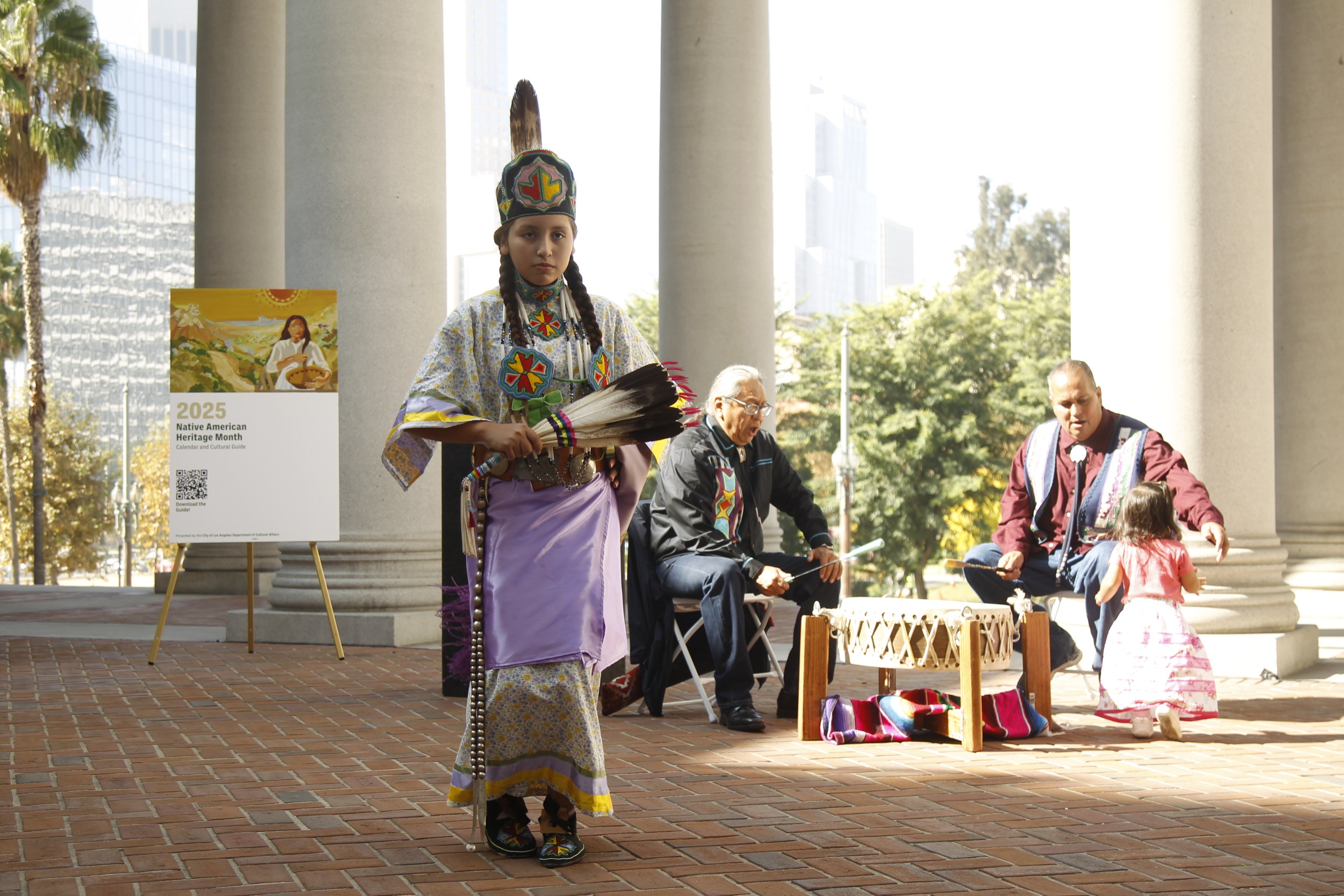
“It’s a time to honor the first peoples of this region, and recognize their living cultures, and celebrate their ongoing leadership at shaping our shared future today,” councilmember Imelda Padilla announced to the crowd last Friday after opening up her November 7th presentation at the L.A. City Council meeting.
The purpose of this meeting was to rectify an official Land Acknowledgement, shaping closer city and tribal relations, and reinforce representation. Voted in unanimously three years ago, L.A. Civil Rights has subsequently worked with tribes across the county to agree to this citywide ordinance.
After a prayer led by Chief Anthony Red Blood Morales of the San Gabriel Band of Indians, the document was read aloud for the first time:
“The County of Los Angeles recognizes that we occupy land originally and still inhabited and cared for by the Tongva, Tataviam, Serrano, Kizh, and Chumash Peoples. We honor and pay respect to their elders and descendants—past, present, and emerging—as they continue their stewardship of these lands and waters. We acknowledge that settler colonization resulted in land seizure, disease, subjugation, slavery, relocation, broken promises, genocide, and multigenerational trauma.
This acknowledgment demonstrates our responsibility and commitment to truth, healing, and reconciliation, and to elevating the stories, culture, and community of the original inhabitants of Los Angeles County. We are grateful to have the opportunity to live and work on these ancestral lands. We are dedicated to growing and sustaining relationships with Native peoples and local tribal governments, including (in no particular order) the …
Fernandeño Tataviam Band of Mission Indians
Gabrielino Tongva Indians of California Tribal Council
Gabrieleno/Tongva San Gabriel Band of Mission Indians
Gabrieleño Band of Mission Indians – Kizh Nation
Yuhaaviatam of San Manuel Nation
San Fernando Band of Mission Indians
Coastal Band of Chumash Nation
Gabrielino/Tongva Nation
Gabrielino Tongva Tribe"
Padilla’s office partnered with the L.A. City/County Native American Indian Commission this November to create opportunities for Native representation in Los Angeles, which counts the largest urban Indigenous population of any metro area in the United States.
The meeting was filled with heartfelt thanks and celebrations from First Nations members and city council members alike, following the opening of an All-Native Group Exhibition inside L.A. City Hall titled Honoring Tribal Firefighters, Indigenous Stewardship and Future Ancestors.
The exhibit outwardly gave thanks to the 14 tribal nations that sent firefighters and resources to Los Angeles during the Palisades and Eaton fires, which occurred at the start of 2025.
Artists included Claudia Brentwood (White Earth Ojibwe), Maree Cheatham (Mvskoke Creek/Choctaw), Valena Dismukes (Choctaw/Suponi), Peggy Fontenot (Patawomeck/Potawatomi Descent), Joel Garcia (Huichol), River Garza (Tongva), Bernie Granados (Apache/Zapotec), Rowan Harrison (Pueblo of Isleta/Navajo), Dawn Jackson (Saginaw Chippewa), Nadiya Littlewarrior (Potawatomi Nation), Kenneth Lopez (Mixteco), Harry Nicholson (Choctaw), Kimberly Robertson, Ph.D (Mvskoke), Arigon Starr (Kickapoo Tribe of Oklahoma), Cheri Thomas (Quinault/Yurok), and Gail Werner (Cupeño/Luiseño/Kumeyaay).
“The devastating fires that ravaged regions like Pacific Palisades and Altadena earlier this year serve as a stark and urgent reminder of our disconnection from the land,” started Shawn Imitates-Dog (Oglala Lakota from the Pine Ridge Reservation), the current chair of the LANAIC.
“This crisis highlights why it is absolutely vital to understand and protect our Native plants, responsible water use, and traditional ecological knowledge,” he continued.
This year, the organization reaches its 49th year of fighting for Native rights and representation in Los Angeles. He noted that cultural burns are a form of working with nature, and are “not just ecological,” but “deeply sacred.”
Shawn went on to state that the L.A. County Harms Report and California’s Fourth Climate Change Assessment have provided evidence of how “Colonization violently disrupted and outlawed these essential traditional land management practices.”
“This suppression, in favor of western-style fire suppression, has contributed directly to the current state of ecological imbalance and catastrophic wildfire severity,” he continued.
I came to the same conclusion last January, using my publication Dead Relatives during the fires to platform a more comprehensive history of Indigenous fire suppression.
Our article titled “Are you with us yet? Los Angeles is Cyberpunk 2025: Fire and ICE, Prison-Slave Labor Heroes, The Olympics and Technology” presented this information in a more modern context, simultaneously touching on and predicting increased ICE enforcement, noting that most frontline firefighters were incarcerated at the time, and warning that the rebuilding of infrastructure around the fires could be used to increase surveillance, but also make way for new and improved technology before the Olympics.
“In an effort to stamp out Indigenous peoples and practices, California banned intentional burning in 1850, within the last four months of the year it became a state (September 9th, 1850). ‘Intentional burning’ was an evasive definition to outlaw cultural burning by Native Americans – members of Indigenous communities were legally shot at for burning as late as the 1930s, to ‘preserve’ timber supplies until the government and large-scale investors could get ahold of their lands,” the writeup begins.
Every day, roadblocks on Indigenous practices like this have been seeing increased pushback by non-Native communities, most locally and notably after the major destruction the January fires demonstrated.
“The purpose of these controlled fires, or prescribed burns as defined when non-Indigenous communities take part, is to reduce dry vegetation to manage how much available plant matter a fire can travel through,” the article continued in summary. “The result is rejuvenated soil, increased biodiversity and tree health, a slower spread of pests and disease, and fewer ladder fuels, which can bring lower-scale fires from the ground to a forest’s canopy.”
This context is assumed by Native communities, being so hard to forget or ignore, but has been largely misunderstood by the general public until recently.
Shawn says facts like these are a “call to action,” rallying to integrate Native cultural burns and other traditions into Los Angeles fire management policy.
The presentation continued with additional ceremonies and statements from First Nations members, closing out with final words of thanks from city council members.
“Decades of poor land management policies and decisions absolutely contributed to the devastation that we faced here in Los Angeles,” said Traci Park, representative of Council District 11, which covers the Pacific Palisades region, of the uncontrollable flames in the area. “I look forward to being a partner, to incorporating your wisdom, your advice, and your learning as we, as a community and as a region, take the steps forward that we need to recover from these devastating events.”
Visit the exhibition in DCA’s Henry P. Rio Bridge Gallery at City Hall, featuring artwork by Native American artists, on view through December 2.
Henry P. Rio Bridge Gallery at City Hall ~ 200 N. Spring St. Los Angeles, CA 90012