Our father, who passed away three years ago, was fond of dichos (sayings) that relayed wisdom to those who cared to listen. The one that comes to mind now with the passing of Dolores Huerta is: Nadie valora el agua hasta que el río se seca (No one values the water until the river runs dry). Dolores Huerta was our river; a larger-than-life figure whose consequence has not been fully appreciated.
We don’t believe that it’s an exaggeration to state that Huerta stands as one of the most consequential leaders in the Chicano community. Her life’s work as a labor organizer, negotiator, political organizer, strategist, movement builder, and mother were key in transforming the lives of generations of young people. She helped countless future leaders reimagine what Chicano power could look like, and what the future might hold.
All of this work was not without personal sacrifice.
In the 96 years she lived, she witnessed incredible change. She lived through the extreme economic hardship that was the Great Depression, saw the world go to war in the 1940s, came of age during the Civil Rights and Women’s Movement, and came to be pivotal during the tumultuous Chicano Movement. She witnessed Mexican-Americans evolve from a largely marginalized population, excluded from political and economic power, into a community central to the nation's political, cultural, and economic future.
It cannot be overstated that she has left an indelible mark on the national culture and imagination. When President Barack Obama echoed Huerta’s famous rallying cry, “Sí Se Puede,” with his infectious “Yes We Can,” he admitted he had borrowed it from her. Indeed, in 2012, he would award her the Presidential Medal of Freedom, recognizing her life’s work and the profound impact she has played in the lives of countless individuals.
Her philosophy was straightforward: organize. When confronted with injustice, Huerta did not simply demand change from those in authority. She believed ordinary people had the responsibility and the power to organize their communities. She believed fundamentally that people’s voices had to be heard, no matter their race, gender, or class. She also understood that organizing, being a leader in this work, could be challenging. And she didn’t sugarcoat this reality. There simply wasn’t another alternative. Her longevity as an organizer is a testament to this fact.
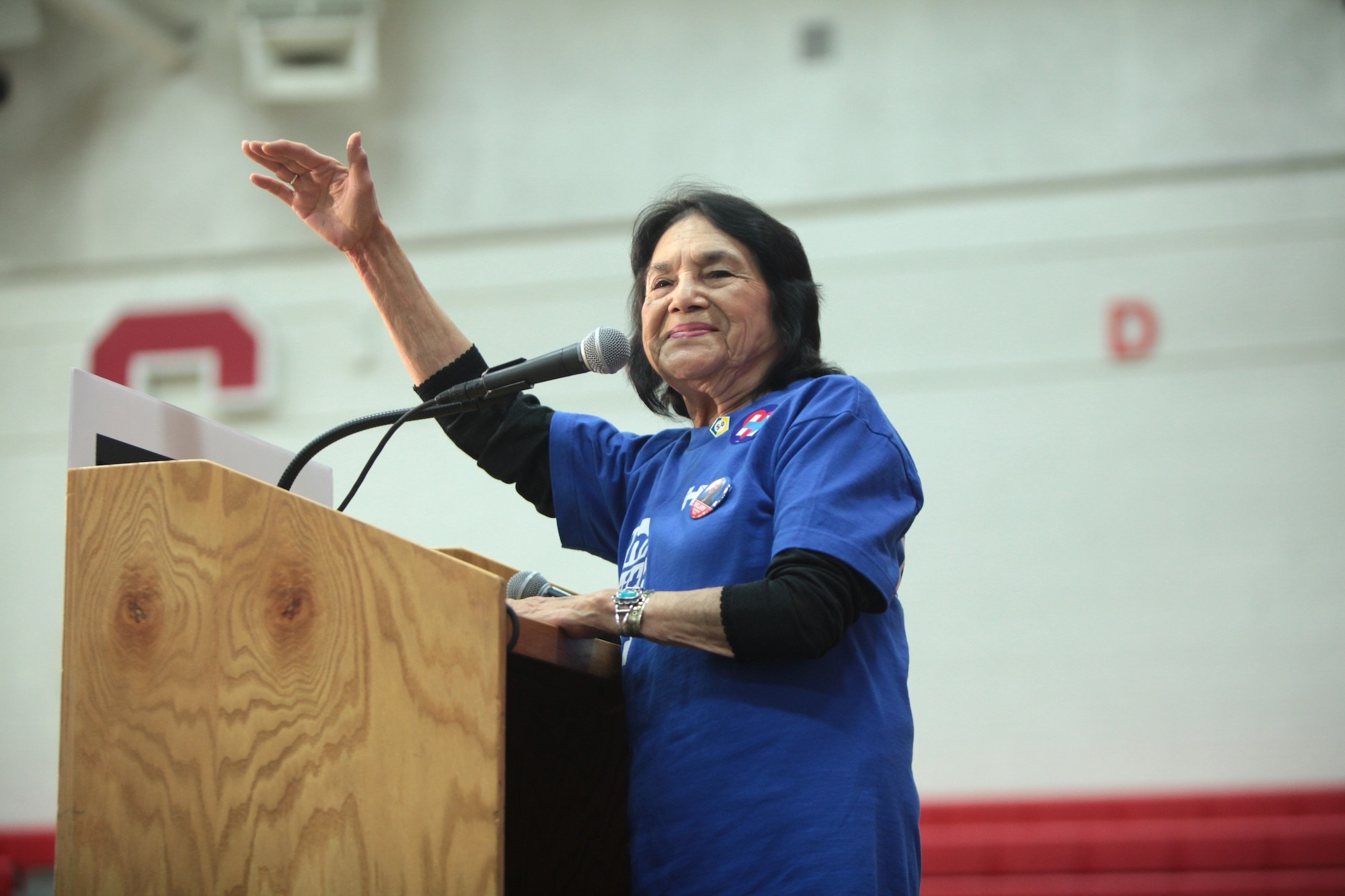
Huerta’s’ commitment was always aligned with working families, the poor, and those in society too often ignored or cast aside. In Arizona in 2006, for example, she spoke before an audience of high school students reminding them of the power of their individual agency in the building of their democracy. In the speech, she admonished those forces, specifically calling out the Republican Party and stating “Republicans Hate Latinos”, acting against the self-determination of their communities.
Huerta understood political power. Her father was an Assemblyperson in New Mexico, had cousins who were judges in Texas, and her grandfather served in the Civil War. Huerta understood that lasting change required more than protest. It required institutions, leadership, political participation, and collective action.
The Farmworkers Movement inspired an entire generation of Chicanos to attend college, become union organizers, enter public service, run for office, and build new social movements. It helped create pathways into the middle-class for families who had been denied opportunity for generations. Huerta did not organize so Mexican-Americans could simply become consumers. She organized so they could become empowered participants in the democracy they defined.
Huerta’s influence transcended ethnicity and national borders. President Barack Obama awarded her the Presidential Medal of Freedom. Her words, “Sí Se Puede,” became an international expression of hope and collective action. Yet the phrase remained deeply rooted in the Chicano experience and the belief that even the most marginalized communities could change their circumstances.
Was Huerta perfect? Of course not. No historical figure is. Her significance lies not in perfection, but in what she made possible. She taught generations that poverty was not destiny, that injustice could be challenged, and that political power could be built from the ground up.
Many of us knew Huerta personally. Thousands have photographs with her, marched alongside her, or shared conversations with her. Her accessibility sometimes made us forget that we were standing alongside a giant of American and world history. In fact, Huerta helped guide a documentary we worked on that explained discrimination in the Tucson Unified School District through the documentary “Outlawing Dolores Huerta” and “Outlawing Shakespeare, the Battle for the Tucson Mind.”
Huerta was not only one of the most consequential Chicanas in history. She was one of the most consequential human beings of our time.
It is difficult to imagine a world without Dolores Huerta. But it is even more difficult to imagine what our world would have been without her contributions. Would many of us have the opportunities we had in education or in the workplace? Huerta and the United Farm Workers created the Mexican-American and Latino middle classes, and inspired generations throughout the world.
We had a hero walking among us. Now we have a responsibility to carry her work forward.