

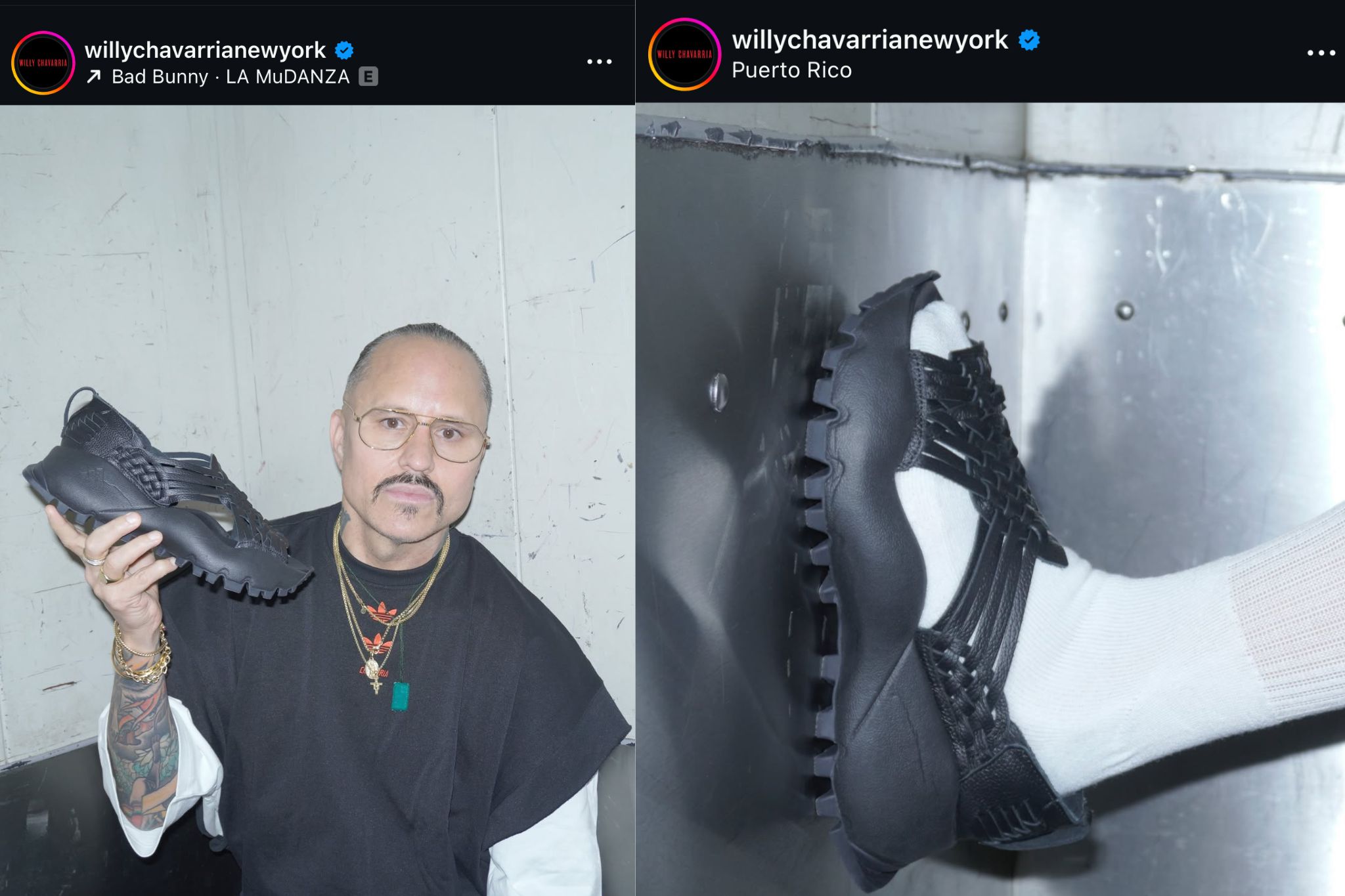
Willy Chavarría’s collaboration with Adidas wasn’t just cultural appropriation; it upheld the social caste system that was established during the Spanish colonial era.
When Adidas released Chavarría’s “Oaxaca Slip Ons,” the backlash on social media was swift. The commentaries echoed that Chavarría should have worked with Mexican artisans, that the slip-ons should at least be made in Mexico, and that he should share those profits with the state or people of Oaxaca.
Shortly after the announcement, Chavarría issued an apology stating that, “the intention was always to honor the powerful cultural and artistic spirit of Oaxaca and its creative communities—a place whose beauty and resistance have inspired me.”
However, if the designer’s intention was to honor Oaxaca, which includes the spirit of resistance, he should have shed light on the many forms of discrimination facing Oaxacans: anti-Indigeneity, color-ism, and class-ism, as well as the economic and political disenfranchisement that Native and Indigenous Oaxacans face both in Mexico and the U.S.
Not all Chicanos appropriate Mexican culture, but as some are generations removed from their Indigenous roots, or simply don’t have strong connections to Mexico, it can lead to an easy slip. One timeline shows that huaraches first entered the U.S. during the era of the Bracero Program in the 1940s, which lured Mexican laborers into the US. Decades later, Chicanos adopted the huaraches as a symbol of activism and cultural pride.
Handing over huaraches, huipiles, mezcal, or Oaxacan food to the global market as a commodity, while marketing them as cultural pride, is a murky place to be. Whether they’re aware of it or not, the ones importing these items are complicit in racial capitalism which is an economic system built to profit from racial inequities and that uses race to dictate whose labor, land, and culture can be exploited for wealth.
Like huaraches, mezcal carries the weight of stigma and survival for Indigenous Mexican people and campesinos, yet becomes a status symbol once it’s stripped from its context and packaged for outsiders.
These specific patterns of cultural appropriation, by Mexican-American, Chicano, and even Mexican people, continue to repeat and have even become a global trend. Chavarría certainly is not the only one using their Mexican, Mexican-American, or Chicano identity to sell cultures they’re not intimately and personally connected to.
This pattern isn’t unique to Oaxaca or Mexico.
We see it in food: lobster, oysters, and certain cuts of meat that were associated with poor people are now eaten by wealthier groups. Sometimes the appropriation is more global, with products becoming items of luxury or specialties in the Western world. Chai, matcha, and yoga all originate from other countries but are largely accessible to certain classes of people in the U.S., often found in bright-colored packaging on grocery store shelves and in studios owned by the privileged. The list can go on. These cultural products are stripped from their context and consumed without recognizing the labor or heritage of the people who created and safeguarded them.
PARALLELS IN HUARACHES AND MEZCAL
Mezcal, once dismissed as the “poor man’s drink,” and negatively associated with farm workers and Indigenous people, is now poured at $20 a glass or in cocktails at trendy bars from Mexico City to New York and beyond. Like huaraches, mezcal carries the weight of stigma and survival for Indigenous Mexican people and campesinos, yet becomes a status symbol once it’s stripped from its context and packaged for outsiders.
The story of mezcal also illustrates how rapidly culture shifts from poverty to luxury, and how Chicanos and other BIPOC individuals often facilitate this shift, sometimes as designers, brand owners, or brokers –all playing a part in the global movement of commodifying culture and upholding social hierarchies.
In one of the informal interviews with Gonzalo Martinez Sernas, a mezcal producer from my pueblo of Santiago, he shared that the mass migration of people from the pueblo in the 1980s and 1990s marked different social classes. The paisanos (townspeople) who had migrated to the U.S. would send their families new tennis shoes, usually Nike, or start wearing them themselves.
Gonzalo didn’t have tennis shoes, so he continued wearing huaraches because, as he says, “we are sure of who we are, where we come from.” Still, huaraches in the pueblo remained a symbol of poverty.
Gonzalo shared stories of his many visits to Mexico City before the mezcal boom; knocking on doors, hoping someone would buy the family’s mezcal, only to be met with closed doors. A couple of times, he had to sleep at bus terminals.
Today, he and his family have an independent premium mezcal brand called Macurichos. He still wears his huaraches. He still speaks Zapoteco. But it’s more acceptable now because he is an artisanal mezcal producer who contributes to the global marketplace.
Now he has white USA-ians, Europeans, as well as wealthier Mexican nationals and U.S.-born and raised BIPOC people, visiting him and taking pictures of the family’s palenque. He matters, at least within the mezcal world, because he brings something to the table; even if he’s physically and mentally exhausted from the work.
For most artisanal mezcal producers, being in the industry is like signing an invisible contract. Labor grows more arduous, and both biodiversity and the socio-cultural fabric become fragmented, all so that consumers can have their cocktails, tastings, pairings, pre-fixe menus, or expand their mezcal collection. These ways of consuming mezcal are removed from the original cultural context.
If it weren’t for Oaxaca–one of the states with both the largest Indigenous populations and one of the highest poverty rates–there would be no mezcal industry. Yet, in the mezcal industry, it’s easier to market mezcal as “Mexican” than to name the pueblos and communities that have kept it alive. But Oaxaca is an example of resistance–as Chavarría recognizes in his full apology–a place where many pueblos still have a particular creative, artistic, artisanal, or skill-based identity.
The external shame of wearing huaraches, drinking mezcal, and wearing huipiles wasn’t internalized by all. One reason we have these cultural elements still available to us is because of the people who chose to hold on to their culture in spite of external forces advocating for assimilation. In this resistance we’ve faced discrimination, often by people who we have shared identities with: Mexican, Mexican-American, Chicano, and Latine people.
ANTI-INDIGENEITY AND ACCOUNTABILITY
There is significant discrimination against Oaxacans by our own people. Mexicans regularly calling us the ugliest people of Mexico, the Latino Los Angeles council members who also called us short, dark, and ugly, and everyday people treat Oaxacans as the lowest in the social hierarchy, while profiting from Indigenous labor and culture. It is a constant reminder of how deeply internalized anti-indigeneity, colorism, and classism run in Latine communities.
In searching to reconnect with their roots and find belonging, sometimes we end up complicit in commodifying the very cultures we claim to want to honor. It could be that living in an individualistic country, despite our collaborative spirit, we still get caught up in the lures of capitalism.
I grew up hearing some of these same messages. I was called Oaxaquita, India, and Maria–all as insults, all by Spanish-speaking people. I still haven’t met Oaxacan peers who have dodged these insults. These life experiences make me more hyper-aware of cultural appropriation and the nuances of power dynamics.
These experiences leave me torn: On one hand, I feel pride that Oaxacan, and by extension Mexican culture, are finally being seen with the regard they deserve. However, without cultural sovereignty, visibility is a facade, and the culture bearers remain vulnerable to extractive capitalism.
In searching to reconnect with their roots and find belonging, sometimes we end up complicit in commodifying the very cultures we claim to want to honor. It could be that living in an individualistic country, despite our collaborative spirit, we still get caught up in the lures of capitalism.
Time will tell if Chavarría's apology will lead to repairing some of the damage done and live up to the true spirit of the origins of Chicano culture. Or if his apology was just words.
It will not be enough to have the huaraches–or any Mexican product–be made in Mexico if the Mexicans making them are stuck in a cycle of poverty and social exclusion. Or if in the U.S., they are being abducted without due process. The winner in this case is Adidas because they still holds the most economic global power. They build wealth from cultures they don’t stand up for.
Beyond apologies, it’s time to imagine a future where working-class Mexican and Indigenous Mexican cultures can thrive without Adidas, Nike, or other conglomerates. A future where these collaborations and partnerships contradict our existence because they threaten the very culture and lifeways we want to amplify.


