

Skip to Content
Tacos

After 34 Years, Hollywood’s Iconic Cactus Taquería #1 Is Being Forced to Close This Sunday

You have two days left to eat at the taquería that survived a drive-by in the 90s and is beloved by Brad Pitt and Johnny Knoxville. We sat down with the owners to go down memory lane with them and remember when Bourdain stopped by to try his favorite lengua tacos.

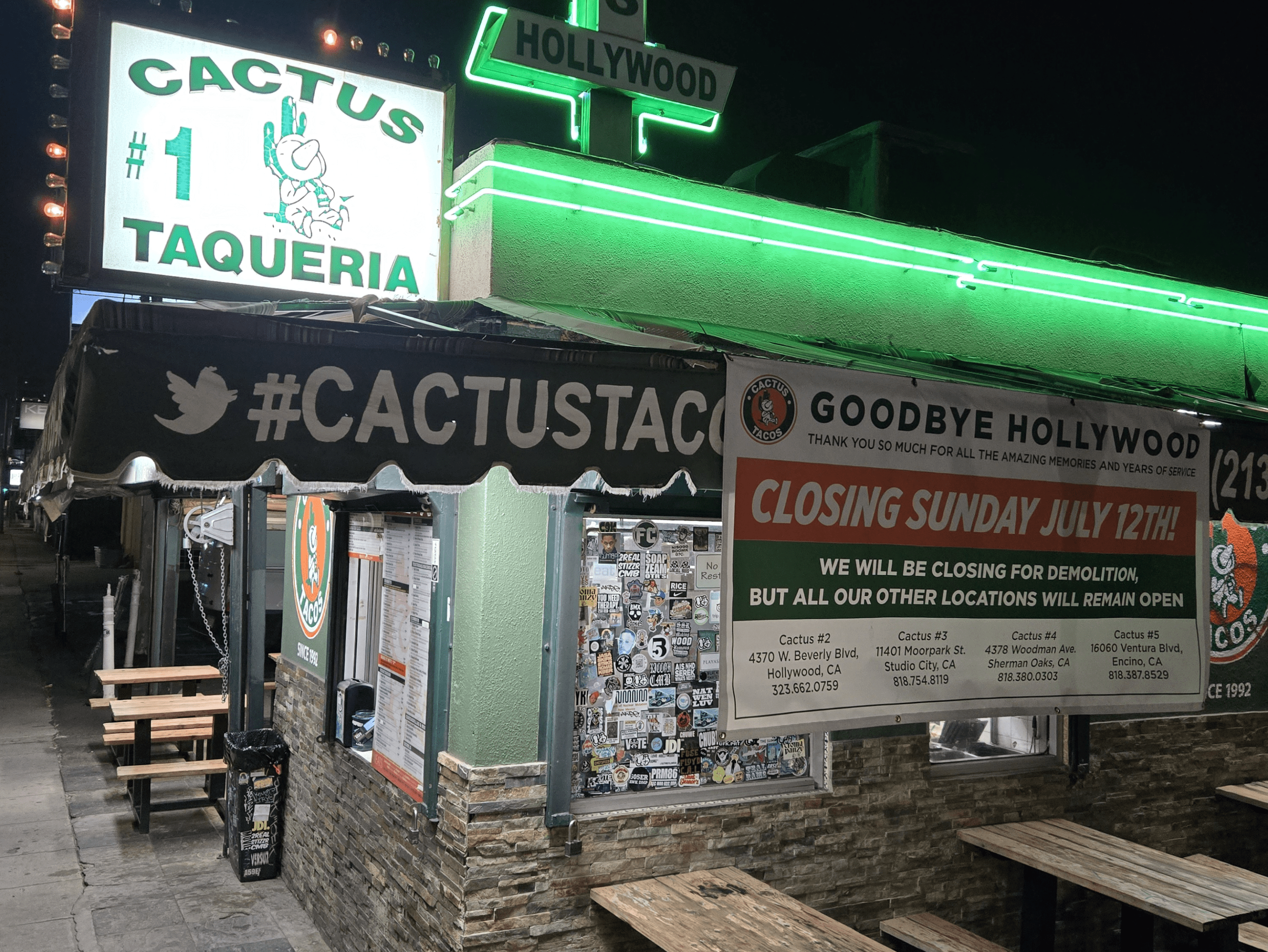
restaurant exterior

Cactus Taqueria #1. Photo by Jake Hook for L.A. TACO.

Sometimes nostalgia gets a bad rap. Like it's some kind of purely reactionary force that keeps people stuck in their ways, resistant to change. 

But nostalgia can also be a way of sharing memories and forming community. 

"What we're going for more than anything, we want nostalgia to hit when you eat here,” says Marlo Tornel, who runs Cactus Taquería with his family. “We want you to be like, alright, this is an L.A. taco like I grew up eating.”

Cactus Taquería has been dishing out tacos and burritos on Vine Street in Hollywood since 1992. Their original location up the street, where Marlo's parents, Mario and Martha, rented an apartment with their kids, was destroyed in the 1994 Northridge earthquake while Marlo was still in diapers. 

“I took my first steps in that kitchen,” he says. 

Cactus’ next location, the one currently still standing on Vine and Barton, was like a phoenix rising from the ashes for the Tornel family. But the story of this particular taco stand may soon be coming to an end. 

Project Angel Food, a non-profit that provides free meals for people with AIDS, cancer, and other serious health conditions, is expanding its operations on the property where the taquería stands. 

That means Cactus Taquería, along with the other businesses on the lot, including El Rancho Supermarket, must vacate by Sunday, July 12th. Cactus announced the news on their Instagram on Thursday, just a few days before they plan to cease operations here.

Cactus Taquería is an American Dream story for the Tornels. Mario Tornel immigrated roughly 40 years ago from Tijuana, Mexico, with practically nothing to his name except his family recipes.

In those days, Marlo says, "We didn't have any money. My mom and dad, when we were living in those apartments, they didn't have money for a babysitter for my sister and myself. So they'd park their car right here next to the stand. We'd set up with our blankets, they'd be selling pastor on one side while me and my sister would do our homework over here.” 

He talks about how his father, who worked from morning until late at night, had to miss soccer games, graduations, and other milestones because of his commitment to growing the family business. 

It's that hard work that Marlo wants people to remember about the Hollywood taco stand. 

Asada, al pastor, and lengua tacos from Cactus Taqueria. Photo by Jake Hook for L.A. TACO.

"We want people to know how much hard work and sacrifice went into this. Because if we don't let that be known, it's like we're throwing all that away, like that time didn't even happen,” he says. 

While Cactus may have other locations now, this one is special to the family because it represents growth and opportunity—something coming from nothing. 

“When my dad opened this location, he told me, lightning doesn't strike twice. But lightning struck here,” Tornel says.

It's also special to the Hollywood community. 

Marlo says he's seen someone propose here after meeting their mate in line late one night. Cactus has catered weddings, birthdays, and even funerals for people who grew up eating its tacos. 

“They would say, your parking lot either saved my life or saved me from getting a DUI. You're keeping people that are not supposed to be on the road, and you're getting them off the road to stop, drink something, get some food in them, absorb the alcohol.

They've also seen plenty of famous faces over the years; celebrities ranging from Jimmy Kimmel to Brad Pitt and Quentin Tarantino have reached out to them for catering because, unbeknownst to them, they'd all eaten there at one time or another and fallen in love with their tacos. 

“We've had Khloe Kardashian and Lamar Odom when they were still together, Paul Rodriguez, Eric Tillman, Hilary Duff, Olivia Rodrigo, [Metallica's] Robert Trujillo, 2 Chainz,” he says. 

The list goes on. Even Anthony Bourdain paid respect to the Cactus, making several appearances at the Beverly Boulevard location for his favorite lengua tacos in Los Angeles, though it was never featured on his shows. 

Stickers on a window at Cactus Taqueria. Photo by Jake Hook for L.A. TACO.

Cactus has also been featured on screen over the years, in movies like “Flight Of The Phoenix” and TV shows like “House” and “Bosch.” A particularly memorable moment came courtesy of “Jackass,” in a scene where Johnny Knoxville's alter ego, Irving Zisman, exposes himself (all prosthetics) to the shock and dismay of the taqueria's customers. But there were no hard feelings at the end of the day; the crew paid for everyone's meals while they were shooting there. 

It's these kinds of only-in-Hollywood experiences that give Cactus Tacos and places like it their ineffable character. You can't put a price on memories like this, which are intrinsically tied to the places where they happen. 

We don't have buildings and monuments and things where we get to put our name up on stadiums built after us and roads named after us. We don't have that, but, well, we have grandma's recipes, and I think that's as special as anything else.

Marlo's life story is bound up in this place. As much as Cactus Tacos is the story of an immigrant family making a life for themselves in the U.S.—a story you can find repeated across Southern California—it's also the story of Hollywood in particular. Cactus Taqueria wouldn't be quite what it is if not for the community in Hollywood that nurtured it from the beginning.

Marlo talks about the changes he's seen in the area since he started working in the kitchen as a boy. 

“If you were in Hollywood in the 90s, Hollywood was gang infested,” he tells us. “Like you had MS 13, 18th street, TMC, you had White Fence, you had Hollywood Locos, you had literally like all these gangsters. And the one thing that was really, really cool that even my dad would say was the craziest fucking thing he said: He would have gang members from MS 13 at this table, 18th Street at this table, you would have fucking White Fence at the other table, TMC at the other table, and the one thing that they respected was that food is sacred.”

Marlo Tornel's parents in the kitchen of the original Cactus Taqueria in 1992. Photo courtesy of Marlo Tornel.

That's not to say Cactus didn't have its share of trouble, though; Marlo describes one incident in which his father had to tell his customers to leave and take cover after someone warned him that the street was about to be "lit up." A few minutes later, Marlo says, someone drove by and emptied an Uzi clip into the side of the building. 

Things have calmed down significantly since those days. Marlo speaks fondly of the era between 2005–2020, where it was “just 15 yeas of everything going right.” 

But when COVID hit, things dropped off very suddenly for the stand, as they did for businesses across the city. Cactus Taqueria was long known for its late-night hours of operation, staying open until 3 or 4 a.m. every night. 

L.A.'s late-night establishments were dealt a heavy blow with the pandemic, one that everyone has struggled to recover from. Places you could once depend on after a night out are increasingly going dark once the sun goes down. Which is a shame, because for Marlo, late-night establishments serve an important purpose. 

“I've heard this from multiple people who would come here and eat at 2 or 3 o'clock in the morning after they were at a bar,” he tells us. “They would say, your parking lot either saved my life or saved me from getting a DUI. You're keeping people that are not supposed to be on the road, and you're getting them off the road to stop, drink something, get some food in them, absorb the alcohol. And if they're drunk enough, they'll fall asleep in their car, and we're fine with that. I'd rather people fall asleep here in the lot and wake up the next day going ‘what the fuck?’ than waking up in a jail cell or worse.”

Late-nite spots like Cactus also serve an important function for the city, by bringing people from all walks of life together in one place. Pimps, drug addicts, municipal workers, and young people coming from shows at the Palladium or bars like The Three Clubs might all be standing in line together, when suddenly they realize Frank Ocean and Tyler, The Creator are waiting behind them to order, too. 

“L.A. definitely has its own style of Mexican food,” he argues. “It's not like anywhere else. We blend cultures together. I think the coolest things I've seen are people making pupusa tacos and birria ramen. We just blend cultures together; I think that's what makes it L.A.-style. We have such a huge plethora of people from all around the world.”

Marlo recalls one night where skateboarder Andrew Reynolds was eating a burrito at the stand, when a teenager came up to him and said, “What's he eating? I need to eat what he eats to do a frontside flip like he does.” 

Experiences like that make the city and its residents feel interconnected, no matter where they come from. You find yourself in it in some small way, just by finding yourself at an institution like this. 

Ultimately though, it's all possible because of the food. Cactus Taquería is one of several old-fashioned taco stands that were once omnipresent across the city, but are increasingly threatened by development and rising rent. 

Marlo mentions the recent closure of Burrito King and hopes someone might revive it. It's important, he says, because these establishments represent a uniquely Los Angeles style of Mexican cooking. 

“L.A. definitely has its own style of Mexican food,” he argues. “It's not like anywhere else. We blend cultures together. I think the coolest things I've seen are people making pupusa tacos and birria ramen. We just blend cultures together; I think that's what makes it L.A.-style. We have such a huge plethora of people from all around the world.”

ICE raids in the city have also taken a toll on the restaurant. Employees who've worked at the taquería for years, even decades, have had to miss work or, in some cases, return to Mexico or Guatemala entirely just to avoid harassment by law enforcement. 

Cactus’ tacos are rooted in the cooking of Tijuana, where the Tornel family is from, adapted to the styles and tastes of Los Angeles. Each member of the family has contributed in some way to tweaking this or that, experimenting with new techniques or new menu items. 

A taco at Cactus Tacos, Marlo says, isn't going to be quite like anywhere else. Even other Cactus locations might flame-grill their meat, while the Hollywood stand sticks to the flat-top griddle his father Mario has sworn by since he moved into the Vine Street stand—though he assures me the quality will be as high at their Studio City location as it is here in Hollywood. 

As with many longtime eateries, that flat top has been seasoned by years and thousands of meals prepared on its surface, giving every taco or burrito a flavor that's completely unique to this address. 

Tacos and burritos are the core of the menu, though they've expanded over the years to include nachos, tortas, and mulitas—and they even have a long section dedicated to vegetarian items. 

Meat options include the general basics like asada, pastor, chicken, lengua, birria, shrimp, and fish. Marlo offers me a trifecta of tacos: carne asada, al pastor, and lengua, all drizzled with salsas made from grandma's recipes. The lengua in particular blew me away; an incredibly tender, melt-in-your-mouth texture, almost flaky like fresh mackerel, with a rich beefy flavor. 

“The trick to making good lengua is that it should be soft,” he says. “It should not have any bite to it. If you have to chew it, you're not doing it right.” 

He's rightly proud of his family's legacy, especially that of his grandmother. He describes one occasion where the then-98-year-old matriarch visited the restaurant. Though she was characteristically humble about her cooking, Marlo announced to everyone eating there that “if you guys don't mind, if you guys like our food, you like the flavor, this woman right here is responsible for all of it.” 

The entire restaurant gave her a standing ovation. 

Marlo Tornel's grandmother, Doña Christina Silva Vega. Photo via Marlo Tornel.

“People start clapping, cheering for her, whistling and rooting her on,” he says. “People got up and shook her hand. I think that type of stuff is special. I'll remember that till the day I die, you know? Like my grandma got to see what she would serve my mom at home be created into something that she never even expected. It's like, Mexican moms, they know their food is good, but they don't know the potential of their food actually has. That's what this place is about.”

As for the future of Cactus Taquería, Marlo admits there will be challenges ahead, but he remains hopeful. His father Mario is particularly undeterred; “My dad is very proud. He just says, ‘we'll go do it on our own, we'll figure it out. If we have to start selling food on the street, then we'll do it.’ And he's not scared.” 

“He's very, like, ‘go get it,’ you know? Like ‘go do, go be productive. Fuck crying, fuck being sad, like let's just go and work.’” Marlo says. “That's what we do. That's what we know how to do." 

Tornel says the family has received offers to sell the business for huge sums, but they've turned them all down because they just didn't feel right. And what feels right now is to continue the business, whatever it takes. 

There are now just a few days left to enjoy the tacos at Cactus Taqueria's flagship spot in Hollywood. 

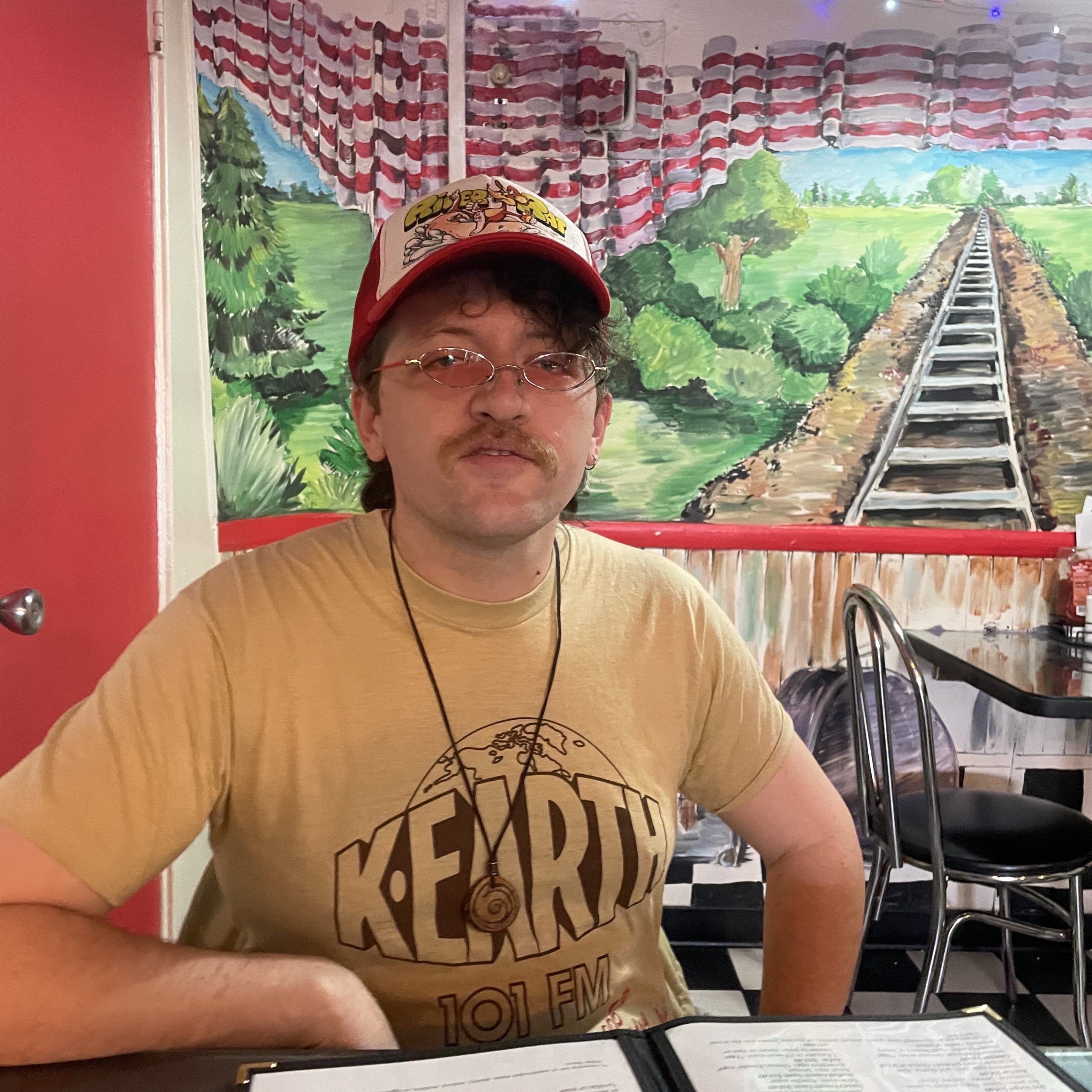
Marlo says that more than anything, he hopes that the social media buzz reaches longtime fans who maybe haven't been around in a while to come relive the memories they have of the place. He says people have recognized his Cactus Taqueria shirt as far away as Japan. The connections people have to this place run deep and reach far from the humble taco joint on Vine. 

“We want to share these recipes because again, you know, my grandma lived such a long life that it's like the least we could do for her, you know?” Tornel says. “We don't have buildings and monuments and things where we get to put our name up on stadiums built after us and roads named after us. We don't have that, but, well, we have grandma's recipes, and I think that's as special as anything else. So, I hope people come enjoy our food; I hope they come support us. We hope people that have memories here want to come back and enjoy a little bit of that before it's gone.”

Stay in touch

Sign up for our free newsletter

More Stories

Public Outcry Sparks Over California City Officials’ Approvals of Immigration Detention Center

California City Chair David Brottlund told one attendee to “shut their mouth.” He issued warnings throughout the meeting that he could have individuals removed from the chambers.

Raised On Highland Park’s Legendary Mariscos Truck, This Street Omelet Chef Is Striving For His Dream Restaurant

Phillip Cejudo grew up serving tostadas at El Mar Azul, and currently oversees his own Venice breakfast street stand by a truck he calls home. His hope is to open Rosie's Canteen in a vintage Airstream and bring wholesome food back to the community that raised him.

July 8, 2026

The Best New Breakfast Sandwich in L.A. Is Hiding In La Mirada

At the center of it all? An all-beef longanisa patty, made entirely from scratch by Filipino-American chef Anthony Evan.

July 7, 2026

Venezuela’s Earthquake Victims Are Hurting. This Is How Angelenos Can Help

Continue supporting Venezuela's earthquake victims with L.A. TACO's list of donation requests, drop-off locations, and charities.

July 7, 2026

‘Mr. B Baby’ Is Painting Wings of Resistance and Representation on East L.A. Streets Against AI Art

"I essentially feel like the communities that I paint in have some sort of ownership towards the murals that I'm creating," says the City Terrace-based artist. "And I really like creating artwork that is accessible, much different than a gallery piece.”

July 7, 2026